
Fresh dairy shopper
You regularly bring home yoghurt and other chilled groceries, and want enough usable fridge space. The Netherlands Nutrition Centre recommends setting your fridge to 4 °C and returning chilled products to it as soon as possible.


Choose a fridge-freezer with enough usable fridge space for your yoghurt and other shopping, and set the fridge compartment to 4 °C: that’s the advice from the Netherlands Nutrition Centre. Freezing isn’t an equivalent alternative to chilled yoghurt, as it can change the texture. Then compare the external dimensions, the separate fridge and freezer capacities, and the stated energy consumption in kWh per year.
You regularly bring home yoghurt and other chilled groceries, and want enough usable fridge space. The Netherlands Nutrition Centre recommends setting your fridge to 4 °C and returning chilled products to it as soon as possible.
You need to fit the appliance into a measured space and want its external dimensions and usable capacity to suit what you actually store. The Consumers’ Association says that factors to consider when choosing include the type of fridge and its capacity.
You expect to use the appliance for a long time, so you’re comparing its size and stated annual energy consumption. Milieu Centraal recommends checking the consumption in kWh per year.
The Netherlands Nutrition Centre recommends keeping chilled yoghurt at 4 °C and putting products that need to stay chilled in the fridge promptly. So first compare the usable fridge space and temperature setting, then consider where it will go, energy consumption and the freezer.
| What to consider | What to look for | Who it matters most to |
|---|---|---|
| Fridge space for yoghurt | Check the usable fridge capacity, shelf layout and temperature setting; the recommended setting is 4 °C. | When I get home with yoghurt and other fresh groceries, I want to be able to chill them without squeezing the packaging in. Around 36% of consumers prioritise fridge space and temperature above all. |
| Kitchen space | Measure the height, width and depth, and check the clearance required for the model. | If the space available is fixed or limited, I want to know in advance whether the appliance will fit and whether its capacity is more than I need. Around 29% of consumers prioritise finding a suitable place for the appliance. |
| Energy consumption | Compare the energy labels and stated consumption in kWh per year for the exact models. | Once I’ve chosen a suitable size, I also want to take the stated annual energy consumption into account. Around 21% of consumers give energy consumption their highest priority. |
| Freezer space and defrosting | Decide how much freezer space you need and check whether the model has No Frost or LowFrost. | If I also store frozen food, I want to know how much freezer space I’ll get and what defrosting maintenance it involves. Around 14% of consumers prioritise freezer space or less time spent defrosting. |
The total capacity includes the freezer compartment and other compartments, so those litres aren’t all usable fridge space.
Compare the separate fridge and freezer capacities, and check that your usual packaging will fit on the shelves.
The Netherlands Nutrition Centre says that freezing can change the texture of yoghurt. A drawer described by the manufacturer as being for fruit and vegetables isn’t proof that it will keep yoghurt in better condition.
Keep yoghurt that needs chilling in the fridge compartment, set the fridge to 4 °C and follow the storage instructions on the packaging.
The energy rating shows a category; the stated consumption in kWh per year also gives you a figure to compare across suitable models.
Compare the label and the kWh per year for the exact models. Only calculate running costs using an applicable electricity tariff.
The Bosch KGN36NWEA is a freestanding fridge-freezer with the freezer compartment at the bottom.
The LG GBV7280AEV is an example of a taller fridge-freezer with a separately stated fridge compartment.
The freestanding AEG RDB424E1AW from the 5000 ColdSense range is an example of a shorter model, with a stated height of 143.4 cm.
The Samsung RB34C600ESA/EF is an example of a fridge-freezer for which Samsung lists a total capacity of 344 l and an E energy rating.
The Liebherr CNsdc 5203 Pure is an example of a NoFrost fridge-freezer.
These fridge-freezers offer different fridge and freezer layouts for storing yoghurt and other groceries. Compare the stated capacities and dimensions with your kitchen and the way you use the appliance.
 No image available
An option to compare if you want to store several market-bought groceries in the fridge compartment.
232 l of fridge space; electronic temperature control; stated consumption of 248 kWh per year; Total Frost Free; stated depth of 57 cm; E energy rating.
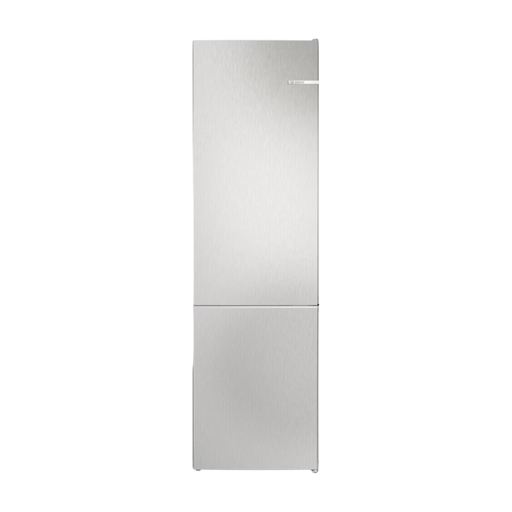 No image available
An option if you store frozen food as well as yoghurt and want to spend less time defrosting.
260 l of fridge space and 103 l of freezer space; stated fridge temperature setting range of 2–5 °C; No Frost in both compartments; stated consumption of 112 kWh per year; height 203 cm.
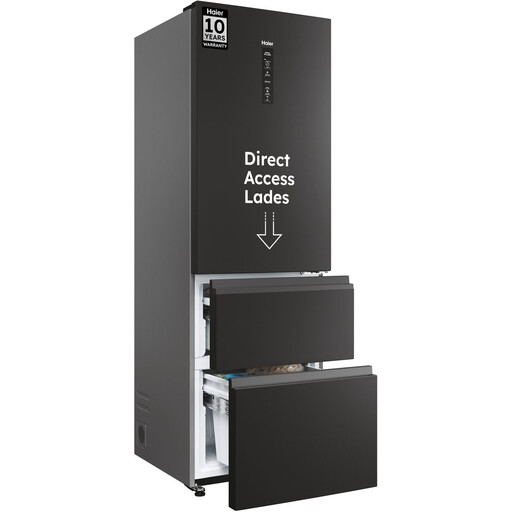 No image available
An option to compare if you want to store chilled and frozen food separately.
235 l of fridge space and 125 l of freezer space; Total No Frost; three adjustable fridge shelves; stated dimensions 59.5 × 185 × 66.7 cm; reversible door.
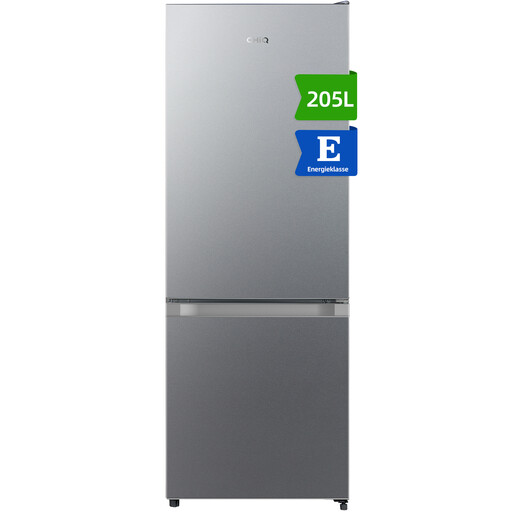 No image available
An option to compare if you have a narrower space available and want the fridge capacity to suit it.
153 l of fridge space and 52 l of freezer space; 4 °C is listed as the recommended setting for the fridge compartment; Low Frost; stated dimensions 540 × 550 × 1440 mm; E energy rating. Low Frost doesn’t mean you can avoid manual defrosting.
 No image available
An option to compare if you’re looking for a medium-sized fridge compartment and are happy to factor in manual defrosting.
187 l of fridge space and 73 l of freezer space; stated fridge temperature range of 2–8 °C; width 55 cm; manual defrosting.
Keep yoghurt that’s sold chilled in the fridge compartment and set the fridge to 4 °C. Also follow the storage instructions on the packaging. The Netherlands Nutrition Centre says that freezing can change the texture of yoghurt.
Put products that need to stay chilled in the fridge as soon as possible. The Netherlands Nutrition Centre recommends a setting of 4 °C; after installation, check with a fridge thermometer that the appliance reaches this temperature.
Compare the stated consumption in kWh per year for the exact models, alongside their capacity and energy rating. Milieu Centraal points to the annual energy consumption shown on the energy label. You can work out the electricity costs using the appliance’s consumption and your own price per kWh.
For this product category, the EU energy label must also be shown online when the product is sold. If an appliance you’ve bought is faulty, the seller is your first point of contact for a solution, as the Dutch government explains. You can return an old similar appliance to the shop or online retailer where you buy a new one, or take it to your local council recycling centre.