
Vandaag of morgen in huis

Kwaliteit gegarandeerd
Download de app
Categorieën

Choosing a new fridge-freezer can be a daunting task. Incorrect dimensions, unexpectedly high energy consumption, or a model that constantly hums are all common pitfalls. This article will help you make an informed decision by outlining the most important specifications and features. We focus on the facts to help you find a model that perfectly suits your household and budget.
Before you start comparing models, it's helpful to know what to look for. This checklist will help you understand the key specifications.
The required capacity (measured in litres) depends on your household size:
Always measure the available space in your kitchen before making a purchase. Remember to allow for extra space at the back and sides for ventilation, typically around 5-10 cm. Most models on the market are freestanding fridge-freezers, which makes installation straightforward.
Since 2021, the EU has used a new energy label ranging from A (most efficient) to G (least efficient). An energy-efficient fridge-freezer can lead to significant savings on your annual energy bill. A model with a C rating is now considered a very efficient choice, as the requirements for A and B ratings are extremely strict. The annual energy consumption in kilowatt-hours (kWh) is always listed on the label.
No one wants a disruptive noise coming from their kitchen. The noise level is measured in decibels (dB). A quiet fridge-freezer is especially important in an open-plan kitchen or studio apartment.
Ice build-up in the freezer compartment reduces efficiency and takes up valuable space. Technologies like No Frost and Low Frost offer a solution.
Aesthetics also matter. Popular finishes include a sleek black fridge or a timeless stainless steel fridge. Also, pay attention to practical details like the door's swing direction. On many models, it is reversible, offering greater flexibility in placement.
Below is a selection of fridge-freezers with various specifications, suitable for different households.
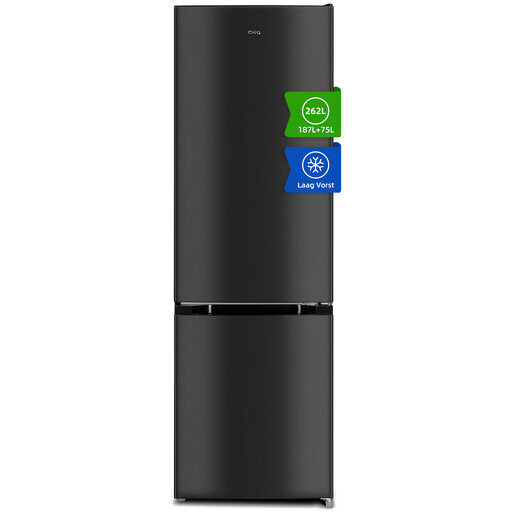
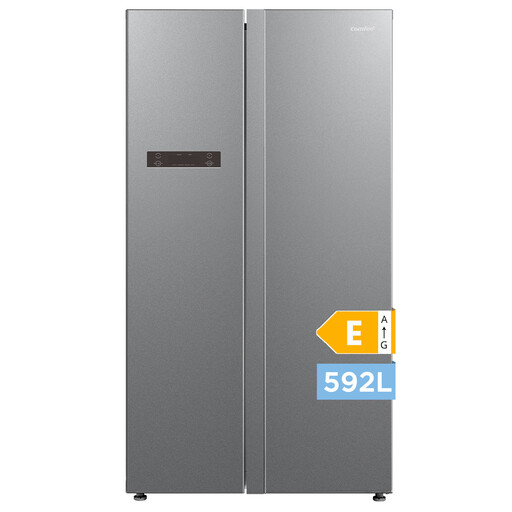
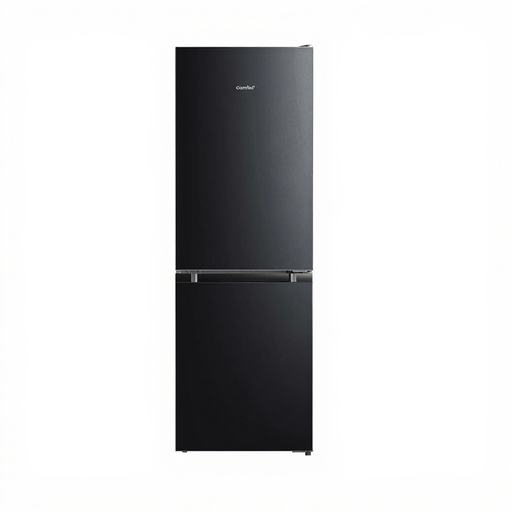
This selection covers a range of needs, but of course, there are many more options available. If you're looking for different dimensions, specific features, or another price point, check out our full range of models.
-> Explore our complete range of Affordable fridges
1. What is the difference between No Frost and Low Frost? With No Frost, moist air is actively removed from the freezer compartment, preventing ice from forming. This means you never have to defrost it. With Low Frost, ice build-up is greatly reduced due to the design of the cooling elements. You only need to defrost it once every few years, a process that is much quicker than with a traditional model.
2. How many decibels (dB) is a quiet fridge-freezer? A model is considered quiet at a noise level of 38 dB or lower, which is comparable to the sound in a library. Models between 39 and 41 dB have a normal noise level. Anything above that can be perceived as audible or disruptive, especially in an open-plan kitchen.
3. What does the energy class on a fridge mean? The energy class, indicated by a letter from A to G, shows how energy-efficient an appliance is. Class A is the most efficient, while G is the least. This rating is based on a ratio between the appliance's capacity and its energy consumption. An energy-efficient fridge-freezer (for example, class C or D) uses significantly less electricity than a model with an F or G rating, which you will see reflected in your energy bill.
Written by: Joybuy Product Recommendation Officer