
Vandaag of morgen in huis

Kwaliteit gegarandeerd

Welkomstaanbiedingen ontgrendelen: GRATIS bezorging | Tot 80% korting | Gratis 30 dagen JoyPlus-proefperiode
Download de app
You’ll usually keep a fridge and freezer for several years. Yet many shoppers focus mainly on capacity or appearance. This can lead to problems: the fridge doesn’t fit properly in the kitchen, the freezer is awkward to use or energy consumption is higher than expected.
As Joybuy Product Recommendation Officer, I filter out the most important product specifications and turn them into practical buying advice. That way, you can avoid paying extra just for a standout feature or marketing claim.
A large total capacity doesn’t tell you everything. For example, a 260-litre fridge-freezer might have 187 litres of fridge space and 73 litres of freezer space. If your household buys lots of frozen food, that second figure is particularly important.
Pay attention to the layout, too. Drawers, adjustable shelves and door compartments all affect how much space you can use in practice. A compact freezer with three well-organised drawers may be easier to use than a larger model with one open compartment.
European energy labels range from A to G. Don’t compare just the letter: check the stated annual energy consumption in kWh per year as well. A larger appliance with a good rating may still use more electricity than a smaller model.
Also check whether the stated capacity and energy rating apply to the whole appliance or just one compartment. The official product specifications and energy label are more useful here than general terms such as ‘energy-saving’.
A No Frost freezer uses air circulation to limit ice build-up. According to manufacturers’ product descriptions, this can reduce the need for manual defrosting, but you’ll still need to clean it. A Low Frost fridge or fridge-freezer may build up ice more slowly, but that doesn’t mean it needs no maintenance at all.
Check whether No Frost applies to the freezer, the fridge or both compartments. Product information isn’t always presented in the same way.
Don’t just measure the recess or floor space. Also check:
A reversible door is useful in a small kitchen, student room or office. For a freestanding freezer, wheels or adjustable feet can make it easier to position.
If you’re buying an appliance for everyday groceries, check the balance between fridge and freezer space. A small fridge of around 90 litres may be enough for one person or a student. A family will usually benefit more from a fridge-freezer with separate drawers and adjustable shelves.
A table-top freezer or compact freezer will often fit under or beside a worktop. A chest freezer offers plenty of storage for its external size, but items at the bottom are less easy to reach.
Noise levels are given in dB(A). A rating of around 37 to 40 dB may be worth considering for an open-plan kitchen, studio flat or bedroom, but the noise you hear also depends on the floor surface and where the appliance is placed.
If you’re putting the appliance in a garage or unheated room, the climate class is important. Check the minimum and maximum ambient temperatures in the product data sheet. Not every fridge or freezer is suitable for a cold garage.

Why it suits this profile: This compact fridge is 47.4 cm wide and offers 92 litres of fridge space. It’s a good fit for a student room, office or household with limited space.
The external dimensions and net capacity are clearly stated. There’s no freezer compartment, so you won’t pay for space you don’t use.
E energy rating, stated annual consumption of 85 kWh, reversible door and a stated noise level of 39 dB.
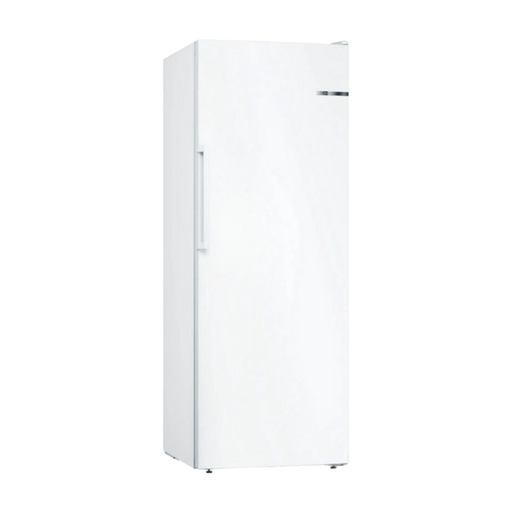
Why it suits this profile: This freestanding freezer combines a 200-litre capacity with NoFrost, an LED display and several storage zones.
NoFrost is listed in the specifications and, according to the product information, prevents ice build-up, reducing the need for manual defrosting.
200-litre capacity, freezing capacity of 16 kg per 24 hours, MultiAirflow, FreshSense and SuperFreeze, according to the product specifications.

Why it suits this profile: This model is designed for anyone who needs extra freezer space but also wants flexibility. According to the product description, you can switch it to fridge mode.
No Frost and electronic temperature control help reduce maintenance and let you adapt how you use the appliance.
122 litres of freezer space, a 4-star rating, stated freezing capacity of 5.5 kg per 24 hours and a stated noise level of 39 dB.

Why it suits this profile: With 153 litres of fridge space and 52 litres of freezer space, it offers a practical balance for couples or small families.
At 54 cm wide, with a reversible door and adjustable feet, it’s easier to fit into a compact kitchen.
205 litres in total, Low Frost, E energy rating and a stated noise level of 39 dB.
We’ve put together a complete, up-to-date list of products that meet these strict selection criteria and the applicable European safety regulations.
Its lifespan depends on how it’s used, where it’s placed, how well it’s maintained and the quality of its components. Keep the ventilation openings clear, clean the door seals and make sure the appliance is level. When buying, check the statutory guarantee and any additional manufacturer’s warranty. A longer compressor service period doesn’t automatically mean that every component is covered for the same length of time.
Use the annual consumption shown on the energy label as a guide. Multiply the number of kWh by your current electricity rate. Actual costs may vary depending on the ambient temperature, how often you open the door and how full the appliance is. So compare models with similar capacities and layouts.
Not necessarily. No Frost is particularly useful if you use your freezer frequently and want to cut down on manual defrosting. A Low Frost model may be enough for a smaller freezer compartment or a household that stores frozen food less often. Always check which compartment the feature applies to.
