
Vandaag of morgen in huis

Kwaliteit gegarandeerd

Welkomstaanbiedingen ontgrendelen: GRATIS bezorging | Tot 80% korting | Gratis 30 dagen JoyPlus-proefperiode
Download de app
A fridge freezer may seem straightforward to choose: decide on the size, compare the price and place the appliance in the kitchen. Yet many disappointing purchases are caused by specifications that are not explained clearly enough in adverts. For example, a spacious fridge freezer may be too deep for your kitchen, while a model with a large freezer compartment may leave you with little usable fridge space.
These points will help you compare a combination fridge freezer, compact fridge or large fridge freezer in practical terms.
A capacity of 260 litres does not tell you how much room you actually have for your shopping. Always check how the space is divided between the fridge and freezer compartments. A household that mainly buys fresh produce will get more use from a spacious fridge than from extra freezer drawers.
Also consider the layout. Adjustable glass shelves, door compartments and a salad drawer determine how efficiently you use the available litres. A fridge with freezer compartment may be sufficient for a student or single person, but is often less suitable for a family that stores a stock of food.
Low Frost generally reduces the amount of ice that forms, but it does not automatically mean that manual defrosting will never be necessary. With No Frost, air is actively circulated in the freezer compartment and, according to the product description, ice formation is reduced or prevented. So check whether No Frost applies to the entire appliance or only to the freezer compartment.
A narrow fridge measuring 54 or 55 cm wide can still be too deep for a small kitchen. Measure:
A fridge with a reversible door gives you more flexibility when positioning the appliance, but check whether changing the door position is possible according to the manual.
For one person or a student, a compact fridge of around 90 litres may be sufficient for everyday shopping. Couples and small households often look for a fridge freezer with a capacity of around 200 to 280 litres. Larger families may benefit from 400 litres or more, but should allow for a larger footprint and greater weight.
Do not compare the total number of litres alone. Look at the capacity of the fridge compartment, the number of freezer drawers and whether there is a salad drawer. A four-star freezer compartment is intended for storing frozen food at around -18 °C; you can find the exact performance details on the product information sheet.
The EU energy label for fridges runs from A to G. The energy rating is useful for an initial comparison, but the stated annual consumption in kWh provides more context. Despite having a better rating, a larger appliance may use more electricity than a smaller model.
Therefore, compare:
An energy-efficient fridge is not automatically the most economical choice if you are paying for extra capacity or features that you do not use.
For an open-plan kitchen, studio flat or holiday home, the noise level is important. The models in this selection have stated noise levels of 37 to 40 dB. Manufacturers provide this figure under standardised conditions; actual performance may vary depending on positioning, the surface beneath the appliance and ventilation.
Make sure the fridge is level and leave sufficient space for air circulation. This helps to limit unnecessary vibrations and additional compressor activity.
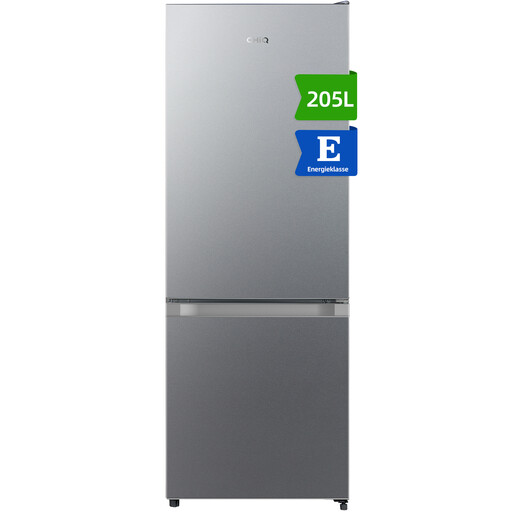
Why it suits this profile: With 153 litres of fridge space and 52 litres of freezer space, this combination is aimed at single people, couples and small households. It is 54 cm wide and has a reversible door.
The product information lists the individual capacities, dimensions and noise level of 39 dB. Low Frost is not presented as full No Frost.
205 litres in total, reversible door, adjustable feet and energy rating E according to the product information sheet.
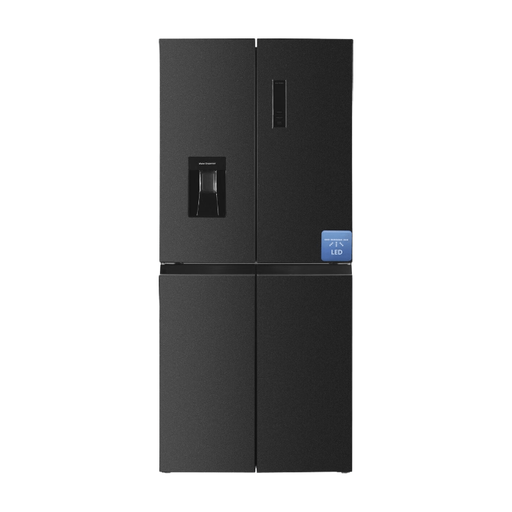
Why it suits this profile: This model offers 419 litres of capacity, divided into 269 litres of fridge space and 150 litres of freezer space. It is well suited to families who buy larger quantities and store a stock of food.
The capacity is broken down by compartment and the stated dimensions are 180 x 79 x 70 cm. Measure your kitchen and access routes carefully beforehand.
Total No Frost, water dispenser, digital temperature control and energy rating D according to the stated specifications.
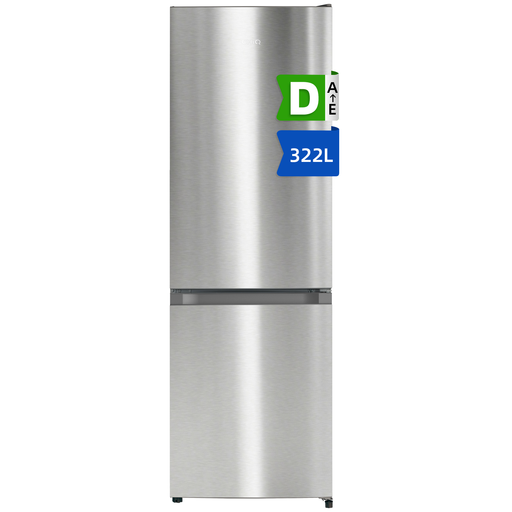
Why it suits this profile: With 226 litres of fridge space and 96 litres of freezer space, this model is suitable for households that regularly store large quantities of shopping.
The product sheet lists a width of 595 mm, a depth of 635 mm and a height of 1,855 mm. The Total No Frost function and annual consumption of 196 kWh are stated separately.
322 litres, inverter compressor, Multi-Airflow, 37 dB, reversible door and energy rating D.
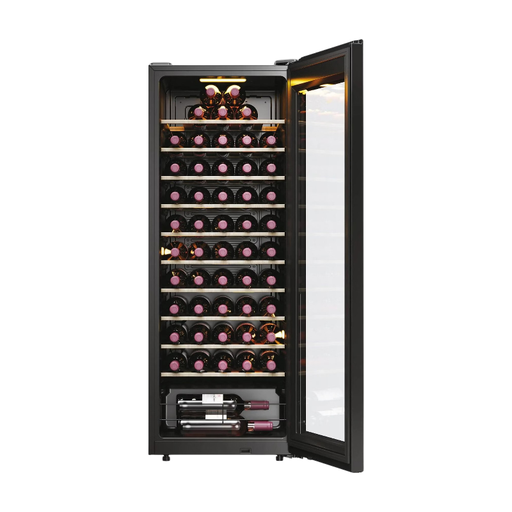
Why it suits this profile: This is not a standard fridge freezer, but a wine cooler for anyone who wants to store bottles neatly in a single temperature zone.
Capacity is expressed as 58 bottles and 150 litres, rather than as general food storage. According to the product information, the temperature zone ranges from 5 to 20 °C.
Ten adjustable wooden shelves, UV-resistant glass, Wi-Fi control and a lockable door.
We have put together a complete, up-to-date list of products that fully meet these strict selection criteria and the applicable European safety regulations.
After transport, leave a new fridge standing upright as instructed in the manual before plugging it in. Place the appliance on a level surface, not directly next to an oven or radiator, or in direct sunlight. Keep the ventilation openings clear and check that the door seal fits properly.
Do not fill the appliance completely immediately after switching it on. Give the fridge time to reach the set temperature. Allow hot dishes to cool to room temperature, covered, first, and make sure that air vents are not blocked.
For a single person, around 90 to 200 litres may be suitable, depending on cooking and shopping habits. Couples and small households often look at 200 to 280 litres. Families who store a stock of food may need more than 300 litres. The division between fridge and freezer space is at least as important as the total capacity.
No Frost can reduce maintenance by preventing or reducing ice formation in the relevant compartment. However, check the exact product description: Low Frost and No Frost are not the same. Compare the feature with the way you use the appliance, and also consider the energy rating and annual consumption.
The lifespan depends on usage, ventilation, maintenance and the quality of the door seal. Clean the interior regularly, keep the ventilation clearance unobstructed and handle glass shelves and drawers with care. Also check the warranty terms and your statutory rights relating to conformity before making a purchase.
