
If you store yoghurt every day
You want to keep opened yoghurt and other chilled foods at the right temperature. An adjustable fridge and a thermometer help you check the temperature; the Netherlands Nutrition Centre recommends 4 °C.


First, choose a fridge whose temperature you can set and check: the Netherlands Nutrition Centre recommends 4 °C for yoghurt. Then choose between a compact model, an under-counter fridge without a freezer compartment, or one with a freezer compartment, based on the space available and how much room you need for other groceries.
You want to keep opened yoghurt and other chilled foods at the right temperature. An adjustable fridge and a thermometer help you check the temperature; the Netherlands Nutrition Centre recommends 4 °C.
You need room for yoghurt and other groceries, but the fridge’s external dimensions must fit the space available. Milieu Centraal and the Consumers' Association highlight size and usable capacity when choosing a fridge.
You want a freezer compartment as well as fridge space in the same appliance. Bear in mind that a freezer compartment takes up space that would otherwise be available for chilling; the Consumers' Association describes under-counter models with and without a freezer compartment.
First decide whether temperature control, fridge space, energy use or a freezer compartment matters most to you. Then measure the space and compare models that suit your needs.
| What to consider | What to look for | Who is this important for? |
|---|---|---|
| Temperature | Check whether you can set the temperature, then measure it after installation with a fridge thermometer. | When storing yoghurt, you’ll want to check that the fridge is cold enough and adjust the setting if needed. Around 36% of consumers give temperature assurance top priority. |
| Fridge space and dimensions | Measure the space where the fridge will go and compare fridge capacity in litres, not just total capacity. | If you chill fresh groceries as well as yoghurt, the appliance needs to fit and offer enough usable space. Around 29% of consumers prioritise having the right amount of fridge space. |
| Energy use | Compare the stated energy use in kWh per year for models that meet your needs for size and features. | If energy use is your main concern, compare suitable models by their annual consumption. Around 21% of consumers make low energy use their top priority when choosing. |
| Freezer compartment | Compare fridge and freezer capacity separately; a freezer compartment takes up fridge space. | If you want to store frozen food too but only have room for one appliance, a built-in freezer compartment could be the answer. Around 14% of consumers give the option to freeze food in the same appliance top priority. |
You may run out of space as soon as you want to store other everyday groceries in it too.
Make a list of what you want to chill at the same time, then compare fridge capacity and external dimensions.
The setting on the dial doesn’t tell you exactly what temperature the fridge reaches where you keep your yoghurt. The Netherlands Nutrition Centre recommends a fridge temperature of 4 °C.
After installation, measure the temperature with a fridge thermometer placed in the middle of the bottom shelf, and adjust the appliance if needed.
According to Inventum, 97 litres of the Inventum KV550’s capacity is for chilling and 16 litres is for the freezer compartment. So the total capacity isn’t all available for yoghurt and other chilled foods.
For models with a freezer compartment, compare the separately stated fridge capacity.
The energy rating isn’t the same as the stated annual consumption in kWh. Milieu Centraal also recommends checking energy use per year.
Compare the stated energy use of models that first meet your needs for space and features.
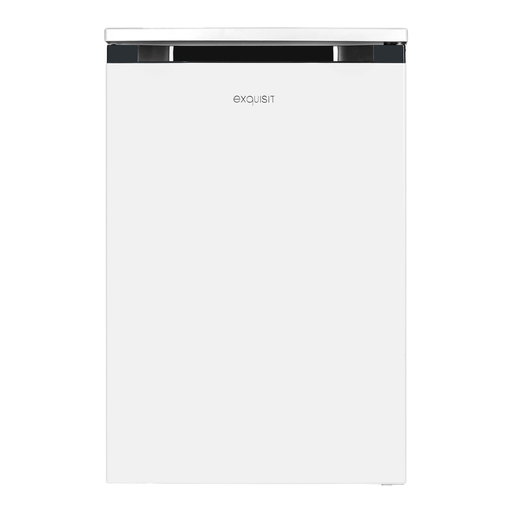
Offers under-counter models with a freezer compartment, including the KV550.
Offers under-counter models without a freezer compartment, including the KKV956WIT.
Offers compact fridges such as the Rci 1620 Plus for anyone looking for fridge space without a freezer compartment.
Offers the KTR15NWEB under-counter model without a freezer compartment, which includes an open-door alarm.
This selection includes under-counter fridges with and without a freezer compartment, for storing yoghurt and other chilled groceries.
 No image available
Ideal if you’re looking for fridge space and a separate freezer compartment in one under-counter model.
95 litres of fridge space and a 14-litre freezer compartment.
Energy rating C; stated energy use of 89 kWh per year.
Temperature control with a dial.
 No image available
An option if you want to combine fridge space and a separate freezer compartment in an under-counter model.
107 litres of fridge space and a 13-litre freezer compartment.
Energy rating C; stated energy use of 87 kWh per year.
Dimensions: 84.50 × 54.90 × 55.70 cm; temperature control with a dial.
 No image available
Ideal if you want to store chilled food without a freezer compartment in the appliance.
Capacity: 129 litres; temperature control with a dial.
Energy rating E; stated energy use of 92 kWh per year.
Dimensions: 54 × 54 × 88 cm.
 No image available
A compact fridge for keeping yoghurt and other chilled groceries neatly organised.
Capacity: 90 litres; temperature setting from 0–10 °C.
Three glass shelves; stated dimensions: 449 × 485 × 842 mm.
 No image available
Worth considering if you’re looking for a compact fridge with adjustable temperature settings.
Capacity: 92 litres; seven temperature settings, with 4 °C as the recommended setting.
Energy rating E; stated energy use of 85 kWh per year.
Dimensions: 831 × 474 × 447 mm. After installation, check the actual temperature with a fridge thermometer.
The Netherlands Nutrition Centre recommends a fridge temperature of 4 °C. Place a fridge thermometer in the middle of the bottom shelf, leave it there for half a day or overnight, and adjust the fridge if the reading is too high.
The Netherlands Nutrition Centre recommends keeping opened full-fat yoghurt in the fridge for 5–7 days. Put the container back in the fridge promptly after use, at 4 °C, and use a clean spoon. For an unopened container, follow the storage instructions and date on the packaging.
Compare the stated energy use in kWh per year of models that meet your needs for size and features. Milieu Centraal recommends checking annual energy use; the EU energy label for household fridges uses a scale from A to G.
According to the Dutch government, if a product is faulty, you can contact the seller to ask for a solution, such as a free repair or replacement. When a consumer buys from a business remotely, there is also a 14-day cooling-off period in many cases; check the terms that apply to your purchase.
Household refrigeration appliances covered by the relevant EU rules must meet energy-labelling requirements, including when sold remotely. If the information isn’t clearly displayed, ask the seller for the energy label and product information sheet for the specific appliance.