
Workshop organiser at a fixed location
You want easy-access fridge space for covered portions and need to be able to check the temperature during the workshop.


For a workshop at a single, fixed location, a table-top fridge is often a good choice if you mainly need to chill covered portions of carrot sticks and other ingredients. If you work at different venues, a portable compressor cool box may be more suitable, while larger quantities call for more fridge space. Before buying, check that your containers will fit, that there’s enough room and a suitable power supply, and measure the actual temperature: the set temperature alone doesn’t prove how cold the carrot sticks stay. The Voedingscentrum recommends keeping cut vegetables covered in the fridge.
You want easy-access fridge space for covered portions and need to be able to check the temperature during the workshop.
You need to transport ingredients and want refrigeration that suits the power supply at the venue.
You store several containers at once and need to weigh up the usable layout and space required against the size of your stock.
A good fit if: you’re at a fixed location and mainly store covered carrot sticks and other chilled ingredients.
Consider: whether your containers will fit on the shelves and whether the fridge offers enough usable space. Inventum lists a capacity of 131 litres for the KK550; Bosch lists 134 litres of fridge space for the KTR15NWEB.
A good fit if: you travel between venues and have access to a suitable power connection there.
Consider: Dometic lists a capacity of 36 litres and AC and DC connections for the CFX5 35. Measure the interior and check the temperature during transport and use.
A good fit if: you store larger quantities at a fixed location or need a fridge designed for professional use.
Consider: Hoshizaki lists 265 litres of net usable capacity and five shelves for the COMPACT K420R L DR G E. Bear in mind how much floor space a tall cabinet takes up.
A good fit if: you genuinely need freezer space as well as room for chilled ingredients.
Consider: Inventum lists 97 litres of fridge space and 16 litres of freezer space for the KV550, compared with a capacity of 131 litres for the KK550 without a freezer compartment.
The points below are grouped by the main concerns consumers have when choosing refrigeration for a cookery workshop.
| What to consider | What to look for when buying | Who may care most about this? |
|---|---|---|
| Refrigeration you can monitor | Keep portions covered, set the fridge temperature and measure it during the intended use. | I want to keep cut carrot sticks covered and check during the workshop that they’re staying chilled. Around 36% of consumers prioritise refrigeration they can monitor. |
| Space for portion containers | Measure your containers and check the fridge capacity and clearance between the shelves. | If I’m preparing several sealed containers, I want to know that they’ll actually fit rather than rely on the stated capacity alone. Around 29% of consumers consider usable fridge space the most important factor. |
| Refrigeration at different venues | Check that the connections suit transport and use at the venue, and that the containers fit inside the cool box. | When I move between workshop venues, I want to take my refrigeration with me and know what power connection will be available. Around 21% of consumers prioritise portability. |
| Placement and power consumption | Measure the space where the appliance will go and check the required clearance in the manual; compare annual energy use in kWh on a like-for-like basis. | With limited space, I want to know in advance whether the appliance will fit and factor in power consumption if I’ll be using it for long periods. Around 14% of consumers consider placement and running costs most important. |
The set temperature and the temperature during use aren’t the same. The temperature can change if the fridge is opened frequently during a workshop.
Check the temperature with a suitable thermometer and close the door after taking out portions. For food stored in a commercial setting, the NVWA recommends checking the temperature regularly with a digital probe thermometer.
The number of litres doesn’t tell you how many sealed containers will fit on the shelves. The Consumentenbond points out that a fridge’s stated capacity doesn’t always reflect what will fit in practice.
Measure your containers and compare the fridge capacity and clearance between the shelves before choosing a model.
Dometic says the CFX5 35 runs on AC or DC power; you’ll need a compatible connection for active cooling.
Check which connection will be available during transport and at the workshop venue, and measure the temperature while the cool box is in use.
Table-top models with and without a freezer compartment, for anyone weighing up fridge space against the need for a freezer.
The KTR15NWEB is a freestanding table-top fridge without a freezer compartment, for a fixed location.
Compressor cool boxes for workshops where refrigeration needs to travel between venues.
Professional COMPACT fridges for fixed locations and larger storage needs.
These product picks cover fixed table-top refrigeration and portable compressor cooling. Compare the space you need for containers, the room available for the appliance and the power supply at the venue.
 Image unavailable
A compact option for a fixed spot where you want to keep covered ingredients chilled.
88 litres of fridge space, three adjustable glass shelves, a salad drawer and temperature control. This product has an energy rating of E.
 Image unavailable
A table-top model without a freezer compartment for a fixed spot where you only need fridge space.
82 litres of capacity, adjustable glass shelves, a salad drawer and temperature control.
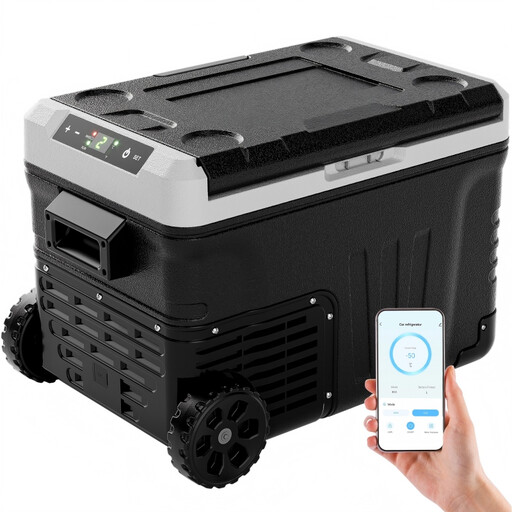 Image unavailable
A portable option if you want to take refrigeration with you and have access to a suitable power connection at the venue.
35 litres of capacity, two zones and app control. The product information gives a temperature range of −20 °C to 20 °C and connections for 12/24 V DC and 220–240 V AC. Active cooling requires a suitable power supply; check the actual temperature with a thermometer.
 Image unavailable
A fixed table-top option if you want to organise different types of chilled ingredients.
129 litres of capacity, two adjustable glass shelves, a salad drawer and temperature control. This product has an energy rating of E.
 Image unavailable
A compact fridge for a fixed location where width is a consideration.
92 litres of capacity and 47 cm wide. The product information lists seven temperature settings, adjustable glass shelves, a salad drawer and a reversible door. This product has an energy rating of E.
Keep the carrot sticks covered in the fridge. For raw vegetables without dressing, the Voedingscentrum recommends storing firm vegetables in the fridge for up to two days. If the packaging gives its own storage instructions, follow those instead.
No, you should also check the actual temperature with a thermometer. The Voedingscentrum recommends setting your fridge to 4 °C. For food stored in a commercial setting, the NVWA recommends regular checks with a digital probe thermometer.
If you only store chilled ingredients, focus on comparing the fridge space available in each model. Inventum lists 131 litres for the KK550 without a freezer compartment, and 97 litres of fridge space plus 16 litres of freezer space for the KV550.
According to the NVWA, food businesses must follow a food safety plan or hygiene code based on HACCP. The NVWA also sets out requirements for safe storage and temperature checks. These rules for businesses don’t automatically apply to every private cookery workshop.
If you’ll be using the appliance for long periods, compare its annual energy use in kWh; actual consumption may differ from the energy label. For a consumer purchase, your statutory rights are separate from any manufacturer’s warranty. ACM ConsuWijzer explains that the seller is responsible if a product doesn’t perform as you could reasonably expect under normal use.