
Occasional stock maker
You want to store a few portions for a weekend lunch and mainly want to know whether your current freezer will do the job.


For a few portions of vegetable stock, you don’t need a separate chest freezer if your existing freezer has enough space and is set to −18 °C or colder. Cool the stock quickly and freeze it in small portions; the Netherlands Nutrition Centre advises storing leftovers in a sealed container within 2 hours of cooking. If you regularly run out of space, compare a chest freezer’s freezing capacity in kg per 24 hours, external dimensions and annual energy consumption.
You want to store a few portions for a weekend lunch and mainly want to know whether your current freezer will do the job.
You freeze stock and other meals more often, so the available capacity and how much you can freeze at once will affect your choice.
You’re looking for extra freezer space outside your heated kitchen and need to check whether the specific model is suitable for the temperature in that location.
Best for: freezing stock occasionally, when you have room for small, sealed portions at −18 °C or colder.
The trade-off: you won’t need another appliance, but you’ll depend on the space available and how much you’re freezing at once.
Best for: regularly freezing stock or other food when you need extra freezer space.
The trade-off: compare the freezing capacity with the size of your batch; the capacity in litres doesn’t tell you how much fresh food you can freeze at once.
Best for: regularly storing larger quantities of food as well as stock, if the external dimensions suit the space you have available.
The trade-off: extra capacity isn’t, by itself, a reason to choose a larger model for a few lunch portions; compare energy consumption and accessibility too.
When considering an additional chest freezer, batch size, available space and using it as an appliance that runs continuously are all relevant factors. The points below will help you choose the right option for your portions.
| What to consider | What to look for | Who should give this more thought? |
|---|---|---|
| Do you need another appliance? | Check whether your current freezer has space and can be set to −18 °C or colder; the Netherlands Nutrition Centre recommends this temperature for freezers. | If I only make stock occasionally, I want to know whether my existing freezer can handle the portions before I make room for another appliance. Around 27% of consumers are mainly concerned about whether they need one. |
| Freezing a batch at once | Compare the weight of your usual batch with the exact model’s stated freezing capacity in kg per 24 hours; freeze in small portions. | If I want to freeze a whole batch, I look at the freezing capacity, not just the litres. Around 27% of consumers mainly prioritise having enough capacity for their own batch. |
| Available space | Measure the space and allow room to open the lid. If the freezer will be in an unheated space, check the climate class and any model-specific information about lower ambient temperatures; according to the Dutch Consumers’ Association, performance varies by model. | If my chest freezer needs to go in a storage room, I want to make sure it will fit and is suitable for the temperature there. Around 20% of consumers mainly consider the space available for installation. |
| Annual energy consumption | Compare the stated consumption in kWh per year with the capacity and energy class; the European Commission says energy labels provide information about consumption and capacity. | If I’m considering a second appliance, I want to take its annual electricity consumption into account when weighing up the extra freezer space. Around 20% of consumers are mainly concerned about ongoing energy consumption. |
| Finding portions and maintenance | Check whether a basket is included and what the exact model specifies about Low Frost, a defrost water drain and manual defrosting. | If I store lots of small containers, I want to keep them within reach and know how much maintenance the chest freezer needs. Around 6% of consumers mainly prioritise the layout and maintenance. |
Litres describe the available storage space; kg per 24 hours is the stated freezing capacity. So a spacious chest freezer doesn’t, by itself, tell you how much fresh stock you can put in at once.
Compare the weight of your usual batch with the exact model’s specification and divide the stock into small portions. The Netherlands Nutrition Centre advises against freezing too much at once.
A statement about use at low ambient temperatures doesn’t automatically apply to other models. According to the Dutch Consumers’ Association, performance at lower temperatures can vary from model to model.
Measure the temperature where you plan to put it and check the climate class and documentation for the exact model.
Inventum says the VK562W reduces frost build-up, but also notes that it still needs to be defrosted manually.
Check the defrosting method and whether a defrost water drain is specified for the exact model.
Manual defrosting takes time from time to time.
The VK562W is a compact chest freezer to compare if you’re looking for extra space for portions.
The TCF0991W is a compact 99-litre chest freezer for anyone looking for extra storage space and a basket.
The CF100EWN is a freestanding 98-litre chest freezer to include when comparing compact models.
The CFc 1875 Plus is a larger chest freezer to compare if you store a wider range of food as well as stock.
The Joybuy products below are chest freezers with different storage capacities and layouts. Choose one based on your portions, available space and preferred controls.
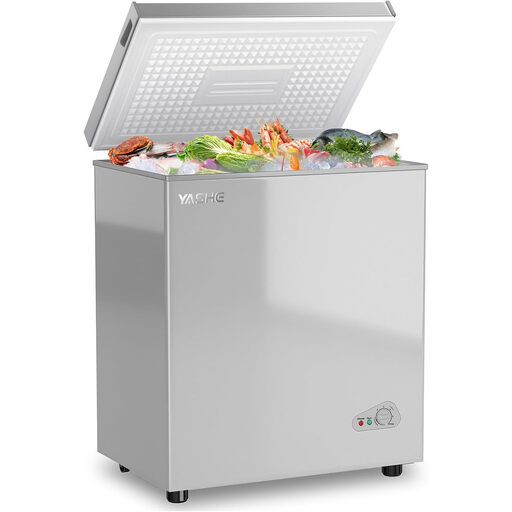 No image available
The capacity and removable baskets are worth considering if you want extra room for portions of stock and would like to organise them.
150 litres; two removable baskets; six temperature settings.
 No image available
The removable basket may be useful if you want to keep portions of stock separate within your extra storage space.
141 litres; switches between fridge and freezer modes; energy class E.
 No image available
The more compact capacity may suit you if you want extra room for portions without opting for a larger model.
95 litres; switches between fridge and freezer modes; energy class E.
 No image available
The larger capacity is most useful if you want to store a wider range of food as well as stock.
291 litres; switches between fridge and freezer modes; energy class E.
 No image available
The storage basket can help you keep smaller portions separate in a compact chest freezer.
98 litres; storage basket; energy class E.
Cool the stock quickly, seal the portions well and freeze them in small quantities. The Netherlands Nutrition Centre advises storing leftovers in a sealed container within 2 hours of cooking and setting your freezer to −18 °C or colder.
The Netherlands Nutrition Centre recommends keeping stock in the freezer for 3 months; after that, its quality may deteriorate. For an unopened shop-bought product, follow the storage advice on the packaging.
It depends on the exact model and the temperature in the shed. The Dutch Consumers’ Association says performance at lower ambient temperatures varies by model, so check the climate class and any additional information from the manufacturer, and measure the temperature where you plan to put it.
Compare the annual consumption in kWh on the energy label of the models you’re considering, as well as their capacity and energy class. The European Commission says energy labels provide information about energy consumption and storage volume.