
Shared freezer organiser
Wants other people to be able to identify the contents, owner and date of similar tubs easily. The Netherlands Nutrition Centre advises putting the date on a sealed container of leftovers.


Start by choosing a label based on the tub and when you’ll apply it, then find a printer that works with it. Laminated tape may be suitable if you label your tubs before freezing them; freezer labels on A4 sheets may be an alternative if you already have a compatible printer. A roll printer can be useful for larger batches, but always check that the printer, label and application temperature are compatible.
Wants other people to be able to identify the contents, owner and date of similar tubs easily. The Netherlands Nutrition Centre advises putting the date on a sealed container of leftovers.
Usually makes a few labels and can apply them to tubs before they go in the freezer. Brother describes laminated P-touch tape, but the cited test does not say how every type of tape adheres to frozen plastic.
Regularly prepares larger quantities and wants to choose a printer and rolls or sheets to suit that way of working. DYMO describes rolls for specific LabelWriter printers; Avery offers freezer labels on A4 sheets for compatible printers.
Suitable if: you want to label individual tubs before freezing them.
Bear in mind: Brother reports a cold test after application to stainless steel at room temperature; this does not prove that the tape will stick to every frozen plastic tub.
Suitable if: you print a lot of labels or want to apply a specific label to a frozen surface.
Bear in mind: DYMO describes a cryogenic label for the LabelWriter 5 series, but its use is described for laboratories and does not prove adhesion to every food container. The LabelWriter 550 requires compatible DYMO rolls.
Suitable if: you already have a compatible inkjet or laser printer and want to label several tubs in advance.
Bear in mind: check the sheet size and printer. Avery specifies separate temperatures for application and storage.
| What to consider | What should you check? | Who should consider this? |
|---|---|---|
| Adhesion and legibility in the freezer | Check the material, surface and application temperature for the specific label. Avery specifies an application temperature of up to -20 °C and temperature resistance from -50 °C to +70 °C. For a specific cryogenic label, DYMO describes application to already frozen surfaces at temperatures as low as -80 °C. | If I want to avoid a label coming unstuck or becoming illegible, I look at the conditions on my tub; around 36% of consumers prioritise adhesion. |
| Information that’s easy to identify | Check that the contents, name and date will fit legibly on your chosen label. The Brother PT-D210VP prints labels up to 12 mm wide; the Netherlands Nutrition Centre advises putting the date on a sealed container of leftovers. | If several people use similar tubs, I want them to be able to identify the contents and date quickly; around 29% of consumers prioritise easy identification in shared spaces. |
| How you work and how many labels you need | Decide whether you’ll make individual labels as you need them or print batches in advance. Also compare the equipment you’ll need: a handheld printer, a roll printer or a compatible printer you already own for A4 sheets. | If I regularly need to label several tubs, I want a process that suits those quantities; around 21% of consumers prioritise batch printing. |
| Consumables | Check the exact tape or roll code and the supported width. DYMO states that the LabelWriter 5 series requires DYMO-branded labels; the PT-D210VP uses TZe tape. | If I regularly replace or top up my labels, I want to know in advance which consumables are compatible with the printer; around 14% of consumers prioritise consumable costs. |
A label that can withstand cold after it has been applied will not necessarily stick to a tub that is already frozen.
Check the application and storage conditions for the exact label, and try it on the surface you intend to use.
Labels that look similar in size are not automatically compatible. DYMO states that the LabelWriter 5 series requires compatible DYMO-branded rolls.
Before buying, compare the full printer model number with the label code.
Freezer labels are also available on A4 sheets for compatible inkjet and laser printers.
First decide whether you need individual labels as you go or want to label several tubs in advance. For A4 sheets, also check that the printer type and sheet size match.
P-touch printers use TZe tape; the PT-D210VP has its own keyboard and prints labels up to 12 mm wide.
The LabelWriter 550 is a desktop roll printer; DYMO describes cryogenic labels for the LabelWriter 5 series.
Avery offers freezer labels on sheets for anyone who wants to use a compatible printer they already own.
These product options are intended for making labels for tubs and other storage items that need to be easy to identify. Before use, check that your chosen labels are suitable for the temperature and surface of your freezer tubs.
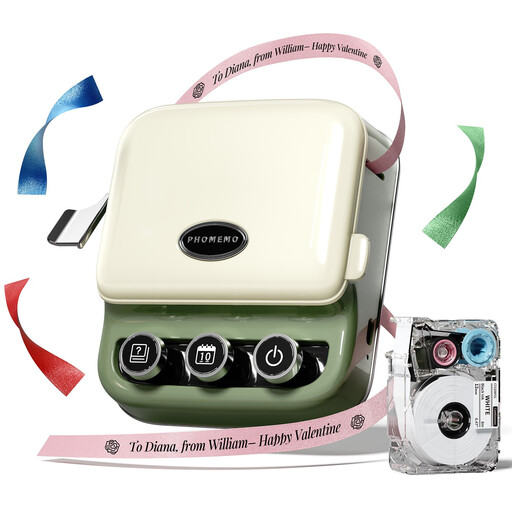 Image unavailable
May suit anyone who wants to design labels on the spot using a mobile device.
Bluetooth; requires the Print Master app. The product name mentions one roll of blank label tape; ribbon tape is sold separately.
 Image unavailable
May suit anyone who regularly wants to create and process several labels at once.
The product description mentions batch printing and Excel import via the Print Master app. The stated label widths range from 20 to 50 mm; the printer needs charging.
 Image unavailable
May suit anyone who wants to design labels for storage boxes using a phone or tablet.
Bluetooth and a rechargeable battery are listed. The product name specifies a label width of 0.59 inch; use requires a mobile device with the relevant app.
 Image unavailable
May suit anyone who wants to create short labels beside a tub using a smartphone or tablet.
The maximum label width is 1.2 cm. The product name mentions one roll of white paper labels; four AA batteries are not included.
 Image unavailable
May suit anyone who wants to make individual labels with a handheld printer and TZe tape.
Bluetooth; stated tape sizes are 3.5, 6, 9 and 12 mm. The product name specifies 180 × 180 DPI and a print speed of 20 mm/s. The maximum supported tape width is 12 mm.
It depends on the specific label and surface. Avery specifies an application temperature of up to -20 °C for its freezer labels; DYMO describes a specific cryogenic label for application to surfaces that are already frozen. Check the conditions for your chosen label and try it on your tub.
The Netherlands Nutrition Centre advises putting cooled leftovers in sealed containers and adding the date. In a shared freezer, clear details of the contents and the name can also help people tell tubs apart.
Check whether the specific material is intended for contact with the food in question. The Netherlands Food and Consumer Product Safety Authority (NVWA) sets out legal requirements for food-contact materials; a label on the outside of a sealed tub is a different use from direct contact with food.
It depends on the activity; rules for professional food preparation do not automatically apply to containers used at home. For hospitality, food businesses and retail, the NVWA describes rules including safe storage and, for unpackaged perishable food, a sticker showing the preparation date. If you’re using this for a business, check which business rules apply to your situation.
For a consumer purchase in the Netherlands, statutory warranty rights apply alongside any manufacturer’s warranty. If a product does not perform as you could reasonably expect under normal use, the seller must offer an appropriate solution at no cost, according to ACM ConsuWijzer.