What should you look for when choosing?
First check that the freezer compartment is suitable for fresh sauce and can be set to −18 °C or colder. Then consider how you’ll organise portions, the freezing capacity and the space the appliance will take up.
| What to consider |
What should you check? |
Who is this important for? |
| Finding portions |
Compare the number and internal dimensions of the drawers with your containers. Agree how you’ll seal, label and date them. |
If I share portions of sauce with others, I want to recognise and find my containers quickly. Around 31% of consumers prioritise keeping track of portions. |
| Batch capacity |
Compare the stated freezing capacity in kg/24 hours with the amount of sauce you add on each cooking day. Also allow for the food already in the freezer. |
When I freeze several cooled portions at once, I want to know how much can be added during that period. Around 31% of consumers say batch capacity is their main concern. |
| Available space |
Measure the height, width and depth, as well as the space needed to open the door or lid. |
In a small shared kitchen, I want extra freezer space without blocking the walkway or work area. Around 23% of consumers prioritise finding an appliance that fits. |
| Energy use and maintenance |
Compare the current EU energy label and the stated consumption in kWh/year. Also check whether the model has No Frost or needs to be defrosted manually. |
If I want to factor in energy use and defrosting, I want to compare these details for the exact model. Around 15% of consumers prioritise running costs and maintenance. |
Freezers at Joybuy
These models include upright freezers with drawers and chest freezers for freezing and organising cooled portions. For the exact model, check the temperature settings and the space needed for installation and opening.
 No image available
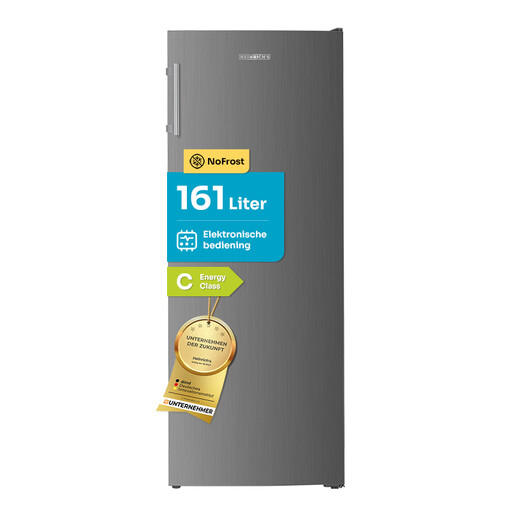
Heinrich’s freezer, 161 l, 3 freezer drawers and 2 drawers
The drawers can help you organise portions for different users; check in advance that your containers will fit.
The product name lists 161 l, No Frost, a temperature range of −14 to −22 °C, energy class C, a reversible door and an alarm function. The range includes −18 °C.
View at Joybuy
 No image available
Frilec BREMEN138-NF-050DW under-counter freezer
This under-counter model is worth considering if you’re looking for an upright freezer with No Frost and a stated freezing capacity.
The product information lists 87 l, a freezing capacity of 5 kg/24 hours, external dimensions of 84,5 × 55 × 59,5 cm and a four-star freezer mode with a recommended temperature of −18 °C. For this use, the convertible appliance must be set to freezer mode.
View at Joybuy
 No image available
Salora 47FRT60WH freestanding freezer, 60 l
The three drawers can keep portions belonging to different users separate; measure the external dimensions and check that your containers will fit.
The product information lists 60 l, a freezing capacity of 6 kg/24 hours and a temperature setting down to −20 °C. This model does not have No Frost; according to the product information, you’ll need to defrost it manually if ice builds up.
View at Joybuy
 No image available
CHiQ JR99DWE chest freezer, 99 l
The chest freezer offers one open space for containers of different shapes; make sure you have top access and agree how to organise it.
The product information lists a capacity of 99 l, a four-star freezer compartment at −18 °C and a freezing capacity of 4,5 kg/24 hours. It includes a wire basket.
View at Joybuy
 No image available
CHiQ JR122WSD freezer, 122 l
This model is worth considering if you’re looking for a freezer with No Frost and a larger capacity; check that its dimensions suit your shared kitchen.
The product information lists 122 l, a four-star freezer compartment at −18 °C, No Frost and a freezing capacity of 5,5 kg/24 hours. The model can also be set to work as a fridge; it must be in freezer mode to freeze food.
View at Joybuy
Frequently asked questions
How cold should the freezer be for cooled sauce?
The Netherlands Nutrition Centre recommends setting the freezer to −18 °C or colder. According to the Netherlands Nutrition Centre, a one- or two-star compartment does not reach this temperature, so check that the freezer compartment you choose is suitable for freezing fresh sauce.
How can we handle sauce safely in a shared kitchen?
Cool cooked leftovers quickly and put them in sealed containers in the fridge or freezer within two hours. Label them with the contents and date, keep different leftovers separate and use clean utensils; this is food safety advice for household use.
How should I defrost and reheat a portion of sauce?
Defrost leftovers in the fridge or microwave, then heat them thoroughly. The Netherlands Nutrition Centre advises against defrosting food on the worktop or refreezing a meal that has already been reheated.
What should I check when installing and maintaining the freezer?
Measure the space where it will go and allow room to open the door or lid. Follow the manual for the exact model when it comes to installation, ventilation space and defrosting. Bosch states that the GTV15NWEB does not have No Frost; Liebherr lists this feature for the FNdi 1624.
Is catering HACCP required because the kitchen is shared?
Not simply because housemates share a kitchen. According to the Netherlands Food and Consumer Product Safety Authority, businesses that produce, process, sell or distribute food must follow a food safety plan or hygiene code. If, for example, you run a catering business from home, it is the business activity that determines whether this applies.


