
Freezing small portions
You want to keep a few tubs of soup after a trip to the market without taking up too much extra space. The Dutch Consumers’ Association lists dimensions and layout as factors to consider when choosing.


For a few tubs of cooled vegetable soup, an under-counter freezer could be a good fit if its drawers will hold your tubs. If you regularly cook large batches, the layout and freezing capacity of a larger upright or chest freezer matter more. Also compare the external dimensions, annual energy consumption and suitability for the space where you plan to put the appliance. The Netherlands Nutrition Centre advises letting cooked soup cool first, then putting it in the fridge or freezer within two hours of cooking.
You want to keep a few tubs of soup after a trip to the market without taking up too much extra space. The Dutch Consumers’ Association lists dimensions and layout as factors to consider when choosing.
You cook several portions at once and need enough usable space and freezing capacity. Inventum and Bosch list this capacity for each model.
You expect to use the freezer often and want to weigh up its size, annual energy consumption and maintenance together. Milieu Centraal advises choosing a suitable size and paying attention to the energy label.
Best for: a few portions of soup and limited space, provided your tubs fit in the drawers.
Trade-off: a compact model offers less room for a large batch.
Best for: several portions or other frozen foods that you want to store separately and keep within easy reach.
Trade-off: the drawers make it easier to find things, but the appliance takes up more space.
Best for: plenty of storage or large packs, if you have enough floor space.
Trade-off: it can hold large or awkwardly shaped items, but individual portions are usually less accessible than in drawers.
Start with the tubs and the amount of soup you want to freeze at once. Then compare the layout, energy consumption and the space where you plan to put the appliance.
| What to consider | What should you check? | Who is this most important for? |
|---|---|---|
| Usable space and layout | Measure the space where you plan to put it and your tubs; compare the model’s capacity, external dimensions and drawer layout. | After a trip to the market, I want to fit in a few tubs without taking up unnecessary space with the appliance; around 36% of consumers prioritise usable space and layout. |
| Freezing capacity | Compare the amount of soup you want to freeze at once with the stated capacity in kg/24 hours. | If I’m freezing a large pan of soup in one go, I want to know whether the appliance can handle that amount; around 29% of consumers give freezing capacity top priority. |
| Annual energy consumption | Compare the consumption in kWh/year on the EU energy label with the capacity in litres. | I want to be able to take a suitable model’s energy consumption into account when considering long-term use; around 21% of consumers prioritise annual consumption. |
| Location and maintenance | Check the climate class and permitted ambient temperature; also see what defrosting system the model has. | If my freezer is going in an unheated room, I want to make sure that the location is within its operating range and know how much defrosting maintenance it needs; around 14% of consumers give location or maintenance top priority. |
The capacity in litres and the amount of fresh food a model can freeze in 24 hours are different specifications. So a spacious freezer doesn’t, by itself, tell you whether it can freeze one large batch of soup.
Check that your portion tubs will fit, and compare the exact model’s stated freezing capacity.
The usable space and capabilities of a freezer compartment vary from one appliance to another. Don’t assume it will hold the amount of soup you want to store.
Check the actual freezer capacity and freezing capabilities of your current appliance before choosing an additional freezer.
An unheated space can get colder than the temperature range a model is designed for. The type of freezer alone doesn’t tell you whether the location is suitable.
Measure the temperature where you plan to put it and compare it with the climate class and the instructions in the specific model’s manual.
The VR600 is an under-counter model, while the VK1422W is a chest freezer; comparing them gives you an idea of the difference between limited and larger storage capacity.
The VV856WIT is an under-counter model to consider if you’re looking for a freestanding freezer for a smaller space.
The GSN29VLEP is an example of a tall upright freezer for storing more items in an organised way.
The FNe 1404 Pure is an under-counter model with NoFrost, worth considering if you also want to factor in defrosting maintenance.
This selection includes compact freezers for portions and larger models for anyone who wants to freeze more at once.
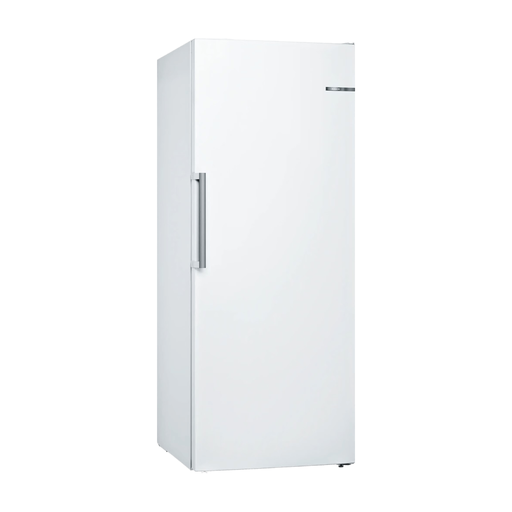 No image available
An option to consider if you want to store several portions separately and freeze a larger amount at once.
The product name lists a capacity of 328 litres, energy class C and a white finish.
The stated external dimensions are 1760 × 700 × 780 mm; allow enough space for installation.
 No image available
An under-counter model to consider if you want to store soup portions in a more compact freezer.
The product name lists a capacity of 87 litres, energy class B and a black finish.
According to the product information, manual defrosting is needed when a thick layer of frost builds up.
 No image available
A compact freestanding model to consider if you want to store different tubs of soup in separate drawers.
The product name lists a capacity of 60 litres and freestanding installation.
According to the product information, this model does not have No Frost.
 No image available
A model to consider if you want to freeze soup in portions and also want to take its stated convertible fridge mode into account.
The product name lists a capacity of 122 litres, four-star freezing, No Frost, a convertible fridge mode and energy class E.
The product information lists a width of 475 mm and a reversible door.
 No image available
A compact freestanding model to consider if you want to store soup portions in separate compartments.
The product name lists a capacity of 60 litres, three compartments and a reversible door.
The stated dimensions are 44,5 × 47,5 × 84,5 cm; the product information says it can be installed under a worktop.
Let the soup cool first, then put cooked leftovers in the fridge or freezer within two hours of cooking, as advised by the Netherlands Nutrition Centre. Store the soup in clean, tightly sealed tubs.
The Storage Guide recommends three months in the freezer for the clear vegetable soup with meat described there; after that, its quality may deteriorate. This time limit does not necessarily apply to every recipe. Write the freezing date on the tub.
The Netherlands Nutrition Centre recommends defrosting leftover meals covered in the fridge where possible; defrosting in the microwave is also an option. Don’t refreeze leftovers that have already been frozen and reheated for eating later.
No, it depends on the specific model and the temperatures in that location. Compare the climate class and any additional temperature information from the manufacturer with the lowest and highest temperatures in the shed.
The EU energy label shows, among other things, the energy class, annual energy consumption and capacity. According to the Dutch government, there is no fixed statutory guarantee period for consumer purchases in the Netherlands; contact the seller if a product is faulty. Check any additional guarantee terms separately.