What should you look for when choosing?
Under-counter freezer with drawers
Suitable if: you have little floor or worktop space and freeze berries in smaller batches.
Consider: compare your daily harvest with the freezing capacity; limited storage space can make shared storage more difficult.
Larger upright freezer
Suitable if: several people need separate storage, or you regularly harvest a larger quantity at once.
Consider: measure the available height and width, and compare annual energy consumption with that of smaller models.
Chest freezer
Suitable if: you store a large amount of shared food and have enough floor space and clearance above the lid.
Consider: plan the layout using labelled containers so you can find different portions. The Consumentenbond describes chest freezers as suitable for large or awkwardly shaped items, but this alone says nothing about a performance advantage.
For consumers looking for a freezer for garden berries in a shared Dutch kitchen, the main considerations depend on the harvest, the available space and how the appliance will be shared.
| What to consider |
What to look for |
Who this matters to |
| Freezing each day’s harvest |
Compare your largest harvest in kilos with the stated capacity in kg per 24 hours; check that the freezer compartment can reach −18 °C. |
If I pick a lot of fresh berries in one day, I want to know how much I can add at once. Around 33% of consumers prioritise freezing capacity per harvest day. |
| Fitting and opening |
Measure the external dimensions and the clearance needed to open the door or lid; then compare the freezer capacity. |
In a small shared kitchen, the appliance needs to fit and remain accessible. Around 27% of consumers prioritise a compact footprint and easy access. |
| Keeping portions separate |
Check the number of drawers or whether there is room for a tray and sealable containers; agree how everyone will divide up the portions. |
If I store berries alongside my housemates’ food, I want to be able to separate my portions and find them easily. Around 20% of consumers prioritise clear, separate storage. |
| Energy use and noise |
Compare the annual consumption in kWh and the stated noise level in dB(A) of models with enough capacity. |
When the freezer is in a shared space, I want to take energy use and noise into account without compromising on suitable capacity. Around 20% of consumers prioritise these factors. |
The Voedingscentrum recommends a freezer compartment that can reach −18 °C for the type of freezing you intend to do; a one- or two-star freezer compartment cannot reach this temperature. Milieu Centraal recommends taking annual consumption in kWh into account when comparing suitable models.
Freezers at Joybuy
This selection includes under-counter models, a larger upright freezer and chest freezers for freezing and storing garden berries separately in a shared kitchen.
 No image available
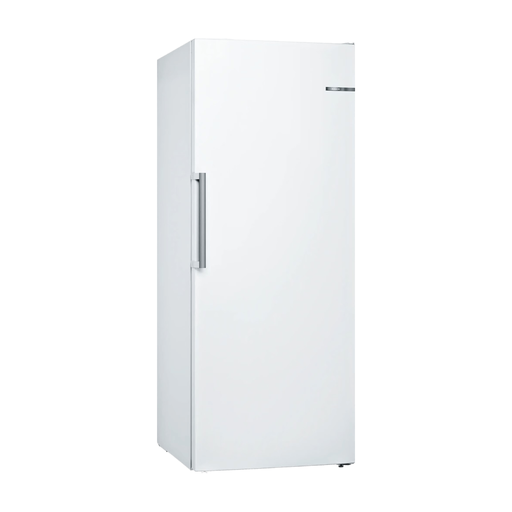
Bosch GSN54AWCV Serie 6, 328 l
For a larger harvest or shared food supplies; check that you have enough space and that the freezer compartment can reach −18 °C.
According to the product description: freezing capacity of 23 kg per 24 hours, 328 litres, 170 kWh per year and 38 dB(A).
Dimensions: 176 × 70 × 78 cm. The product description lists No Frost, Vario Zone and a Big Box drawer.
View at Joybuy
 No image available
Frilec BREMEN132-040BW, 87 l, black
An under-counter model with three drawers for smaller, separate portions; check that the capacity suits your shared food supplies.
According to the product description: freezing capacity of 4,4 kg per 24 hours, 84 kWh per year and 37 dB.
Dimensions: 55 × 84,5 × 58 cm. The product description states that it requires manual defrosting and does not have No Frost.
View at Joybuy
 No image available
Salora 47FRT60WH, 60 l
A compact model with three drawers for keeping portions separate. The stated temperature range is −20 °C to −12 °C, so −18 °C is within that range.
According to the product description: freezing capacity of 6 kg per 24 hours, 195 kWh per year and 41 dB.
Dimensions: 47,2 × 44,6 × 84,5 cm. The product description states that it does not have No Frost.
View at Joybuy
 No image available
CHiQ JR99DWE chest freezer, 99 l
A chest freezer for anyone who wants top access and has space for shared food supplies; remember to allow room for the lid to open.
According to the product specifications: freezing capacity of 4,5 kg per 24 hours, 169 kWh per year and 39 dB. The recommended setting is −18 °C.
The product description lists a wire basket and a footprint of 0,26 m²; you will also need room to open the lid.
View at Joybuy
 No image available
CHiQ JR122WSD, 122 l
A freezer for anyone looking for more capacity than a small under-counter model; compare its dimensions with the space available in your shared kitchen.
According to the product specifications: freezing capacity of 5,5 kg per 24 hours, 193 kWh per year and 39 dB. The product description lists No Frost.
The product description states that the temperature can reach −24 °C, and lists a width of 47,5 cm and a reversible door.
View at Joybuy
Frequently asked questions
Can I freeze berries in the freezer compartment of a shared fridge?
Only if the freezer compartment can reach −18 °C for this purpose and there is enough room to avoid adding too much at once. According to the Voedingscentrum, one- and two-star freezer compartments cannot reach this temperature.
How can I stop berries freezing together?
Wash the berries and pat them dry before freezing. The Voedingscentrum recommends using a sealable container, freezer bag or tray, and spreading the berries in a thin layer so they do not freeze together.
What should I consider when positioning and maintaining a freezer?
Measure the space and the clearance needed to open the door or lid. Also check the defrosting method for the specific model: ETNA states that the VV856WIT has no frost-reduction feature, while Bosch lists No Frost for the GSN29VWEP.
What information is shown on the EU energy label for freezers?
According to the European Commission, since 1 March 2021 the EU energy label for household freezers has used a scale from A to G. The label includes annual energy consumption, freezer volume and noise level, among other details; compare these figures for each model.
Is the statutory warranty in the Netherlands always limited to two years?
No. According to the Dutch government, statutory warranty in the Netherlands does not have a fixed term: a product must meet the expectations you can reasonably have of it. If a product is faulty, the retailer is your point of contact; a manufacturer’s warranty is additional.


