
Solo cook with limited freezer space
You’d like to store the occasional portion of cooled fruit crumble and want to check whether your existing freezer compartment is enough before buying an additional appliance.


For a few portions of cooled fruit crumble, your existing freezer compartment is a sensible first option if there’s room. An additional freezer is mainly worthwhile if you regularly need more freezer space. It will also use electricity, as Milieu Centraal points out. So, when buying, compare capacity, freezing capacity, annual energy consumption and the permitted ambient temperature. NoFrost is particularly useful if you want to avoid manual defrosting.
You’d like to store the occasional portion of cooled fruit crumble and want to check whether your existing freezer compartment is enough before buying an additional appliance.
You also freeze other prepared meals and are looking for extra freezer space you can rely on to store portions neatly.
You’re looking for a compact solution and are weighing up the external dimensions, door clearance, noise and permitted ambient temperature against the space you have available.
First, check whether your existing freezer compartment has enough room. If you regularly need extra capacity, compare the usable capacity and operating requirements of suitable models.
| What to consider | What should you check? | Who is this important for? |
|---|---|---|
| Suitable capacity | First, check the available space in your existing freezer compartment. If you’re considering an additional appliance, compare its capacity in litres with the dimensions of your portion containers and its stated annual energy consumption in kWh. | If I only freeze one portion now and then, I want to know whether my current freezer compartment is enough. Around 36% of consumers prioritise suitable capacity without an unnecessary second appliance. |
| Freezing portions | Check the freezing capacity in kg per 24 hours and whether the temperature setting is suitable for storing frozen portions at around −18 °C. | I want to store cooled portions alongside other prepared meals. Around 29% of consumers prioritise being able to freeze and store individual portions. |
| Suitable location | Measure the height, width and depth, and allow for the door to open and the ventilation space specified in the manual. Also check that the climate class is suitable for the temperature of the location. | If space is limited, the freezer needs to fit where I plan to put it and be able to operate there according to the manufacturer. Around 21% of consumers consider a suitable location the most important factor. |
| Defrosting and maintenance | Check whether the exact model has NoFrost; a feature that only reduces frost build-up is not the same thing. Also compare capacity, dimensions and annual energy consumption. | I want to spend as little time as possible defrosting manually, without choosing a larger freezer than I need. Around 14% of consumers prioritise avoiding defrosting. |
Two freezers use energy together, even when the extra space is barely used. Milieu Centraal also recommends checking annual energy consumption in kWh when comparing freezers.
First, check whether your existing freezer compartment is suitable and has enough space for sealed portions. Then compare the annual energy consumption of models that meet your needs.
A spacious freezer can store a lot, but its capacity doesn’t tell you how much fresh food the appliance can freeze in a day according to its specifications.
Compare the freezing capacity in kg per 24 hours and, if necessary, freeze smaller quantities at a time.
NoFrost and features that reduce frost build-up are not the same thing. A model without NoFrost may need to be defrosted manually.
Check the features of the exact model and weigh up ease of maintenance against the capacity, dimensions and energy consumption you need.
Manual defrosting takes time.
The permitted ambient temperature varies by model. So an appliance won’t necessarily work in every location where it physically fits.
Check the climate class and installation instructions for the model you choose, especially if you’re putting it in a cold storeroom or a warm room.
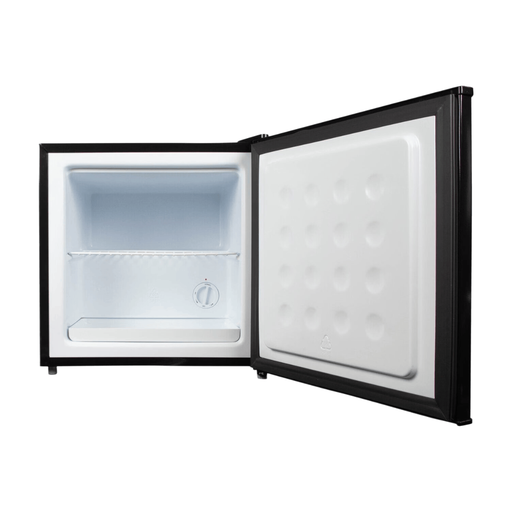
The TFM4402B is an example of a small freestanding freezer for a little extra storage.
The VR550 is an under-counter model with drawers for anyone who regularly stores several types of portion.
The GTV15NWEB is an under-counter model that lets you compare layout, freezing capacity and stated energy consumption.
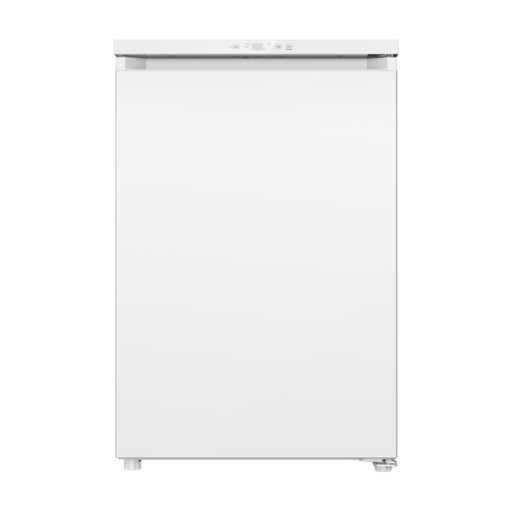
The FNe 1404 is an under-counter model to consider if NoFrost is important to you.
These models range from compact freezers for a little extra space to under-counter models with drawers or NoFrost. Compare their capacity and specifications with your portions and the space available.
 No image available
A compact option if you need a little extra freezer space.
31-litre capacity; freezing capacity of 2 kg per 24 hours; stated consumption of 147 kWh per year; reversible door and adjustable thermostat.
 No image available
An under-counter model with drawers for anyone who wants to keep several portions neatly organised.
87-litre capacity; three transparent drawers; freezing capacity of 4,4 kg per 24 hours; stated consumption of 84 kWh per year; dimensions 550 × 850 × 580 mm. The product details don’t mention a NoFrost feature.
 No image available
A roomier model with drawers if you want to organise other frozen foods as well as crumble.
60-litre capacity; three drawers; freezing capacity of 6 kg per 24 hours; stated consumption of 195 kWh per year; adjustable range of −12 °C to −20 °C; dimensions 472 × 446 × 845 mm. The product details don’t mention a NoFrost feature.
 No image available
An under-counter model to consider if you want to avoid manual defrosting.
87-litre capacity; NoFrost; freezing capacity of 5 kg per 24 hours; stated consumption of 145 kWh per year; recommended temperature −18 °C; dimensions 84,5 × 55 × 59,5 cm. The stated ambient temperature is 10 °C to 43 °C.
 No image available
A larger option if you want to store other frozen foods too, and would like to factor in the convertible fridge function.
122-litre capacity; NoFrost; freezing capacity of 5,5 kg per 24 hours; stated consumption of 193 kWh per year; 39 dB according to the product name; dimensions 475 × 565 × 1155 mm. The stated ambient temperature is 10 °C to 43 °C.
Leave the crumble to cool first, then put it in the fridge or freezer within two hours, as advised by Voedingscentrum. Use clean, airtight containers; smaller portions freeze faster. The recommended temperature for a freezer is −18 °C.
Voedingscentrum gives three months as a general guideline for leftovers, not as a guarantee for every type of fruit crumble. Bear the ingredients in mind, and don’t automatically apply the storage period for fruit flan.
Voedingscentrum recommends defrosting frozen leftovers covered in the fridge where possible. You can also defrost them in the microwave. Follow a suitable method for your recipe and packaging when preparing the food afterwards.
Fridges and freezers must meet European energy labelling and ecodesign requirements, as described by the European Commission. If you buy online from a business as a consumer, you’re entitled to a 14-day cooling-off period in many cases. In the Netherlands, statutory consumer rights apply, but there’s no fixed statutory warranty period. If a product is faulty, the seller must provide a solution, according to the Dutch government.