
Vandaag of morgen in huis

Kwaliteit gegarandeerd

Welkomstaanbiedingen ontgrendelen: GRATIS bezorging | Tot 80% korting | Gratis 30 dagen JoyPlus-proefperiode
Download de app
Buying a freezer seems straightforward, until you discover how much difference there is between a mini freezer, under-counter freezer, upright freezer and chest freezer. A model may look compact, yet still not fit because of an unusually narrow doorway. Low purchase costs can also be disappointing later due to higher energy consumption or frequent manual defrosting.
As a Joybuy Product Recommendation Officer, I filter product information based on verifiable specifications. This helps you separate marketing claims from practical features and compare products more effectively.
A capacity of, for example, 60, 85 or 122 litres does not tell you everything. Drawers, flaps and shelves determine how much usable space you actually have. Transparent drawers often make it easier to see what you have than an open freezer compartment, while a chest freezer can hold larger packages but offers less visibility.
So check:
The current European energy labels range from A to G. Do not just look at the letter; also check the stated annual consumption in kWh. Two models with the same energy rating may still have different consumption because of their size, insulation and usage.
An energy-efficient freezer is particularly worthwhile when it runs continuously. For an additional freezer in the garage or utility room, the appropriate climate class also matters. Check that the ambient temperature matches the product information. A cold garage is not automatically suitable for every appliance.
According to the product description, No-Frost reduces or prevents ice build-up, but performance and maintenance vary by model. A freezer without No-Frost must be defrosted manually when a thick layer of ice forms. This takes time and can reduce the available space.
You should also compare noise levels in dB(A). On paper, a 37 dB model is quieter than a 42 dB model, but the positioning, flooring and acoustics of the room affect how it sounds in practice. This is an important consideration for a freezer intended for an open-plan kitchen, office or student accommodation.
Measure not only the space where the freezer will stand, but also the route it will take to get there. Allow for doorways, skirting boards, ventilation space and enough room to open the door fully.
A reversible door offers extra flexibility. However, check whether the door can be reversed according to the instructions and whether the required installation space is available.
According to the product specification, a 4-star freezer is designed for long-term storage at temperatures of around -18 °C or lower. The freezing capacity, such as 4.4 or 5.5 kg per 24 hours, indicates how much fresh food the appliance can freeze during that period according to the stated specification.
If you regularly buy large quantities of food, look at more than just the capacity:
A No-Frost freezer can be convenient if you do not want to defrost it manually. According to the product description, Low Frost limits ice formation, but this does not always mean that maintenance is eliminated completely. With a model that needs to be defrosted manually, you must switch the freezer off before cleaning or defrosting it.
Also consider the controls. A mechanical dial is simple and straightforward. Electronic controls may offer more modes, such as freezing, cooling, chilling or soft-freeze. With flexible models, check carefully which temperature settings are actually specified.

Why it suits this profile: The 60-litre capacity and freestanding design are suitable for a small kitchen, office or student room where every centimetre counts.
The three compartments keep the limited capacity organised. The reversible door makes it easier to position in a confined space.
60-litre capacity, 4-star rating, three storage compartments and a reversible door.

Why it suits this profile: This model combines 122 litres of freezer space with No-Frost, multi-airflow and various modes for households that value flexibility.
The product information states 39 dB, No-Frost and electronic temperature control. This makes it easier to assess the noise level and maintenance requirements in advance.
122 litres, energy rating E, 193 kWh per year according to the product information sheet, freezing capacity of 5.5 kg per 24 hours and a reversible door.
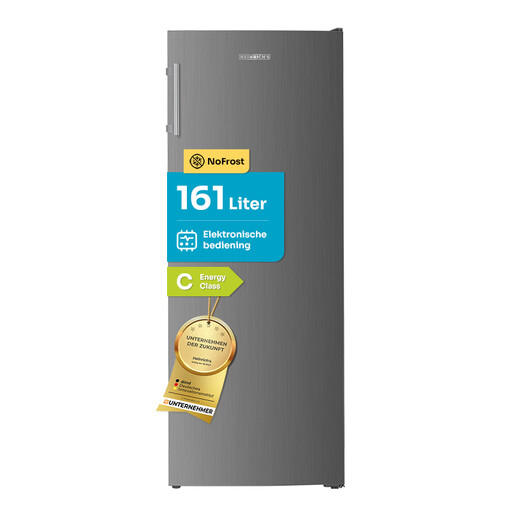
Why it suits this profile: The larger capacity and combination of drawers and trays are suitable for households that regularly store large quantities of food.
No-Frost is specified for the freezer compartment. The layout with three drawers and two trays prevents food from ending up only at the bottom of one open space.
161-litre capacity, No-Frost, LED display, fast-freeze function and a reversible door hinge according to the product description.

Why it suits this profile: A fridge freezer saves space when you need a full-sized fridge as well as freezer storage.
The specifications list 187 litres of fridge space and 73 litres of freezer space separately. This allows you to assess the balance in advance based on your household’s needs.
260-litre total capacity, 55 cm wide, energy rating E, three freezer drawers and a reversible door.
We have put together a complete, up-to-date list of products that fully meet these strict selection criteria and the applicable European safety regulations.
That depends on how much food you store and your shopping habits. A compact freezer with a capacity of 60 to 85 litres may be sufficient as extra storage for one person or a small household. For regular stockpiling, 120 litres or more is more practical. Also measure the available space and check that the drawers can be pulled out fully.
Not every model is suitable for use in a garage. Check the stated climate class and minimum ambient temperature. You should also ensure a level surface, sufficient ventilation and protection from moisture. Do not place a freezer directly next to a heat source or in full sunlight.
Check the annual consumption in kWh on the energy label. The actual cost depends on your energy tariff, ambient temperature, how often the door is opened and how full the freezer is. A smaller model does not automatically use less electricity if it has a poor energy rating. Always compare the size, energy label and annual kWh consumption together.
