
Vandaag of morgen in huis

Kwaliteit gegarandeerd

Welkomstaanbiedingen ontgrendelen: GRATIS bezorging | Tot 80% korting | Gratis 30 dagen JoyPlus-proefperiode
Download de app
A hand mixer, stick blender, stand mixer or blender can save you a great deal of time. Even so, it is not always obvious which appliance is right for your kitchen. For example, a high-wattage claim does not automatically mean that a mixer can handle heavy dough well. A large mixing bowl may also prove less practical if the appliance takes up a lot of space or is difficult to clean.
When choosing food processors and blenders, focus above all on the combination of power, capacity, accessories, operating time and ease of cleaning. Below, you’ll find the key points to consider, along with some popular choices for different uses.
A powerful blender with 1,000 or 1,200 watts sounds appealing, but wattage does not tell the whole story. The shape of the jug, the blades, the overheating protection and the recommended operating time also matter.
With a stand mixer, the difference between peak power and rated power is also important. The Monsga SM100, for example, lists 1,000 watts peak power and 600 watts rated power. So make sure you compare the same measurement across different models.
A 5- or 6-litre bowl is not always fully usable. Dough, whipped cream and batter need room to mix properly. The Monsga mixers list a maximum capacity of 6 litres, but a recommended usable capacity of 5 litres. The Kenwood Chef XL also has a 6.7-litre bowl, while the space it requires on your worktop is greater than that of a hand mixer.
So check:
A multifunctional stand mixer with a whisk and dough hook can be useful for baking, but it is not essential if you mainly purée soup. A stick blender with a chopper and whisk offers greater flexibility in a compact format. For making large quantities of smoothies, a jug blender makes more sense.
Don’t just look at the number of accessories. Consider the tasks you actually carry out. Attachments should click firmly into place, be easy to clean and, ideally, be available separately from the manufacturer.
For light batter and whipped cream, a hand mixer with several settings is generally practical. The Philips 5000 Series Hand Mixer HR3745/00 has a power rating of 450 watts, six speeds and an automatically driven 3-litre bowl. According to Philips’ product information, its motor mixes faster than earlier models; this is a brand claim, not a general guarantee for every recipe.
A stand mixer with a dough hook is more suitable if you regularly make bread, pizza or biscuit dough. The AUCMA ASM1559 has a 450-watt motor, six speeds and a pulse function. The AUCMA ASM1541 offers 400 watts, ten speeds and a 5-litre bowl. More speeds mainly give you greater control; they do not automatically mean better results.
For a one- or two-person household, a compact smoothie blender with a cup may be sufficient. The Nutribullet Exclusive Blender has a 700 ml cup and a 900-watt motor. For several people, a jug blender is more practical. The Philips HR3020/20 has a 2-litre jug and a stated working capacity of 1.5 litres.
With a jug blender, pay attention to the maximum fill line. Hot liquids are not suitable for every model. The product information for the Philips HR3020/20 states that ingredients must be below 80 °C. Nutribullet’s product information warns against blending hot liquids because of the possible build-up of pressure.
Check whether the whisk, beaters, dough hook, mixing cup or chopper is included as standard. According to the product description, the Braun MultiMix 3 HM3105 has its centre of gravity positioned above the accessories, with the aim of putting less pressure on your hand while mixing. This is a SmartMix feature described by Braun; your experience may vary.
Important basic rules:
A visible CE marking is relevant for European conformity, but it does not indicate how much batter an appliance can handle or how long it will last. Keep your proof of purchase and check the statutory minimum two-year guarantee for consumers in the European Union.
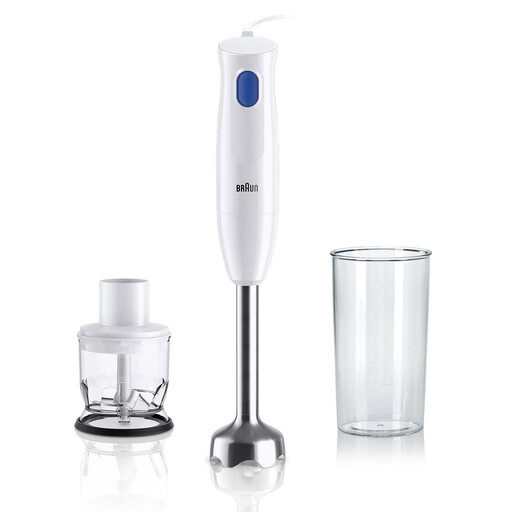
Why it suits this profile: A compact stick blender for smoothies, sauces and small preparations. The 450-watt motor, 600 ml cup and 350 ml chopper keep your set-up neat and manageable.
The controls offer one speed, so you don’t pay for settings you may never use. The EasyTwist connection is designed for changing accessories.
Lightweight design, BPA-free cup and included chopper. According to the product information, certain parts are dishwasher-safe; check the manual.

Why it suits this profile: A spacious stand mixer with a mixing bowl for home bakers who alternate between batter, cream and dough and may want to add more accessories later.
The bowl capacity and included K-beater, whisk and dough hook make its functions clearer than a loose collection of accessories.
6.7-litre stainless steel bowl, metal housing and automatic speed control according to the product details.

Why it suits this profile: For families making large batches of smoothies, sauces or cold preparations who want to combine manual settings with automatic programmes.
The jug has a capacity of 2.1 litres and there is a separate 700 ml cup. This lets you match the quantity to one serving or a larger batch.
1,200 watts, fourteen manual speeds and four automatic programmes according to the product description. The manufacturer also states that the appliance alerts you when more liquid is needed.
We’ve put together a complete, up-to-date list of products that fully meet these strict selection criteria and the applicable European safety requirements.
A stand mixer with a dough hook is generally more practical for regular bread, pizza or heavy biscuit dough. A hand mixer is mainly suitable for batter, whipped cream and lighter mixtures. Always check the maximum dough quantity and resting time in the manual.
The lifespan depends on usage, maintenance, storage and workload. Allow the motor to cool down according to the instructions, do not use damaged accessories and do not exceed the maximum operating time. A longer warranty period may provide additional reassurance, but it is not a guarantee of a specific lifespan.
Power consumption depends on the wattage and operating time. A 1,000-watt appliance running for one minute theoretically uses around 0.017 kWh. In practice, programmes, rest periods and the motor’s actual power output are what determine consumption. So use the correct quantity of ingredients and avoid unnecessarily long blending cycles.
