
Vandaag of morgen in huis

Kwaliteit gegarandeerd

Welkomstaanbiedingen ontgrendelen: GRATIS bezorging | Tot 80% korting | Gratis 30 dagen JoyPlus-proefperiode
Download de app
A food processor can take care of many kitchen tasks, from kneading dough and whipping cream to chopping vegetables, mincing meat and blending ingredients. However, not every appliance is suitable for the same jobs. A compact food processor is useful for everyday chopping, but it is not automatically suitable as a dough mixer. A stand mixer can handle large quantities of dough, while an electric mini chopper takes up less space.
As a Joybuy Product Recommendation Officer, I focus primarily on verifiable specifications and practical use. This helps you avoid paying for features you will rarely use.
A high wattage may sound appealing, but it does not tell you everything about performance. Also check:
For example, the Monsga SM100 is listed with a peak power of 1000 watts, alongside a stated nominal power of 600 watts. This difference is important when you are looking for a food processor for baking. For heavy bread dough, the highest number on the packaging is not the only factor that matters. You should also consider the permitted operating time and maximum quantity.
A multifunctional food processor with a blender, meat grinder, citrus juicer and mini chopper may seem convenient. In practice, accessories take up space and need to be cleaned after use. So start by identifying your main tasks:
An appliance with fewer functions may therefore be more practical than a model with lots of unused attachments.
The capacity of a bowl is not the same as its usable capacity. A 6-litre bowl, for example, cannot always be filled completely, particularly when making dough. So check the recommended filling quantity in the manual.
For a household of one or two people, a bowl of around 1.3 to 2.3 litres may be sufficient. Families and home bakers who prepare larger portions may prefer to look at models with capacities of 5 to 7 litres. Also take into account the dimensions on your worktop and the storage space needed for the accessories.
A food processor with multiple speed settings gives you more control over different preparations. A low setting is suitable for gentle mixing or kneading, while higher settings are intended for whisking or fast chopping. A pulse function is useful for short bursts, such as when roughly chopping vegetables.
Bear in mind that a brand claim is not the same as a guaranteed result. According to Monsga’s product description, the SM100 has eight speeds, a recommended operating volume of 5 litres, and protection against overloading and overheating. These are verifiable product specifications; the final experience depends on the recipe, quantity and how the appliance is used.
A stainless-steel bowl is practical for mixing and kneading. With a food processor, the blades and discs are more important. Check that you receive the accessories you need:
Sharp blades must be safe to fit and remove. The motor unit must not be immersed in water. Also check whether removable parts are suitable for hand washing or dishwasher cleaning.
A food processor should stand securely on a flat work surface. Non-slip feet, a locking mechanism and automatic shut-off in the event of overheating are useful safety features. Always unplug the appliance before changing accessories or cleaning it.
With a meat grinder such as the Monsga G100, the cutting plate, blade, auger and hopper must be cleaned carefully and dried thoroughly after use. The product information states that the motor housing may only be wiped with a damp cloth. Do not touch cutting edges directly.

Why it suits this profile: This compact model is designed for everyday chopping, slicing, grating and mixing without taking up the space of a large food processor on your worktop.
The product information clearly states a single 1.3-litre bowl and 650 watts. This tells you in advance that it is primarily a compact food processor, not a heavy-duty dough mixer.
650 watts, pulse function, reversible slicing and grating disc, dishwasher-safe parts and cable storage.

Why it suits this profile: This spacious kitchen mixer is designed for kneading and mixing, making it well suited to households that bake regularly and prepare larger portions.
The stated 7-litre capacity and 1200-watt power rating make the bowl and motor easier to compare than relying solely on a marketing name such as “XL”.
7-litre capacity, 1200 watts, automatic speed control, integrated scales and stainless-steel housing.
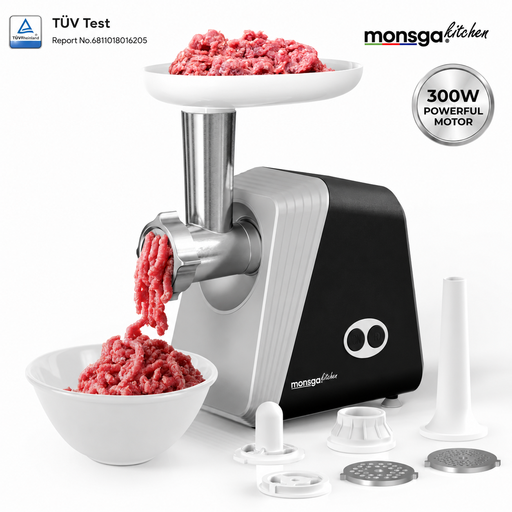
Why it suits this profile: This appliance is designed for users who want to mince their own meat and also prepare sausages, kibbeh or biscuits.
The three mincing discs make the desired result clear: fine, medium or coarse. The reverse function can help when ingredients become stuck, but always follow the instructions.
Stated power of 300 watts, up to 1200 watts maximum power, three cutting discs, sausage filler, kibbeh attachment and cord storage.
We have put together a complete, up-to-date list of products that fully meet these strict selection criteria and the applicable European safety regulations.
Look for a sturdy stand mixer with a dough hook, a stable base and sufficient bowl capacity. Do not focus solely on the maximum wattage; also consider the recommended dough capacity and maximum operating time. For regular heavy dough, a compact mini chopper or food processor is usually less suitable.
Energy consumption depends on the power rating and operating time. A 1000-watt appliance theoretically uses 1 kilowatt-hour during one hour of continuous use, but food processors generally run for shorter periods. Chop ingredients in batches, use the correct speed and allow the motor to cool down whenever the manual instructs you to do so.
Its lifespan depends on the workload, maintenance and storage. Clean removable parts immediately, dry blades and discs thoroughly, and never immerse the motor unit. Also check whether replacement accessories are available. Products with a clearly visible CE mark and a statutory guarantee also provide clarity about the basic obligations within the European market.
