
Vandaag of morgen in huis

Kwaliteit gegarandeerd

Welkomstaanbiedingen ontgrendelen: GRATIS bezorging | Tot 80% korting | Gratis 30 dagen JoyPlus-proefperiode
Download de app
A food processor can chop, slice, grate, blend, purée or knead. But not every appliance is suited to every task. A compact mini food processor is handy for herbs and small portions, while a multifunctional food processor needs more space and accessories.
If you’re looking to buy a food processor, you might start by checking the wattage or the number of functions. But these can be misleading. An appliance with lots of accessories may end up unused if it’s difficult to clean, and a large bowl isn’t much help if you usually cook for one or two people.
A higher wattage doesn’t automatically mean that every ingredient will be processed more effectively. The shape of the blades and bowl, the speed settings and the maximum running time all matter too. A 300 W electric chopper may be suitable for onions, herbs and smaller quantities, but harder ingredients often call for short pulses and enough time to rest.
A food processor with accessories might look appealing, but check which parts you’ll actually need. A food processor with blender is useful if you want to make smoothies or sauces as well as chop ingredients. If you only need to slice and grate, a simpler model may take up less storage space and leave you with less washing up.
Also watch out for conflicting product information. Check the current box contents, bowl capacity and functions on the product page before you order.
Sharp blades, locking systems and parts that aren’t dishwasher-safe all affect everyday use. When preparing raw meat, nuts or baby food, it’s important to clean the appliance straight away. Never immerse the motor unit in water. Always follow the instructions and unplug the appliance before removing any accessories.
Choose the capacity to suit the portions you make:
Check the dimensions as well as the capacity. An appliance that’s 40 cm tall may not fit under a kitchen cupboard. A compact food processor with parts that can be stored inside the bowl will save space.
Consider the stated power alongside the functions. For example, the Philips HR7320/00 has a 700 W motor, 19 functions and two colour-coded speeds. The Bosch MCM3200W lists 800 W, two speeds and a pulse function. For heavier preparations, the maximum continuous running time is also important. Some choppers are designed for short pulses of up to 30 seconds, while a blender may have a separate maximum cycle time.
Sharp stainless steel blades are important for chopping and puréeing. For grating and slicing, check which discs are included and the size of the feed tube. A glass bowl can make it easier to check the texture, but it’s heavier than plastic. Check whether the bowls and accessories are dishwasher-safe and whether the parts are suitable for contact with food.
For appliances used to prepare baby food, follow the manufacturer’s instructions, process ingredients at a safe temperature and clean the blades and bowls straight away. A product description is no substitute for nutritional or medical advice.

Why it suits this user: The two glass bowls, with capacities of 0.6 and 2 litres, let you choose between small portions and larger preparations. The controls offer two speeds.
The different bowl sizes mean you don’t have to use the same large container for every quantity. The product description also mentions a safety lock.
300 W, two glass bowls, two sets of blades and bowls that are dishwasher-safe according to the product information.
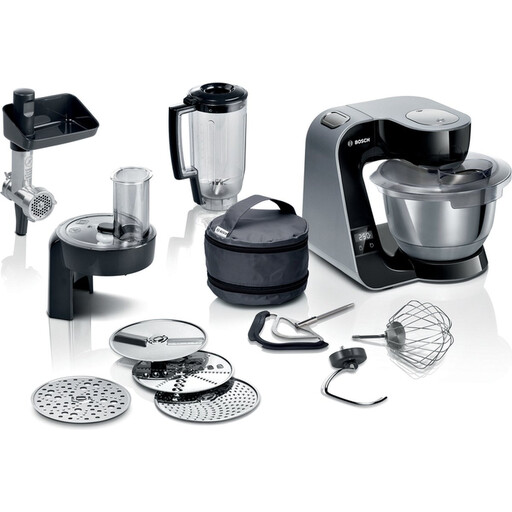
Why it suits this user: This model combines a 3.9-litre stainless steel bowl with 1000 W of power, an LED display, built-in scales and a range of accessories.
The specifications make it clear what you’re paying for: capacity, power, scales and specific accessories, rather than just a high number of functions.
1000 W, 3.9 litres, dishwasher-safe parts and accessories such as dough hooks, a whisk, a blender and slicing discs.

Why it suits this user: This model is designed for anyone looking for a food processor with a blender for slicing, grating, puréeing, kneading, making smoothies and crushing ice.
Each function has a specific accessory: a 1.3-litre bowl, two slicing discs and a 600 ml personal blender with a drinking lid.
900 W, seven speed settings, a 1.3-litre capacity and six accessories listed in the product details.
We’ve put together a complete, up-to-date list of products that meet these strict selection criteria and the applicable European safety requirements.
That depends on what you’re preparing. A compact chopper with lower power may be enough for herbs, onions and soft ingredients. For dough, hard vegetables or larger quantities, power, bowl shape and the pulse function matter more together than wattage alone.
Some models are described as suitable for puréeing or preparing baby food. Check the recommended age, temperature limits, bowl materials and cleaning instructions. Process ingredients separately when necessary, and clean the blades and bowl straight after use. A food processor is no substitute for guidance on suitable foods for your child.
Energy consumption depends on the power and how long you use the appliance. A 700 W appliance running for ten minutes theoretically uses around 0.117 kWh. In practice, choppers often run for less time because they work in pulses. So focus on how you’ll use the appliance, how long it takes to clean and which accessories you’ll actually use.
