
Vandaag of morgen in huis

Kwaliteit gegarandeerd

Welkomstaanbiedingen ontgrendelen: GRATIS bezorging | Tot 80% korting | Gratis 30 dagen JoyPlus-proefperiode
Download de app
A food processor can take care of much of the preparation work: from kneading dough and mixing batter to chopping vegetables, mincing meat and blending ingredients. However, one appliance is not automatically suitable for every task. A stand mixer is mainly designed for baking, while a food processor is often better suited to chopping, slicing and grating.
The product name can also create expectations that do not fully match the specifications. So do not just look for terms such as “multifunctional” or “powerful motor”. Check what is actually included and what the appliance is designed to do.
A motor power rating of, for example, 1,000 or 1,200 watts sounds clear, but check whether this refers to the rated power or a maximum peak power. The Monsga SM100, for example, is described as having 1,000 watts of peak power and 600 watts of rated power. These two figures are not the same.
For a stand mixer used for bread dough, the gearing, stability and recommended maximum dough quantity are also important. A high wattage alone does not indicate how much dough you can process over an extended period.
A multifunctional food processor with a blender, vegetable chopper, dough mixer and electric meat grinder may seem appealing. However, accessories take up space and need to be washed after use. Ask yourself which functions you will genuinely use:
A 6-litre mixing bowl may be attractive for families, but the usable quantity is often lower than the maximum capacity. The Monsga SM100, for example, is listed with a 6-litre bowl and a recommended usable capacity of 5 litres. This difference matters if you regularly make large quantities of bread dough or batter.
Also check the dimensions. An appliance approximately 40 centimetres high may not fit under a kitchen cupboard if the head needs to be raised.
For a food processor for home use, the following details are useful:
A blender has different requirements. According to the product specifications, the Philips HR3020/20 has a 1,000-watt motor, three speeds plus pulse, and a 2-litre jug with a working capacity of 1.5 litres. That is a different application from a dough mixer.
Stainless steel is commonly used for mixing bowls and mincing plates. For plastic bowls, look for a clear statement about food contact, such as BPA-free when specified by the manufacturer. Also check whether the components are dishwasher-safe. This does not automatically apply to the motor housing, blades or all accessories.
Sharp blades and mincing plates must be handled with care. Unplug the appliance before changing accessories or cleaning it.
A food processor with accessories is only versatile if those accessories are suitable for your recipes. A whisk is useful for whipping cream and egg whites, while a dough hook is designed for dough. A reversible slicing and grating disc is helpful for vegetables, but it does not replace a proper meat grinder.
Also check whether accessories are included or need to be purchased separately. Some stand mixers have additional attachments available, but these are not included as standard.

Why it suits this profile: A compact food processor for anyone who mainly wants to chop, slice and grate vegetables without leaving a large appliance on the worktop.
The functions are clearly defined: chopping, slicing and grating. The bowl has a capacity of 1.3 litres and, according to the product description, the components are dishwasher-safe.
650 watts, a 1.3-litre bowl, pulse function and cable storage. The Express Serve function sends sliced ingredients straight into a bowl or pan.

Why it suits this profile: For home bakers who regularly make large quantities of batter or dough and value a spacious bowl.
The product specifications list 1,200 watts, a 7-litre bowl, automatic speed control and integrated scales. This makes important buying criteria easy to verify.
Stainless steel housing, 7-litre capacity, kneading and mixing as the main functions, plus a stated 2-year manufacturer's warranty.
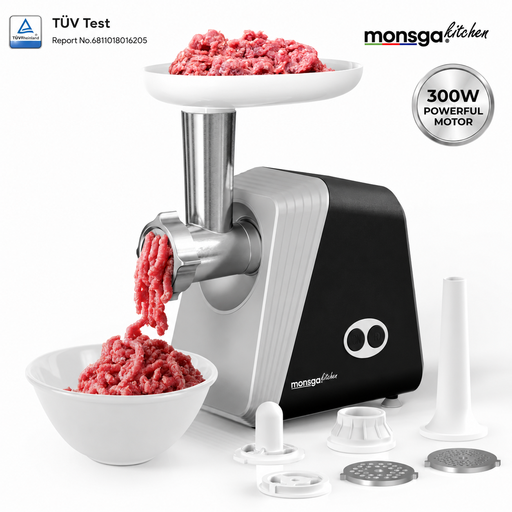
Why it suits this profile: For households that want to prepare their own mince, sausages or kibbeh and are looking for a dedicated electric meat grinder.
The set includes three mincing plates, a sausage filler, kibbeh attachment and biscuit maker. You can therefore see in advance which uses are genuinely covered by the package.
Rated power of 300 watts, maximum 1,200 watts according to the product description, reverse function and removable components for manual cleaning.

Why it suits this profile: A compact multifunctional food processor for everyday meal preparation, such as chopping, mixing, slicing and grating.
The functions and controls are clearly specified: 800 watts, two speeds plus pulse and a 2.3-litre bowl.
Suitable for slicing, grating, chopping and mixing. Its size is designed for kitchens where storage space is limited.
We have put together a complete, up-to-date list of products that fully meet these strict selection criteria and the applicable European safety regulations.
A food processor, often referred to as a stand mixer, is mainly suitable for mixing, whisking and kneading. A food processor is more focused on chopping, slicing, grating and sometimes blending. A multifunctional food processor can combine several functions, but always check which accessories are actually included.
That depends on the intended use. For light preparations such as batter or soft vegetables, a lower power rating may be sufficient. For heavy bread dough or regular mincing, it is more important to consider the rated power, maximum quantity and recommended operating time. So do not compare only the wattage of stand mixers, blenders and food processors.
Switch off the appliance, unplug it and wait until the blades or whisks have come to a complete stop. Clean removable components according to the instructions. The motor housing must not be immersed in water. Dry the components thoroughly before storing them, particularly after processing raw meat. This also helps to reduce odours and any residue left behind.
