
Vandaag of morgen in huis

Kwaliteit gegarandeerd

Welkomstaanbiedingen ontgrendelen: GRATIS bezorging | Tot 80% korting | Gratis 30 dagen JoyPlus-proefperiode
Download de app
A food processor can chop, slice, grate, mix, knead and purée. However, not every model is suited to the same kitchen. A compact mini food processor is enough for herbs and small portions, while families often benefit more from a food processor with a large bowl. The difference is not just the wattage, but also the capacity, accessories, controls and ease of cleaning.
A food processor rated at 1000W or more may sound powerful, but wattage does not tell you everything about how it will perform in practice. The appliance must also be suitable for the quantity of ingredients and the type of task. A 200W motor may be suitable for small portions of herbs, onion or nuts, but less suitable for regular kneading or larger quantities.
Always check:
A 3.4-litre bowl does not automatically mean that you can process 3.4 litres of food at once. The Philips Avance HR7776/90 has a total bowl capacity of 3.4 litres, while the maximum capacity for dry or liquid ingredients is 2.4 litres. The maximum amount of flour is 1000 grams.
When choosing a food processor with a large bowl, usable capacity is therefore more important than the biggest number on the packaging. A small bowl can also be more practical for sauces or baby food, as the ingredients are less spread out.
A multifunctional food processor with lots of accessories is only useful if you actually use them. Look at the specific components:
Also consider storage. Accessories left loose in a kitchen cupboard are more easily misplaced. On some compact models, components can be stored inside the bowl.
For everyday chopping, grating and mixing, a power rating of around 700 to 900W is often a sensible choice. For heavier dough or more intensive use, a 1000W or 1300W model may be worth considering. That does not mean higher ratings are necessary for every user.
Multiple speeds give you more control over the texture. A pulse function is useful when you want to chop briefly without completely reducing the ingredients to a fine consistency. An electric chopper with a single button is simpler, but offers fewer adjustment options.
Choose the bowl based on your usual portions:
Also check the dimensions of the motor unit. A compact food processor that is 40 centimetres tall may not fit beneath every kitchen cupboard. Weight and non-slip feet are important if you regularly process hard ingredients.
Stainless steel blades are common in food processors and electric choppers. Glass bowls can be useful for seeing the ingredients, but are generally heavier than plastic ones.
A food processor should only be described as dishwasher-safe for the components for which this is explicitly stated. Check whether this applies to the bowl, blades, lids and discs, or only to certain accessories. The motor unit must not be placed in water or the dishwasher. Sharp blades should also be handled carefully when washing by hand.

Why it suits this profile: This model combines a compact design with 800W of power and a 2.3-litre bowl. It is well suited to everyday preparations without immediately committing to a large kitchen appliance.
The specifications list both the power rating and the bowl capacity. With two speeds and a pulse function, you know what to expect in advance instead of relying solely on marketing terms.
800W, 2.3-litre bowl, chopping, mixing, slicing and grating; dimensions of 39.7 × 26.3 × 36.9 cm.
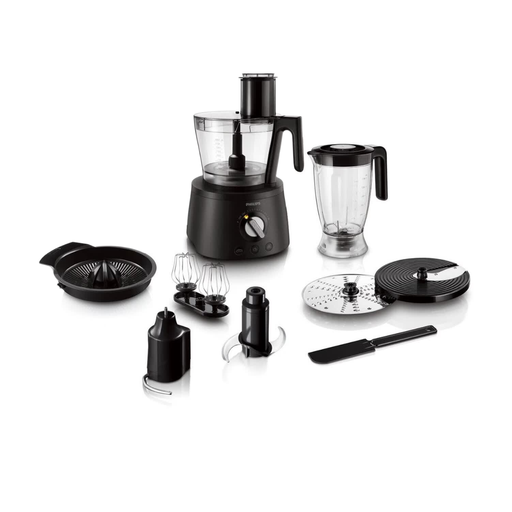
Why it suits this profile: The 3-in-1 design is aimed at households that want to carry out multiple preparations with one base unit, including chopping, kneading, whisking and citrus pressing.
The product information states specific maximum capacities: 2.4 litres for dry or liquid ingredients and 1000 grams of flour. The included accessories are also clearly listed.
1300W, 3.4-litre bowl, 12 speeds plus pulse function, and accessories that are dishwasher-safe according to the product specification.
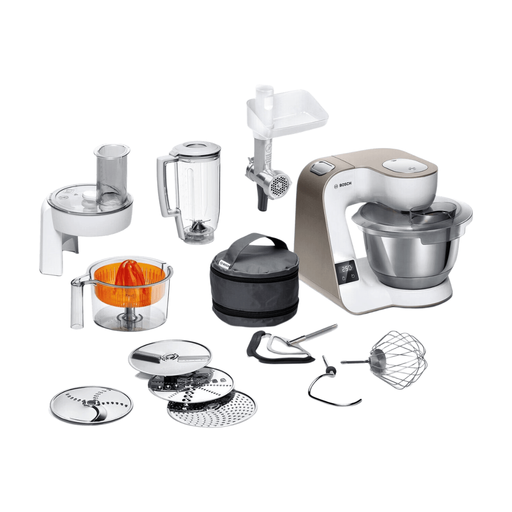
Why it suits this profile: This is more of a kitchen machine than a traditional compact food processor. The combination of 1000W, seven speeds, planetary motion and additional accessories is well suited to baking and a range of kitchen tasks.
The product description distinguishes between the maximum capacity of 2.7 kg and the 1.25-litre blender jug. This makes it easier to match the accessories and capacity to your recipes.
1000W, seven speeds, pulse and turbo functions, planetary motion, blender jug and accessories such as a meat mincer and citrus press.

Why it suits this profile: Combining a food processor with a blender and a personal blender jug is practical for smoothies, sauces and everyday portions.
The main bowl has a capacity of 1.3 litres and the accessories are clearly specified. This prevents the blender function from being confused with a large mixing bowl.
900W, seven speeds, 1.3-litre bowl, blender function, ice-crushing capability and six specified accessories.
We have put together a complete, up-to-date list of products that fully meet these strict selection criteria and the applicable European safety regulations.
Not always. A food processor is generally designed for chopping, slicing, grating and puréeing. A kitchen machine often has a mixing bowl with a whisk and dough hook, making it more suited to whisking and kneading. Some models combine both functions, but check which accessories are included.
Its lifespan depends on use, maintenance, workload and storage. Use the appliance in accordance with the instructions, do not exceed the maximum capacity and allow the motor to cool down when recommended. Check the blades and bowls regularly for damage. In the EU, consumers are entitled to at least the statutory guarantee of conformity; additional manufacturer warranties may vary by product.
Energy consumption depends on the power rating and how long the appliance is used. An 800W appliance running for one minute theoretically uses around 0.013 kWh. In practice, the actual figure depends on the load and efficiency. Short preparation times and a pulse function generally help to limit the total running time.
