
Vandaag of morgen in huis

Kwaliteit gegarandeerd

Welkomstaanbiedingen ontgrendelen: GRATIS bezorging | Tot 80% korting | Gratis 30 dagen JoyPlus-proefperiode
Download de app
A food processor can combine many kitchen tasks: chopping, slicing, grating, mixing, kneading and sometimes blending too. That makes one appliance appealing to families, keen cooks and meal preppers. However, a multifunctional food processor can disappoint if you focus mainly on the wattage or the number of accessories.
The most important question is not how many functions are listed on the packaging, but whether the appliance suits your kitchen, quantities and cleaning routine.
A motor power rating of 1,200 or 1,300 watts sounds impressive, but it does not automatically indicate how easy an appliance is to use every day. Also consider:
Some models are designed for short pulses. The ochama Food Processor 750W, for example, states that you should use short pulses for heavy preparations and allow the motor to cool between cycles. This is important when processing nuts, hard vegetables or larger quantities.
A 2-in-1 blender and food processor can take several forms. One model may come with a separate blender jug and food processor bowl. Another may only have a small blender attachment or primarily function as a mini chopper.
So check whether the set is suitable for what you want to prepare:
A food processor with accessories is only practical if they are easy to fit, clean and store. A large accessory package also takes up space. Pay attention to storage options and check whether separate parts are dishwasher-safe. The motor base must never be immersed in water.
For everyday home use, it is helpful to assess power alongside the controls and operating time. An appliance with several speeds gives you more control when working with soft ingredients, dough and coarser preparations. A pulse function is useful for short bursts of chopping without immediately reducing ingredients to a fine consistency.
Always follow the manual regarding maximum quantities and breaks. The motor may need to cool down during heavy preparations. This not only prevents overloading, but also helps avoid unnecessarily shortening the appliance’s lifespan.
The capacity stated on the packaging is not always the same as the practically usable quantity. A bowl of 2 to 3 litres can be useful for a family, while a compact kitchen may benefit more from a smaller footprint.
Also note the difference between:
A food processor with a blender is particularly useful when both components are large enough for your usual portions.
Stainless steel blades and grating discs are common choices for vegetables, fruit and other foodstuffs. Check whether the blades are removable and how to clean them safely. Hold sharp components by the plastic centre, not by the cutting edge.
An integrated scale can be useful for recipes and meal prep. According to the product information, the Kenwood models below have a built-in digital scale that lets you weigh ingredients in the bowl or on a platform.
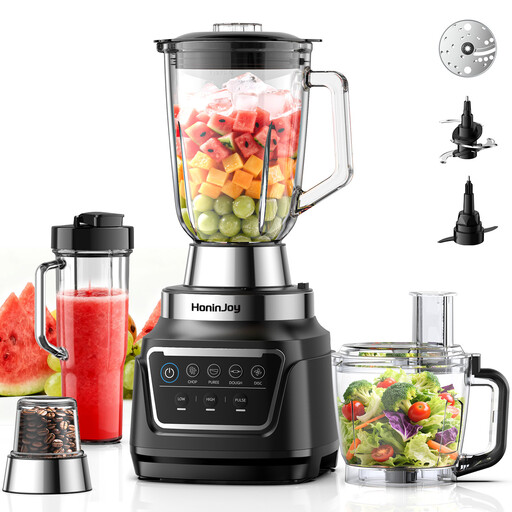
Why it suits this profile: The set combines a 2-litre food processor bowl with a 1.5-litre blender jug, grinder jar and sports bottle. This provides a range of functions without requiring you to buy several separate appliances.
The functions are divided between separate bowls and jars. However, check beforehand that all the parts fit in your dishwasher and storage space.
According to the product description: up to 1,300 watts, one-touch programmes and dishwasher-safe detachable parts.
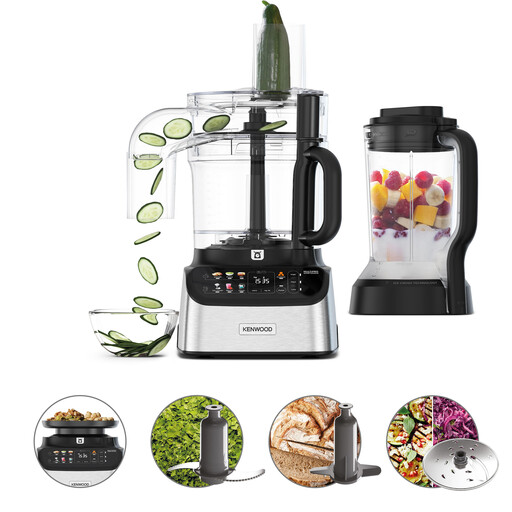
Why it suits this profile: This model is aimed at users who cook frequently and want one appliance for weighing, mixing, kneading, puréeing, chopping, grating, slicing and blending.
The product information lists a separate 1.5-litre blender, a 3-litre bowl, six presets and an integrated scale. This means the key functions are clearly specified.
According to the product description: 1,000 watts, dough hook, micro-serrated cutting blade and a disc for slicing and grating.
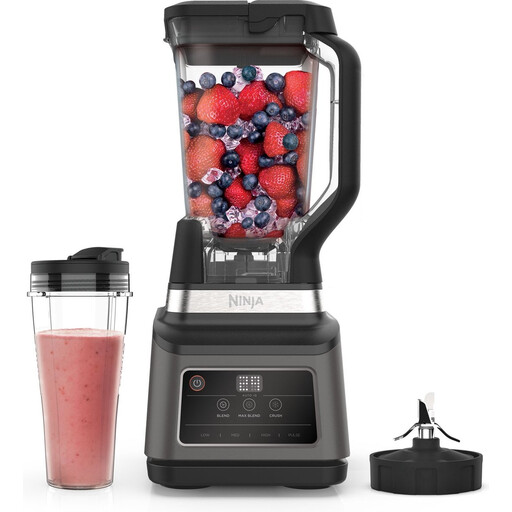
Why it suits this profile: This model is ideal for users who mainly want to prepare smoothies, sauces, frozen fruit and ice, but also need a chopping function.
The set lists both a 2.1-litre jug and a 700-millilitre cup. When buying, however, check exactly which slicing and chopping accessories are included.
According to the product information: 1,200 watts, four speeds, Auto-IQ programmes and dishwasher-safe removable parts.
We have put together a complete, up-to-date list of products that fully meet these strict selection criteria and the applicable European safety regulations.
Read the manual before use and check that the bowl, lid and accessories are properly locked in place. Place the motor base on a stable, dry surface and do not use the appliance without ingredients if the manufacturer advises against it.
Also bear the following points in mind:
The product listings for several models mention a statutory warranty of at least two years within the EU. Keep your proof of purchase and contact the seller if there is a problem, in accordance with the applicable consumer protection rules.
Yes, if the model has a blender jug or a suitable blending attachment. Check the jug’s capacity, the maximum fill level and the instructions for ice or frozen ingredients. A standard chopping bowl is not automatically suitable for liquid smoothies.
That depends on the tasks. A lower power rating may be sufficient for chopping, mixing and making simple sauces. If you also want to knead dough, crush ice or process larger portions, consider models from around 800 watts. Power is only one factor: capacity, blades, cooling and operating time are also important.
Energy consumption depends on the wattage and operating time. An appliance rated at 1,000 watts uses theoretically around 0.017 kWh when running for one minute. In practice, a food processor usually runs for short periods and in pulses. As a result, the cost per preparation generally remains limited; accessories, cleaning and potential replacement have a greater impact on the overall cost of ownership.
