
Vandaag of morgen in huis

Kwaliteit gegarandeerd

Welkomstaanbiedingen ontgrendelen: GRATIS bezorging | Tot 80% korting | Gratis 30 dagen JoyPlus-proefperiode
Download de app
A food processor can take care of many tasks: kneading dough, chopping vegetables, whipping cream or making smoothies. However, an appliance with lots of accessories is not automatically suitable for every kitchen. The difference often comes down to the drive system, the space available and how easy the parts are to clean.
The Joybuy Product Recommendation Officer helps you look beyond marketing terms and focus on verifiable features. This helps you avoid paying for functions you will rarely use.
A high wattage may sound appealing, but it does not tell you everything about practical performance. The motor design, overheating protection, bowl capacity and accessory type are at least as important. For heavy bread dough, a stand mixer with a bowl and sturdy dough hook is usually a more sensible choice than a compact hand mixer.
Also look out for conflicting information. Product details may vary between versions. Always check the exact model, the accessories included and the contents of the manual.
A multifunctional food processor may come with a blender, chopper, whisk, slicing discs or meat mincer. This is useful if you genuinely use these functions. However, accessories take up storage space and need to be fitted and cleaned separately.
Ask yourself which tasks you do every week:
Baked-on dough around the drive system or hard-to-reach blades can make an appliance less pleasant to use every day. Check which parts can be removed and whether the product information states that they are dishwasher-safe. The motor housing must not be immersed in water.
“Automatic cleaning” or “dishwasher-safe” also does not mean that every part can be placed in the dishwasher without checking. Consult the manual and note the difference between the bowl, blades, lid and motor unit.
For light preparations such as batter, cream and soft vegetables, a lower power rating is often sufficient. If you regularly make bread, pizza or pasta dough, you will benefit more from an appliance with several speed settings, a pulse function and overheating protection.
A pulse function operates in short intervals. This is useful when chopping or when you want to mix ingredients gently. Always follow the maximum quantities and recommended operating time. Some compact blenders, for example, should not be run for more than short cycles consecutively.
A 4 to 6-litre bowl is useful for families and keen home bakers, but a large bowl does not mean that you should always process large quantities. Check the maximum dough capacity, not just the total bowl capacity.
For smoothies, a jug of around 1.5 to 1.75 litres is suitable for several glasses. A glass jug is heavier than a plastic one, but according to the product description it can be a robust choice for home use. Always check whether the jug is suitable for hot liquids; this does not automatically follow from the material.
Check that the accessories lock firmly into place and that the appliance cannot start when a lid or mixer arm is not properly closed. Important points include:
Sharp blades, rotating hooks and slicing discs should only be handled when the plug has been removed from the socket. The statutory guarantee in the EU is at least two years for consumers; additional terms may apply depending on the seller and product.
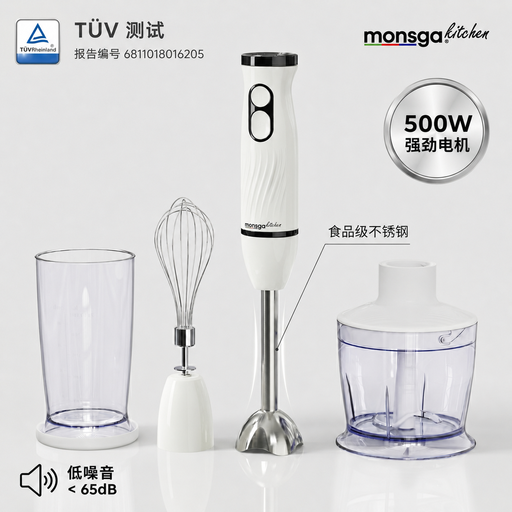
Why it suits this profile: This hand blender takes up very little space and combines blending, whisking and chopping for soups, sauces, smoothies and small food preparation tasks.
The set focuses on a limited number of useful accessories rather than a large collection that requires extra storage space.
Normal and turbo settings, a 500 ml chopper, a 500 ml measuring jug, a 1.5-metre cable and dishwasher-safe removable accessories according to the product description.
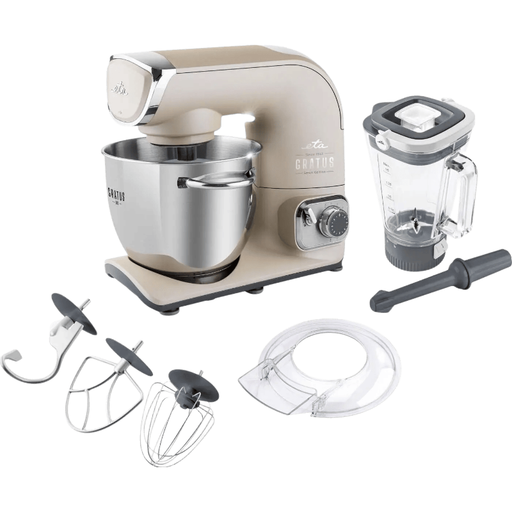
Why it suits this profile: A spacious stainless-steel bowl and planetary mixing action make this suitable for home cooks who want to prepare a range of dishes using one main appliance.
The specifications state more than just the power rating. They also include a maximum dough capacity, safety lock and thermal protection.
1500 W according to the product information, a 5.5-litre bowl, a 1.5-litre blender jug and dishwasher-safe non-metal parts.
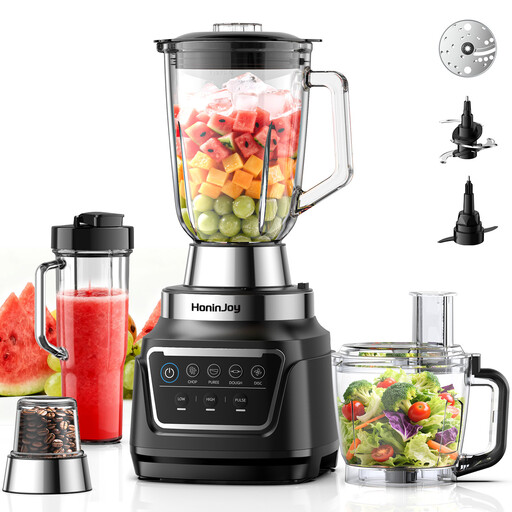
Why it suits this profile: This combination is designed for chopping, puréeing, dough preparation, grating, slicing, making smoothies and grinding, making it suitable for households that regularly carry out a wide range of kitchen tasks.
The product description mentions a 2-litre food processor bowl, a separate blender jug and a secure lid lock. Before buying, check which parts are included with your particular version.
1300 W maximum power according to the listing, an 80-gram grinder jar, a 24 oz sports bottle and removable parts that can be placed on the top rack of the dishwasher according to the product information.
Before buying, measure the space on your worktop and check the height required when the mixer arm is raised. A stand mixer of around 5 to 6 litres is useful for families, but takes up more space than a hand mixer or hand blender.
Also consider the noise level, weight and cable length. A heavy appliance is often more stable when handling firm dough, but is less convenient to store. For everyday use, what matters most is whether you can take out, assemble and clean the appliance without too much effort.
We have put together a complete, up-to-date list of products that fully meet these strict selection criteria and the applicable European safety requirements.
That depends on the motor, dough hook, bowl and maximum dough capacity. Pay particular attention to the limit stated in the manual. Do not run the appliance for longer than necessary, and stop if the motor noticeably slows down or becomes hot.
A food processor is mainly designed for chopping, slicing, grating and puréeing. A kitchen mixer or stand mixer with a bowl is more suited to mixing, whisking and kneading. A multifunctional food processor sometimes combines both functions, but the accessories can make the machine larger and more difficult to clean.
Consumption depends on the power rating and operating time. In theory, a 1000 W appliance uses 1 kWh when it runs continuously at full power for one hour. In practice, food processors usually run for shorter periods and at varying speeds. A lower power rating does not automatically mean lower costs if you need to run the appliance for longer.
