
Vandaag of morgen in huis

Kwaliteit gegarandeerd

Welkomstaanbiedingen ontgrendelen: GRATIS bezorging | Tot 80% korting | Gratis 30 dagen JoyPlus-proefperiode
Download de app
A food processor can chop, slice, grate, blend, purée and sometimes knead. Yet some of these appliances end up unused at the back of a kitchen cupboard. The problem is often not a lack of features, but a poor match between the appliance and your cooking habits.
If you mainly chop onions, you don’t need a large food processor with dozens of accessories. A family that regularly makes dough, on the other hand, won’t get much use out of a small electric chopper. Before you buy a food processor, look out for these common pitfalls.
A 1,000-watt motor sounds impressive, but the figure alone tells you nothing about the bowl capacity, accessories or maximum running time. For small quantities, a compact food processor with a lower wattage may be more practical. Also check whether the manufacturer specifies a maximum continuous running time or a pulse setting.
A multifunctional food processor often comes with discs, blades, a blender jug, a whisk and a dough hook. That can be useful, but only if you’ll actually use those parts. Check where you’ll store the accessories and whether they fit inside the bowl. An appliance that’s awkward to put away is less likely to be used.
A food processor with a bowl of 2 litres or more is suitable for larger quantities, but may be less efficient for a single onion, a small amount of sauce or baby food. Check both the capacity and the minimum quantity the appliance can process effectively. For small portions, a mini food processor or chopper may make more sense.
For everyday chopping, grating and slicing, many models have a stated power rating of between 700 and 1,000 watts. A higher figure can be useful for tougher ingredients or dough, but also consider:
A food processor with a blender can be handy if you want to make smoothies or liquid sauces as well as chop ingredients. If so, check that the blender jug is included and what its capacity is.
For a busy family, a bowl of around 2 to 3 litres is practical for larger portions. A compact food processor with a bowl of around 0.9 to 1.5 litres takes up less space and is better suited to smaller households.
Check the appliance’s external dimensions, not just the bowl capacity. A model that’s almost 40 centimetres tall may not fit easily under kitchen cupboards. Also check its weight and whether it has non-slip feet. A heavier appliance is generally more stable on the worktop, while a lighter model is easier to take out of a cupboard.
A vegetable slicer usually needs reversible slicing and grating discs. For dough, look for a food processor with a dough hook or a stand mixer with a kneading attachment. If you regularly grind nuts, coffee or herbs, you could consider a separate grinding cup or chopper.
Also check:
Never leave sharp blades loose in a cutlery drawer. Unplug the appliance before changing or cleaning accessories.

Why it suits this type of user: This model combines an 800W motor with a 2.3-litre bowl and is designed for everyday chopping, blending, slicing and grating. Its dimensions make it a good choice if you want a versatile appliance without needing to clear a large area of worktop.
The two speed settings and pulse function make it straightforward to use. The product specifications clearly list the key functions, without relying on a long list of separate accessories.
800W power, a 2.3-litre bowl and compact dimensions of 39.7 × 26.3 × 36.9 cm.
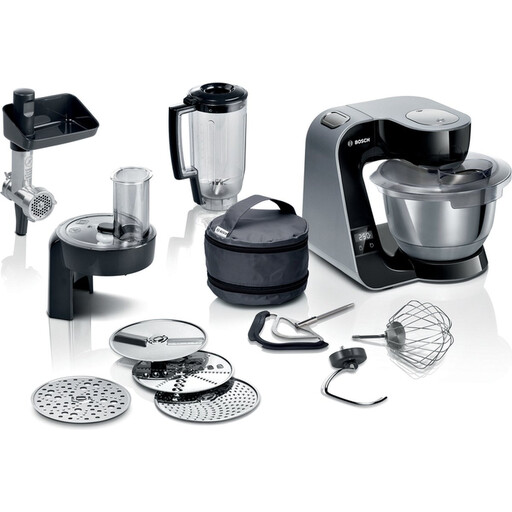
Why it suits this type of user: With a 3.9-litre stainless steel bowl, built-in scales, an LED display and a range of accessories, this model is well suited to home cooks who want to prepare a variety of dishes using one main appliance.
The functions and included parts are clearly specified, including dough hooks, a whisk, a blender, a chopping disc and a grating disc. This makes it easy to check in advance whether the set is right for your recipes.
1000W power, a 3.9-litre stainless steel bowl, built-in scales and dishwasher-safe parts, according to the product description.

Why it suits this type of user: This model combines a food processor with a blender function, an ice-crushing function and a 600 ml personal blender. It’s a good fit if you want to avoid juggling several appliances for smoothies, sauces and everyday food preparation.
The functions come with clearly defined components: a 1.3-litre bowl, six accessories and a separate blender with a drinking lid. This gives you a clear idea of the space and accessories you’ll need in advance.
900W power, seven speed settings, a 1.3-litre bowl and a 600 ml personal blender.
We’ve put together a complete, up-to-date list of products that meet these strict selection criteria and the applicable European safety requirements.
A food processor is generally designed for chopping, slicing, grating and puréeing. A stand mixer often has a larger mixing bowl and is more commonly used for mixing, whisking and kneading. Some models combine both functions. So check which accessories are included rather than relying on the product name alone.
Its lifespan depends on how often you use it, how well you maintain it, how hard you work it and how you store it. Use the appliance within the limits set out in the instruction manual, let the motor cool down after heavy use and don’t replace damaged blades or parts with unsuitable alternatives. In the European Union, new consumer products are generally covered by a minimum two-year legal guarantee; additional manufacturer’s warranties vary by brand and model.
Energy use depends on the appliance’s power rating and how long you use it. An 800-watt appliance uses a maximum of 0.8 kilowatt-hours if it runs continuously for an hour. In practice, a chopper is usually used for short periods, often in pulses. The actual cost will therefore depend on your electricity tariff and how often you use it.
