
Vandaag of morgen in huis

Kwaliteit gegarandeerd

Welkomstaanbiedingen ontgrendelen: GRATIS bezorging | Tot 80% korting | Gratis 30 dagen JoyPlus-proefperiode
Download de app
A food processor can take care of much of the preparation: slicing vegetables, grating cheese, chopping nuts, kneading dough and making smoothies. However, a multifunctional food processor is not automatically suitable for every household. A large accessory set may end up unused in the cupboard, while a small bowl may not be big enough for batch cooking.
So don’t just look at the wattage or the number of functions. Capacity, accessories, safety and cleaning are just as important in determining whether you use the appliance every day.
A high power rating sounds appealing, but it does not tell you everything about how the appliance performs in practice. Also check:
A 750-watt electric food processor may be sufficient for vegetables and sauces, while intensive dough kneading or processing hard ingredients may require a different design. According to the product information for some models, the motor must cool down after heavy use. This is important if you want to prepare several batches one after another.
A food processor with accessories can slice, grate, chop, blend and knead. In practice, the accessories you use regularly are the most relevant. So check whether the package actually includes:
Also consider storage. Multiple discs and blades take up space and need to be stored safely.
An appliance that is difficult to clean is less likely to be used. Look for removable parts and check whether the product information states that they are dishwasher-safe. The motor base must not be immersed in water.
Blades and slicing discs are sharp. Always unplug the appliance before changing or cleaning accessories. Do not fill bowls above the indicated maximum mark. Also, do not process boiling liquids in a blender unless the instructions explicitly allow it. With many models, hot ingredients must be allowed to cool first.
A bowl of around 1.5 to 2 litres is often suitable for everyday cooking for a small household or family. For batch cooking, it is not just the total capacity that matters, but also how much food you can safely process at once. A blender jug may have a different capacity from the food processor bowl.
A food processor for smoothies should also be suitable for your portion sizes. A personal cup is handy for a single drink on the go, while a jug is more suitable when you are making several glasses at once.
If you want one appliance for a wide range of tasks, compare the functions of each model rather than relying solely on the marketing name. A food processor with blender typically combines a bowl with slicing and grating discs and a separate blender jug. A kitchen machine with a blender may also include a mixing bowl, dough hook or whisk, but it often takes up more space.
For hard ingredients, the blades and discs are more important than the number of programmes. According to Ninja’s own product information, the stainless-steel blades of the BN750 are intended for ingredients including ice and frozen foods. This is a brand claim about performance; always use the specified quantities and settings.
Measure the available space on your worktop beforehand. Check the height if the appliance will be positioned underneath kitchen cupboards. A blender with a glass jug may be heavier than a model with plastic parts. Plastic bowls are often lighter, but the product description should state that they are suitable for food contact.
Check each part individually to see whether it is dishwasher-safe. For example, the Kenwood KAH359GL is described as having a blender jug that is not dishwasher-safe. This differs from models where the product specifications state that all removable parts can be placed in the dishwasher.
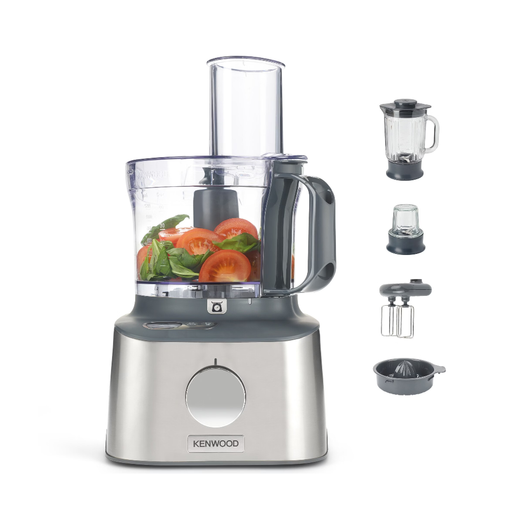
Why it suits this profile: This model combines a 2.1-litre bowl with a 1.2-litre glass blender jug, built-in scales and several preparation functions. It is well suited to beginners who want to try different tasks without choosing a large appliance straight away.
The specifications clearly state two speeds plus a pulse setting, an 800W motor and a bowl capacity of 2.1 litres. This makes it easier to assess the controls and size in advance.
Built-in scales, glass blender jug, chopper and removable parts that are dishwasher-safe according to the product information.
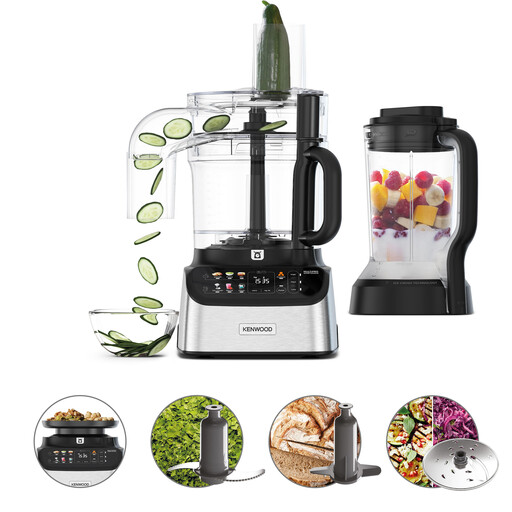
Why it suits this profile: The combination of automatic programmes, integrated scales, a 3-litre bowl and a 1.5-litre blender is practical for families and home cooks who often prepare larger quantities.
The product information lists not only presets, but also four speed settings and a pulse function. This means you can still control the process manually alongside the automatic operation.
1000W motor, dough hook, 2-in-1 grating and slicing disc, ice-crushing function and digital scales.
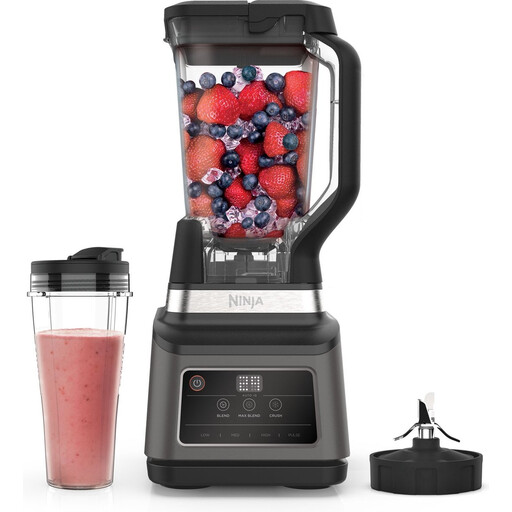
Why it suits this profile: This model is primarily designed for blending, smoothies, sauces and frozen ingredients. The 2.1-litre jug and 700ml cup provide two sizes for sharing or enjoying a single portion on the go.
The product details specify four settings, 1200W power, two containers and removable parts that are dishwasher-safe. This makes the choice easy to assess, but the model does not list a dough hook or grating and slicing discs.
2.1-litre jug, 700ml cup, Auto-IQ programmes according to the manufacturer and stainless-steel blade assembly.
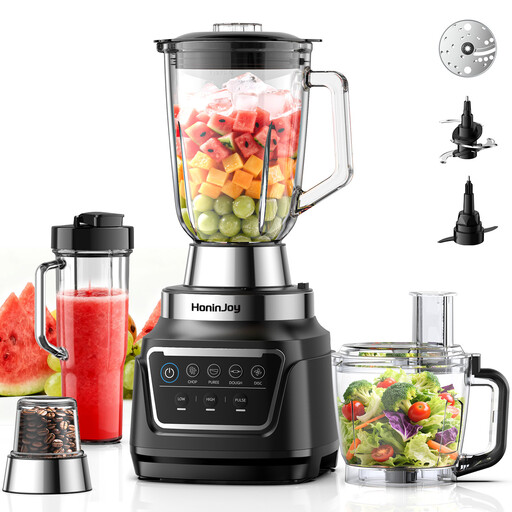
Why it suits this profile: This set is designed for anyone who wants to combine chopping, blending, grinding, slicing, grating and dough preparation in one appliance. The different bowls and containers let you choose the right one for each task.
The accessory list separately mentions a 1.5-litre blender jug, 2-litre processor bowl, grinder and sports cup. However, check in advance which parts you actually need.
According to the product description, 1300W maximum power, multiple containers and removable parts that are dishwasher-safe.
We have put together a complete, up-to-date list of products that fully meet these strict selection criteria and the applicable European safety regulations.
Before buying, make a short list of the tasks you regularly carry out. If you mainly process onions, carrots and cheese, a food processor with a chopper and grating and slicing discs will be more useful than an extensive blender. For smoothies, sauces and baby food, a powerful blender jug or stick blender with a mixing cup is the more logical choice.
Also check:
A food processor for dough should have a suitable dough hook or mixing function. A blending function alone does not make an appliance suitable for heavy kneading.
No. A blender is primarily designed for liquid preparations such as smoothies, soups and sauces. A food processor generally uses blades and discs for chopping, slicing and grating. A combination model may offer both functions, but check which accessories are included.
Its lifespan depends on use, maintenance, storage and workload. Use the appliance according to the manual, do not exceed the maximum quantities and allow the motor to cool when instructed. Replace damaged bowls, blades or cables in good time.
Power consumption depends on the wattage and operating time. A 1000-watt motor theoretically uses 1 kilowatt-hour when running continuously for one hour. In the kitchen, a food processor usually runs for much less time, so the actual cost per preparation depends on the total operating time and your energy tariff.
