
Vandaag of morgen in huis

Kwaliteit gegarandeerd

Welkomstaanbiedingen ontgrendelen: GRATIS bezorging | Tot 80% korting | Gratis 30 dagen JoyPlus-proefperiode
Download de app
A food processor can take much of the chopping work off your hands, but not every model suits every kitchen. A compact food processor is handy for a small batch of pesto or baby food, while a multifunctional kitchen machine is better suited to families and batch cooking. If you mainly mince meat, you will need different features from someone who kneads dough or makes smoothies.
The most important question is therefore not how many functions an appliance has on the packaging, but which tasks you carry out each week. This helps you avoid paying for accessories that end up unused in a drawer.
A motor power rating of 1,000 or 2,200 watts, for example, sounds impressive, but the result also depends on the shape of the bowl, blades, slicing discs and maximum operating time. An electric chopper with a lower power rating may work perfectly well for onions and herbs, but be less suitable for large quantities of dough or hard ingredients.
So check:
A 2-litre bowl does not mean you can always process 2 litres of food. With hard ingredients, meat or liquids, the practical filling capacity is often lower. An overfilled bowl will also produce a less even result.
For one or two people, a mini food processor of around 500 to 900 ml may be sufficient. For a family or preparing several meals at once, approximately 1.5 to 2.3 litres is more practical. If you mainly make dough, you should also look at the maximum dough capacity, not just the bowl capacity.
A kitchen machine with accessories may seem versatile, but every additional disc, jug or whisk needs to be stored and cleaned. Check whether the parts are dishwasher-safe and whether they fit inside the bowl. Also check whether a blender jug, vegetable slicer or meat grinder is actually included; sometimes a function appears in the product name, but the accessory version is limited.
For chopping and puréeing, making sauces and processing soft vegetables, a modest motor is often sufficient. For nuts, hard vegetables, meat or dough, a more powerful model with several settings and a pulse function is more useful. A pulse button delivers short bursts, giving you better control over the texture.
One example is the Bosch MCM3200W MultiTalent 3, with 800 watts, a 2.3-litre bowl and two speeds plus a pulse function. According to Bosch product information, the appliance is intended for tasks including chopping, mixing, slicing and grating.
Pay attention to the material of the blades and how they are secured. Stainless steel is a common choice for slicing and chopping blades. A locking mechanism prevents the bowl or lid from coming loose easily during use, but you should always assemble the appliance according to the instructions.
A glass bowl is sturdy and makes it easy to see the texture, but it may be heavier than plastic. Plastic is often lighter and easier to store. When preparing baby food or raw meat, check which parts can be used and cleaned separately. Do not use the same bowl for different ingredients without cleaning it thoroughly first.
Measure your worktop and kitchen cupboard before ordering. Do not just look at the height of the motor base, but also consider the space needed to use the feed chute. A compact food processor can remain on the worktop; a larger kitchen machine more often needs a permanent place.
According to the product information, the Kenwood MultiPro Go Blend FDP23.380GR has a 1.3-litre bowl, seven speed levels and a 600 ml personal blender. This makes a combination of blender and food processor appealing for anyone with limited space who still wants to prepare smoothies, sauces and sliced vegetables.

Why it suits this profile: The combination of 800 watts, a 2.3-litre bowl and basic functions is ideal for everyday preparation without moving straight to a large kitchen appliance.
The specifications clearly state two speeds and a pulse function. This means you do not have to rely on a high wattage alone.
2.3-litre bowl; 800 watts; chopping, mixing, slicing and grating.
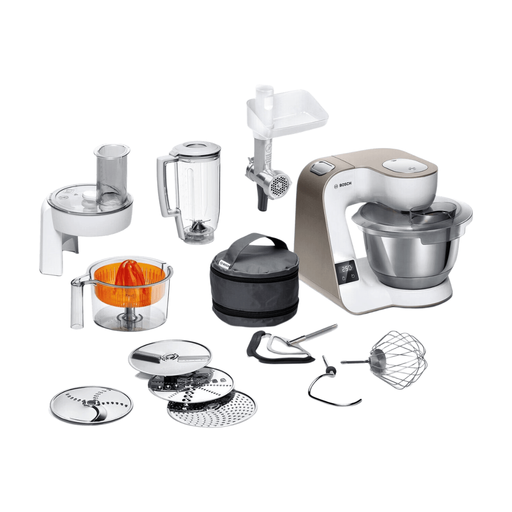
Why it suits this profile: This model is designed for households that want to do more than chop and slice, including mixing, kneading and weighing ingredients.
The included accessories are clearly listed, including a dough set, meat grinder, citrus press and blender jug. However, check which parts are included with your particular variant.
1,000 watts; seven speeds; integrated scales; 1.25-litre blender jug.

Why it suits this profile: The three stackable stainless steel bowls are practical for anyone who prepares vegetables, meat and purée separately.
The product information states a maximum operating time of 30 seconds per cycle. This makes the limitation clear during intensive use.
350 watts; 2.5, 2.2 and 1.8-litre bowls; two speeds; 304 stainless steel.
We have put together a complete, up-to-date list of products that fully meet these strict selection criteria and the applicable European safety regulations.
For small portions of fruit, vegetables or cooked ingredients, a baby food maker or mini food processor may be sufficient. According to the product information, the BC Babycare mini food processor has a capacity of 10 fl oz, a glass bowl and one-button operation. Its compact size of approximately 3.8 by 3.8 by 7.4 inches is particularly suitable for small preparations.
For this type of use, look for:
A food processor breaks food down, but it does not replace safe preparation, cooling or hygienic storage. Always follow the manufacturer’s instructions and only use sharp blades under adult supervision.
Only if the model has a blender jug or blender attachment. A standard chopping bowl is not always suitable for large quantities of liquid. Check the stated capacity and do not process hot liquids if the instructions do not allow it.
Its lifespan depends on use, maintenance, workload and the availability of replacement parts. Allow the motor to cool down if the instructions specify a maximum cycle, use the correct speed and check the blades and locks regularly. The statutory guarantee in the EU lasts for a minimum of two years; additional manufacturer terms may vary by brand and model.
Actual consumption depends on the power rating and operating time. An 800-watt appliance running for ten minutes theoretically uses less energy than when operating continuously for an hour. As many preparations are completed in short pulses, total operating time is usually more important than the maximum wattage alone.
