
Livraison le jour même et le lendemain

Qualité garantie

Débloquez vos offres de bienvenue: Livraison GRATUITE | Jusqu'à -80 % | 30 jours d'essai gratuits à JoyPlus
Téléchargez l'application
Food storage containers may seem straightforward, but you quickly notice when you have chosen the wrong one. A lid that does not close properly, a container that is too large for your fridge or plastic that is not suitable for the microwave can all cause daily frustration. Marketing terms such as “airtight” or “leakproof” also mean little if the closure, temperature limits and usage instructions are not clearly stated.
For households, students, meal preppers, parents and office workers, these are the main pitfalls to watch out for:
Start by considering the quantities you actually store. Small sizes are practical for herbs, nuts, fruit or sauces. Medium-sized food storage containers with lids are more useful for lunch or leftover pasta. If you regularly prepare meals in advance, you will usually benefit from several containers with the same dimensions or a logical range of sizes.
Square containers often make efficient use of space in a fridge or kitchen cupboard. Rectangular models fit neatly alongside one another and are suitable for longer foods or larger portions. Also check whether the containers are stackable and whether empty ones can be nested inside each other.
A clip-on lid with several locking points can help secure the lid evenly. For airtight food storage containers, check that the product information actually specifies a sealing closure. Also look for wide edges or tabs, which make opening easier when your hands are wet or cold.
For commuting or school, a compartmented lunchbox is useful when you want to keep different ingredients separate. A container with five compartments works differently from a set of separate meal prep containers. With wet dishes, it is still sensible to carry the container upright unless the manufacturer explicitly recommends transporting it otherwise.
When choosing plastic food storage containers, three questions are important:
According to the product information, the Curver Fresh & Go models in this selection are described as BPA-free and suitable for food contact in line with European food safety regulations. The stated usage range is -40 °C to +100 °C. This does not mean that every use is automatically safe: remove the lid when using the microwave and do not use these containers in a conventional oven. Always check the instructions on the product page and packaging.
With freezer-safe containers, leaving enough space above the food is useful because liquids can expand. Allow hot meals to cool before sealing and freezing them. This helps reduce condensation and unnecessary strain on the lid.
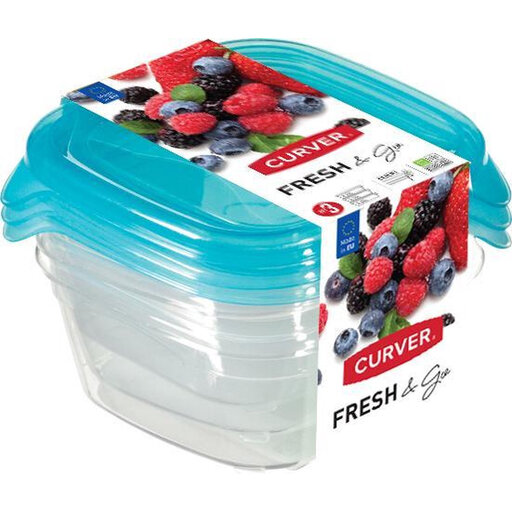
Why this suits the profile: The three compact 0.25-litre containers are suitable for snacks, nuts, sauces and small leftovers. This means you do not need to buy a large set with a range of different sizes straight away.
The small, fixed size prevents you from leaving unnecessary amounts of air and cupboard space around small portions. According to the product information, the containers are suitable for the freezer, microwave and dishwasher; the lid must be removed before heating.
Three identical sizes, a stackable design, snap-on lids with tabs and a stated temperature range of -40 °C to +100 °C.
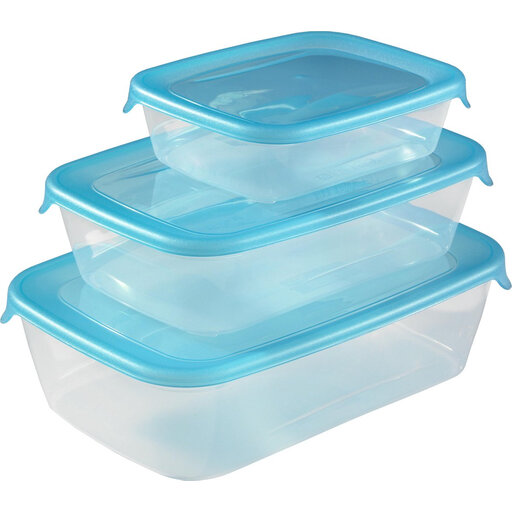
Why this suits the profile: The three different sizes offer greater flexibility for households that store both small side dishes and larger leftovers.
The range prevents you from using one impractical size for everything. The product information mentions snap-on lids, stackability and nestability, helping to keep storage more organised.
Sizes of 0.5, 1 and 2 litres, BPA-free plastic according to the product information, suitable for the freezer, microwave and dishwasher.
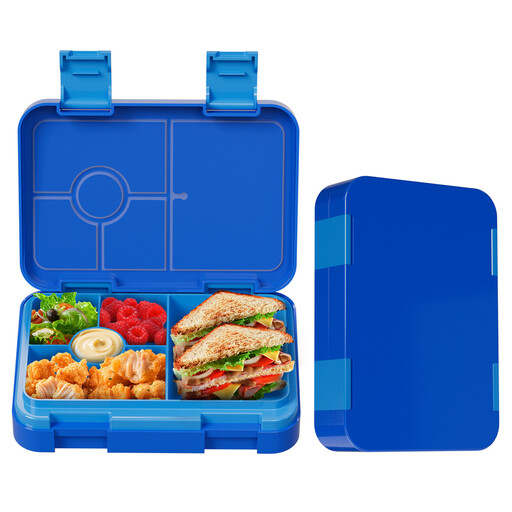
Why this suits the profile: The five compartments are designed for a lunch with multiple components, such as bread, fruit, snacks and side dishes. This makes it suitable for office workers, students and parents who want to carry separate portions.
The fixed compartment layout means you do not need several small containers for one lunch. The product name mentions double latches; check the current usage and cleaning instructions before buying.
Five separate compartments and double latches according to the product name. Available in blue; a pink version is also available.
We have put together a complete, up-to-date list of products that fully meet these strict selection criteria and the applicable European safety regulations.
A practical supply does not always have to be one large set. For example, consider:
A set of spice jars or storage containers with labels can be useful when you want to keep dry ingredients neatly organised. With this type of set, however, check which capacity, closure and material details are actually provided. An attractive appearance says nothing about how well the lids fit or whether the containers are suitable for moist foods.
No. Check the specific product information. The Curver containers mentioned above are stated to be suitable for microwave use, but the lid must be removed. Do not use plastic containers in a conventional oven unless this is expressly permitted.
Their lifespan depends on use, temperature, dishwasher cycles and the condition of the plastic. Regularly check containers and lids for cracks, distortion and closures that no longer fit properly. It is best to replace damaged containers.
That depends on your portions. Containers of around 0.8 to 1 litre are often practical for an individual meal, while 0.25 to 0.45 litres is suitable for snacks and side dishes. If you prepare a variety of dishes, you can choose a set with several sizes or a compartmented lunchbox.
