
Vandaag of morgen in huis

Kwaliteit gegarandeerd

Welkomstaanbiedingen ontgrendelen: GRATIS bezorging | Tot 80% korting | Gratis 30 dagen JoyPlus-proefperiode
Download de app
A food steamer can make cooking easier: vegetables, fish, rice and other ingredients are prepared with steam, often without additional cooking fat. However, not every electric food steamer or steaming pan is suitable for every kitchen. A compact model may not offer enough space for a family, while a large 3-tier steamer can be awkward if you have limited storage space.
Pay attention to marketing claims, too. Terms such as “healthy”, “professional” or “multifunctional” say little without clear product specifications. Below, you’ll find the key points to check before buying, along with models suited to different situations.
A 3-tier steamer may seem convenient, but the total capacity and dimensions of the individual tiers determine how much food you can actually prepare at once. So don’t just check the number of tiers; also look at the total capacity, diameter and height. For some dishes, a steaming basket that can hold a large plate or a whole fish is more practical than several small baskets.
During prolonged steaming, the water reservoir may run empty. If you have to dismantle the entire steamer to add water, you lose heat and steam. An external filling point or a clearly visible water-level indicator is therefore useful for meal prepping and family meals.
With a standalone steamer or stainless-steel steaming pan, the base must be suitable for your hob. Induction requires a magnetically compatible, composite base. Always check whether induction, gas, electric and ceramic hobs are explicitly listed in the product information. A model intended only for gas and electric cooking will not automatically work on induction.
For one or two people, an electric steamer of around 2 to 3 litres may be sufficient. Families will generally benefit more from 6 litres or above, especially if you want to prepare vegetables and a main course at the same time. With larger pans, consider the available space in your kitchen cupboards and the weight when the pan is full.
A capacity of 9 to 14 litres may be suitable for large portions, fish, several types of vegetables or batch cooking. However, the stated capacity is not always the same as the usable cooking space. Stackable trays and a well-fitting lid help distribute the steam efficiently.
304 stainless steel is often used for steaming pans and baskets. The material is corrosion-resistant and suitable for contact with food when the product is used according to the instructions. Also check the handles, lids and connections. Heat-resistant silicone handles can make the pan easier to grip, but they will still become hot during use.
Plastic steaming trays can be lighter and easier to store. Check whether the manufacturer states that the components are suitable for food contact and whether they are dishwasher-safe. If the product has a non-stick coating, it is best to avoid metal utensils and abrasive sponges.
A timer with automatic shut-off prevents the appliance from heating unnecessarily. A transparent lid or viewing window allows you to monitor progress without repeatedly lifting the lid. Also look for:
Steam can cause burns. Use a food steamer on a level surface, keep children away and lift the lid away from you when opening it.
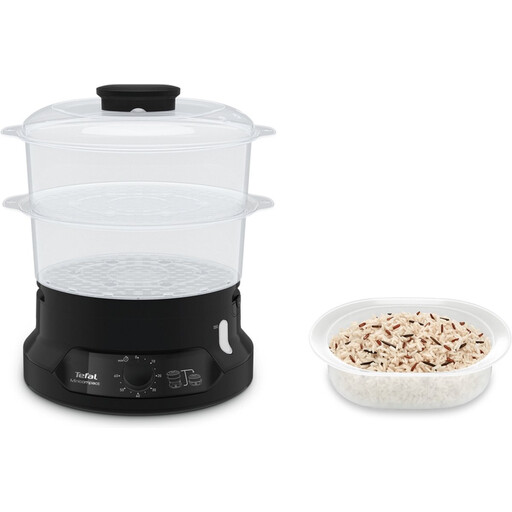
Why it suits this profile: The 6-litre capacity provides space for small to medium-sized households. The stackable trays are practical when you have a compact kitchen.
The product description states that it has a timer of up to 60 minutes, automatic shut-off and a water-level indicator. This means you don’t have to rely solely on cooking time or marketing terms.
800 W, 6-litre capacity, rice bowl and the option to refill during steaming, according to the product information.
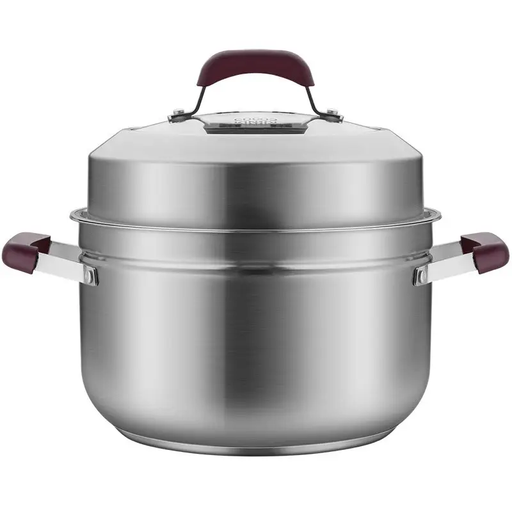
Why it suits this profile: This spacious pan is designed for families and cooks who want to use one pan for steaming, cooking, pasta, soup and grains.
The specifications list a 24 cm diameter, 10.5-litre capacity and compatibility with gas, electric, ceramic and induction hobs. This makes it easier to check whether it is suitable for different kitchens.
304 stainless steel, transparent lid, heat-resistant handle and multifunctional use according to the product description.
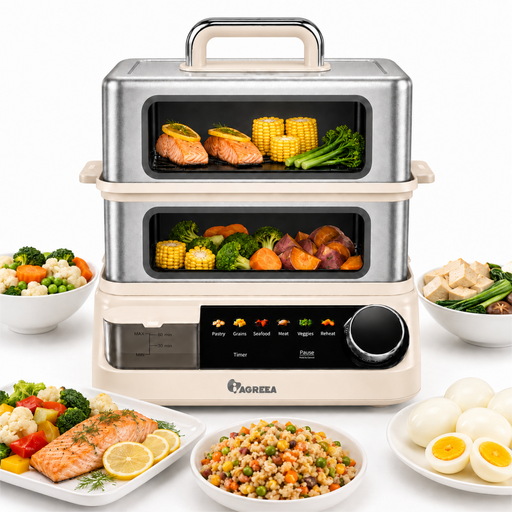
Why it suits this profile: The two tiers and large capacity are designed for family meals, larger portions and preparing several ingredients in one cooking cycle.
The product information lists two stainless-steel trays, an external 2.5-litre water reservoir and six presets. You can compare these features with your cooking routine before buying.
14-litre capacity, 2000 W, viewing windows and two separate steaming levels according to the product description.
We’ve put together a complete, up-to-date list of products that fully meet these strict selection criteria and the applicable European safety regulations.
Place ingredients with the longest cooking time at the bottom or closest to the heat source. Cut vegetables into similarly sized pieces so that they cook more evenly. Don’t pack the trays too tightly; steam needs to be able to circulate. Use rice and grains in a lidded rice bowl when one is included.
When using a steamer pan on induction, you generally shouldn’t set the hob any higher than necessary to maintain a constant flow of steam. Excessive heat can cause discolouration or boil the pan dry. Check the water level during cooking and use oven gloves when moving hot components.
Clean a stainless-steel steamer with mild washing-up liquid and avoid metal scouring pads. If limescale builds up, the manufacturer’s maintenance instructions may help. Components of an electric food steamer should only be put in the dishwasher if this is explicitly stated.
It depends on the power rating, cooking time, amount of food and energy tariff. An 800 W electric food steamer theoretically uses 0.8 kWh in one hour, although actual consumption may be lower if the appliance switches off intermittently. Compare the power rating and cooking time rather than just the purchase price.
The lifespan depends on the material, frequency of use, limescale build-up and maintenance. A stainless-steel steamer pan has no electrical heating element, but the handles and lid can still wear out. With an electric model, regular descaling, correct filling and careful handling of the cord and base are important.
A standalone steamer or steaming basket is suitable for induction when the manufacturer explicitly states induction compatibility. Also check the diameter of the base. Electric models use their own heating element and do not need to sit on an induction zone. Checking the product specifications is more important here than relying on the general term “steamer”.
