For a cookery workshop, choosing between a compact food slicer and a larger slicing machine depends mainly on the size of the roast beef, the slice thickness you want and how many slices you’ll be cutting in one go. A compact machine generally needs less worktop space; according to the stated specifications, a larger model may offer more room for slicing, but it also needs a dedicated spot and space for cleaning. Check, too, that the controls, food holder and safety guard suit the people who’ll be using the machine.
Which slicing machine is right for you?
Workshop host serving roast beef
You want to be able to adjust the slice thickness and check that the planned piece of meat fits on the carriage, while keeping safe use in mind. Among the model specifications compared here, HENDI lists a food holder and blade guard; other models have their own usage requirements.
Workshop leader supervising participants
Consider the food holder, safety guard, controls and the space around the machine when participants will be slicing themselves. Arboportaal also explains that rules for safe working are relevant when machinery and work equipment are used in a work setting.
Organiser planning several rounds of slicing
You’ll want to clean parts between rounds and keep raw and cooked ingredients separate. The Voedingscentrum recommends using clean equipment and keeping raw and cooked food separate; food safety rules may also apply if you’re selling food.
What should you consider when choosing?
Start by checking the size of the roast beef and the slice thickness you want. Then consider your workspace, whether participants will operate the machine and how you’ll clean it between rounds.
Compact food slicer
A good fit when: the meat fits on the carriage and you’ll be slicing in short sessions. Compare the stated operating time, too: ritter lists a duty cycle of 5 minutes for the E 16.
Keep in mind: according to the manufacturer, the ritter E 16 is intended for domestic, non-commercial use. So don’t assume that every compact model is suitable for every workshop.
Larger slicing machine
A good fit when: the size of the meat and your planned slicing rounds call for more room to slice. HENDI states that the Profi Line 250 has a maximum slicing diameter of 180 mm.
Keep in mind: HENDI lists the weight of this version as approximately 16 kg. The manufacturer states both a slicing thickness of up to 12 mm and a maximum of 10 mm in the specifications table; check the range if thicker slices are important.
| What to consider |
What to check before buying |
Who is this important for? |
| Slice thickness and grip |
Check the adjustment range, food holder and which blade comes with the exact version. An adjustment range alone doesn’t guarantee a particular slicing result. |
I want to be able to adjust the slice thickness and hold the meat firmly on the carriage for the slices I want to serve. Around 31% of consumers give control over slice thickness top priority. |
| Participant operation |
Check the food holder, safety guard, controls, stability of the setup and the manual for the exact model. |
If participants will be slicing themselves, I want the machine set up safely, with clear controls and protection. Around 25% of consumers put participant safety first. |
| Cleaning between rounds |
Check the manual for instructions on dismantling and cleaning parts; set aside clean equipment for raw and cooked food. |
When switching between ingredients, I want to be able to clean the machine thoroughly between rounds and keep raw and cooked food separate. Around 25% of consumers prioritise hygiene between slicing rounds. |
| Size and slicing workload |
Measure the meat and the available workspace, then compare them with the model specifications and your planned slicing rounds. |
I want to know in advance whether the meat will fit on the carriage and whether there’s enough room to position the machine safely. Around 19% of consumers focus mainly on fit, workspace and slicing workload. |
Which buying mistakes can you avoid?
-
Choosing based only on wattage or the product title
A Joybuy product title for the Clatronic MA 3585 lists 500 W, while the specifications table and Clatronic state 150 W.
Compare the full model code and product specifications. Check the blade, carriage and intended use, rather than looking at wattage alone.
-
Assuming a serrated blade is a smooth meat blade
The blades supplied vary by version: FRITEL lists a serrated blade for the SL 3657, while Severin lists a slicing blade for the AS 3915.
Check what’s included and what each blade is intended for before you order.
You may need to buy a different blade separately, if the manufacturer offers one for the model.
-
Using a domestic model in a commercial workshop without checking first
The manufacturer limits the ritter E 16 to domestic, non-commercial use. This matters if the workshop takes place in a commercial setting.
First, establish where the machine will be used and read the manual for your chosen model. Don’t rely on a description such as ‘professional’ alone.
Brands to compare
HENDI
The Profi Line 250 is a larger slicing machine to compare if size and a dedicated workspace are important considerations.
- According to HENDI, version 210000 has a 250 mm blade, a food holder, a blade guard and removable parts for cleaning.
- HENDI lists both a slicing thickness of up to 12 mm and a maximum of 10 mm in the specifications table. Check which range applies to the version on offer.
Severin
The AS 3915 is worth comparing if you want to slice roast beef and other ingredients, and are considering a separate slicing blade.
- Severin lists a removable blade, an included slicing blade and continuously adjustable slice thickness from 0 to 15 mm.
- Check the contents and instructions for the exact version; the stated specifications don’t guarantee a particular result when slicing your roast beef.
ritter
The E 16 is a domestic model to consider for short slicing sessions.
- ritter lists a 17 cm blade, a carriage travel of approximately 18 cm and a duty cycle of 5 minutes.
- The manufacturer specifies domestic, non-commercial use. Bear this restriction in mind when choosing a machine for a workshop.
FRITEL
The SL 3657 is a metal food slicer to compare if you want to slice bread or other ingredients as well as meat.
- FRITEL lists a 170 mm blade, a removable carriage with a food holder and a slicing thickness of 0 to 20 mm.
- According to FRITEL, the supplied blade is serrated and isn’t dishwasher-safe. Don’t assume a smooth meat blade is included.
Clatronic
The MA 3585 is a food slicer with a serrated blade to compare with other compact models.
- Clatronic lists a 190 mm serrated blade, an adjustment range of 0 to 15 mm and a power rating of 150 W.
- A Joybuy product title lists 500 W, while the specifications table states 150 W. Check the details for the exact version before choosing based on power.
Electric food slicers at Joybuy
These electric food slicers are options to compare for slicing meat and other ingredients. For each model, consider the blade, adjustment range, controls and the space you have available.
 No product image available
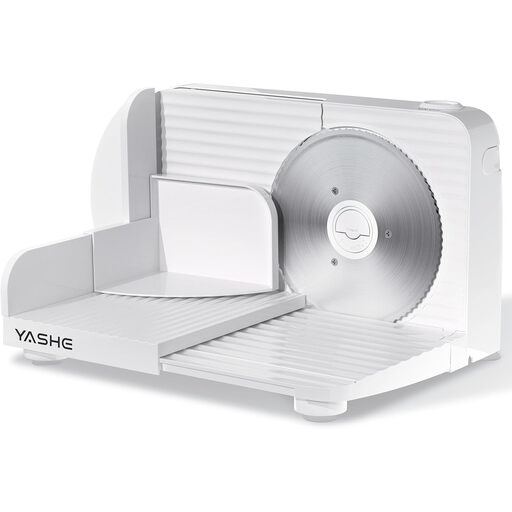
YASHE SL-5801D23B3, 180 W
Worth comparing if adjustable slice thickness and features for guiding meat are important to you.
- Adjustable slice thickness from 0 to 15 mm.
- 17 cm blade and removable parts.
- The description lists a food pusher, safety switch and non-slip feet.
View at Joybuy
 No product image available
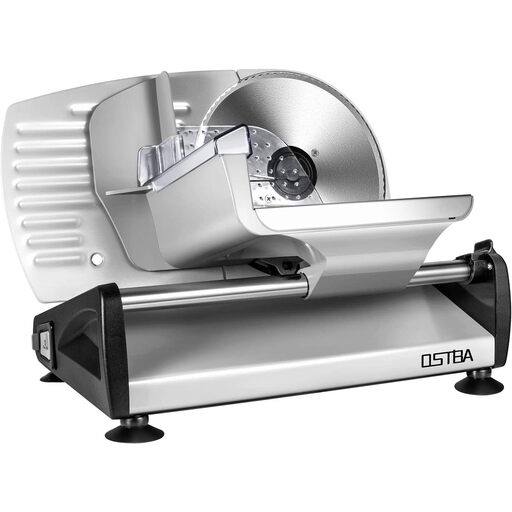
OSTBA SL518, 150 W
Worth comparing if you want to consider an adjustable slicing range and a food guide for slicing meat.
- 19 cm blade and adjustable slice thickness from 0 to 15 mm.
- The description lists a food guide and a lock that is operated together with the on button.
- The description states that the parts are removable.
View at Joybuy
 No product image available
ritter serano⁷ Professional
Worth comparing if you want to assess a smooth blade for meat and a wider adjustment range against your own slicing needs.
- The product description states a slicing thickness of up to 23 mm.
- The product description lists a 24 cm cutting path, a collection tray and a removable carriage.
- The controls are described as having a momentary setting and a continuous operation setting.
View at Joybuy
 No product image available
FRITEL SL 3110, 100 W
Worth comparing if you’re weighing up a foldable design and serrated blade for slicing meat and bread.
- 170 mm blade diameter and adjustable slice thickness from 0 to 15 mm.
- The description lists a removable carriage and food holder.
- The blade is described as serrated.
View at Joybuy
Frequently asked questions
Can everyone use the same slicing machine during the workshop?
Make sure the machine is used according to the manual, with supervision, a stable workspace and safe cleaning arrangements. If employees operate the machine, rules on work equipment and protection against cutting hazards are also relevant; a private workshop isn’t automatically considered the same type of work setting.
How can you stop raw meat from contaminating sliced roast beef?
Keep raw and cooked food separate and use clean equipment. The Voedingscentrum recommends cleaning shared equipment thoroughly between uses; also follow the machine’s manual when dismantling the slicer.
Do you always need a food safety plan for a cookery workshop?
Not simply because an event is called a workshop. The NVWA outlines food safety obligations for businesses and for individuals who sell food or drink to consumers. These include working with an HACCP-based plan or a hygiene code. Check whether, and how, your activity falls under food sales.
How long can you keep cooked roast beef?
The Voedingscentrum recommends keeping opened cooked roast beef in the fridge for two days and not leaving leftovers out of the fridge for more than two hours. For an unopened pack, follow the label.
Which product marking should you check before buying?
Products that fall under an EU product category requiring CE marking must carry the prescribed marking before they are placed on the market. Check the marking and product documentation for the exact machine; a CE logo on its own doesn’t prove that participants can slice safely without instruction.


