
Fan of thinly sliced meat
You mainly slice chilled, cooked meat for sandwiches or a sharing platter, and want to choose a blade that suits the job.


For thin slices of chilled, cooked pork, a smooth meat slicer blade with adjustable thickness is a sensible choice. Check that the blade is compatible with the exact model. If you also want to slice bread or store the machine compactly, compare the supplied blade and the design. Bear in mind that product specifications don’t guarantee a particular cutting result.
You mainly slice chilled, cooked meat for sandwiches or a sharing platter, and want to choose a blade that suits the job.
You want to use the same machine for lunch and bread, so you’re comparing the blades supplied with it.
You use the machine now and then and want to be able to store it compactly afterwards.
Choose this when: thin slices of soft, cooked meat are your main priority.
Trade-off: Ritter describes this blade as suitable for soft foods, but not for bread.
Choose this when: you want to use one machine for meat and foods such as bread.
Trade-off: a universal or serrated blade isn’t automatically the same as a smooth meat slicer blade for thin slices.
Choose this when: you use the machine occasionally and compact storage matters.
Trade-off: check that the supplied blade shape is right for the slices you want to make.
| What to consider | What should you look for? | Who should pay particular attention? |
|---|---|---|
| Thin slices of meat | Check the blade shape, whether a smooth meat slicer blade is compatible with the exact model, and the thickness range specified by the manufacturer. Ritter describes a smooth blade for thin slices of soft foods. | If I mainly want to slice cooked meat thinly, I’ll start by checking the blade and thickness setting; around 33% of consumers prioritise thin slices of meat. |
| Cleaning after use | Check the manual to see which parts can be removed and how to clean them. Also check how to use the food holder. | If I want easy access to the parts after slicing meat, I’ll check the cleaning instructions; around 27% of consumers say cleaning is their top priority. |
| Slicing meat and bread | Compare the blades supplied and check whether any other blades are compatible with the exact model. | If I want to use the same machine for lunch and bread, I’ll check the blades supplied; for around 20% of consumers, using it for different foods is the top priority. |
| Compact storage | Check whether the model folds and look at its dimensions and the shape of the blade supplied. | If I only use the machine occasionally, storage space could be the deciding factor; around 20% of consumers give it top priority. |
Blade shape matters: Ritter describes a smooth ham or meat slicer blade for soft foods and thin slices, but not for bread.
Start with what you’ll use it for most, then check which blades are included with the exact model and which are compatible.
The SL 3110 and SL 3657 differ in features such as storage and blade type. Compare them based on your main use and the space you have available.
Worth considering if you’re mainly weighing up which blade is right for soft meat or different types of food.
The AS 3915 is a useful comparison if you’re considering a metal multi-purpose slicer that the manufacturer lists with a meat slicer blade.
The DO522S is worth considering if the height of the food you’re slicing and use with different types of food matter to you.
The Master M20F is an option to compare if you’re interested in the stated fine adjustment and want to factor in slicing meat.
These Joybuy products are multi-purpose food slicers with a universal or serrated blade. Compare the blade shape with the thickness of slice you want, especially if you want to slice soft meat thinly.
 Image unavailable
Suitable for slicing meat and other foods; the product description mentions meat.
Universal blade; adjustable range 0–20 mm; blade diameter Ø 19 cm; 150 W; carriage at 15°.
The product description limits continuous use to 10 minutes, followed by 30 minutes to cool down.
Before buying, check that the blade shape is right for the thin slices you want to make.
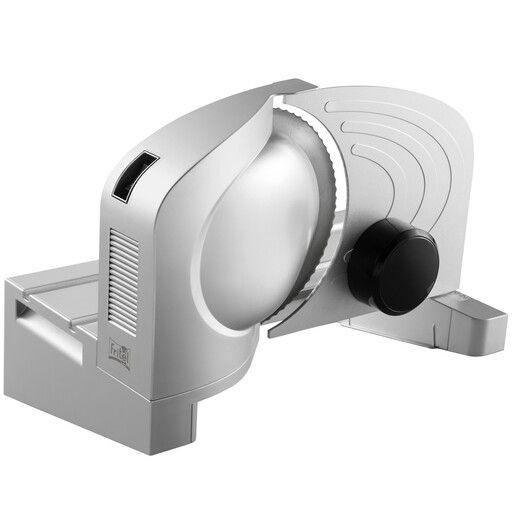 Image unavailable
An option to compare if you want to use the same machine for meat and bread.
Serrated blade; adjustable range 0–20 mm; blade diameter Ø 17 cm; 160 W; carriage at 15°.
A serrated blade isn’t the same as the smooth meat slicer blade Ritter describes for thin slices of soft foods. Check which blade shape suits your needs.
 Image unavailable
Suitable for occasional use when compact storage matters; the product description lists a folding design.
Serrated blade; adjustable range 0–15 mm; blade diameter Ø 17 cm; 100 W.
Check that the serrated blade is suitable for the cooked meat slices you want.
Store cooked meat in the fridge and use it within two days, advises the Netherlands Nutrition Centre. Take small portions out of the fridge for your meal. According to the Netherlands Nutrition Centre, you should throw away perishable food that has been left out of the fridge for more than two hours.
It depends on the blade: Ritter describes a smooth ham or meat slicer blade for soft foods and thin slices, but not for bread. Check which blades are included with the exact model and which are compatible.
For a consumer purchase in the Netherlands, the seller is responsible for the statutory guarantee if the product doesn’t meet the standard you could reasonably expect, according to ACM ConsuWijzer. A manufacturer’s guarantee doesn’t replace this right; what applies in your situation depends on the circumstances of the fault.
CE marking is required for electrical products placed on the market in the Netherlands, according to the Netherlands Food and Consumer Product Safety Authority. The marking is the manufacturer’s declaration that the product meets the applicable requirements; it isn’t the same as an independent inspection required for every consumer product. Check the marking on the specific model.