
Vandaag of morgen in huis

Kwaliteit gegarandeerd

Welkomstaanbiedingen ontgrendelen: GRATIS bezorging | Tot 80% korting | Gratis 30 dagen JoyPlus-proefperiode
Download de app
A food slicer can be handy for bread, cheese, cold meats and vegetables, but not every model is right for every kitchen. An electric slicer takes up more space, while a mandoline or vegetable slicer may be cheaper and simpler. The right choice depends mainly on what you slice most often, how much control you want over slice thickness, and how important cleaning and safety are to you.
A higher wattage doesn’t tell you everything about how easy a machine is to use. Its construction, drive system, stability and blade all affect how well it performs. A model with a metal housing and metal food holder may feel quite different from a lightweight machine with a plastic base.
Check the recommended operating time too. According to the product information for the Fritel SL 3710, the motor can run for a maximum of ten minutes at a time, followed by a cooling period. This matters if you want to slice a lot of bread or cold meats in one go.
A budget vegetable or potato slicer may be perfectly suitable for chips, cucumber slices or grated carrot. But for bread and cold meats, you’ll usually need more control. Without adjustable slice thickness, slices may be too thick for sandwiches or too delicate for soft bread.
So check not only whether the thickness is adjustable, but also the range. Some electric models range from 0 to 15 mm, while others offer a range of up to 20 or 23 mm.
A sharp blade, a loose carriage or a hard-to-reach cutting area can make everyday use unnecessarily difficult. Before you buy, look for:
Whichever type of slicer you choose, you’ll still need to handle it carefully. Always use the food holder with an electric slicer, and unplug it before removing the blade.
An electric slicer is especially suitable for regular use and larger quantities. Think bread for a family, cheese for a sharing platter or cold meats for several sandwiches. A meat slicer with a suitable smooth or serrated blade may be more practical for this than a standard bread slicer.
A manual mandoline, multi-purpose vegetable slicer or potato slicer usually takes up less space and doesn’t need electricity. These tools are particularly suitable for vegetables, fruit and potatoes. However, the slicing speed depends entirely on your own movement and how stable the tool is.
A stainless steel slicer is worth considering if you want a surface that’s relatively easy to clean and can withstand daily contact with moist ingredients. Also check the type of blade:
Always check what’s actually included. A product photo may show several accessories, while the product description lists just one blade.
Measure the available space beforehand. According to the product specifications, the Fritel SL 3655 is 40 cm long, 30,6 cm deep and 26,3 cm high. At 42 cm long, the Fritel SL 3710 is slightly larger. Blade size matters too: the models mentioned have blade diameters of 17 and 19 cm respectively.
A carriage angled at 15 degrees can make it easier to feed ingredients into the machine. This is a technical feature, not a guarantee of a particular slicing result. The final result also depends on the ingredient, the pressure you apply and how you use the food holder.
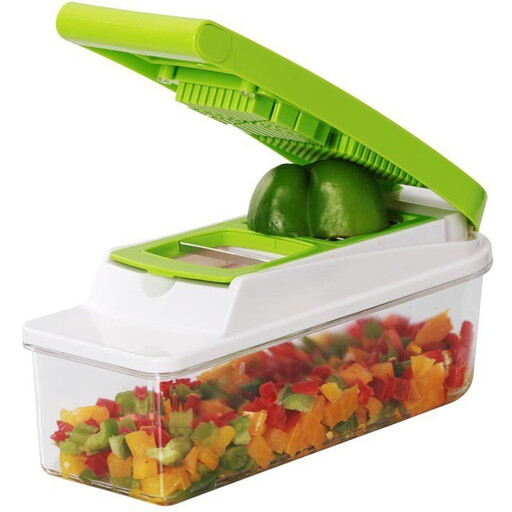
Why it suits this type of user: This manual set is designed for everyday slicing and grating of ingredients such as cucumber, onion, carrot and cheese. The included collection container helps you gather ingredients as you prepare them.
The product information lists five cutting techniques and a collection container, so you won’t need a separate tool for every vegetable. It’s still a manual solution, not a replacement for an electric meat slicer.
Five cutting techniques, stainless steel blades and a collection container; dimensions 31,2 x 11,5 x 14 cm.
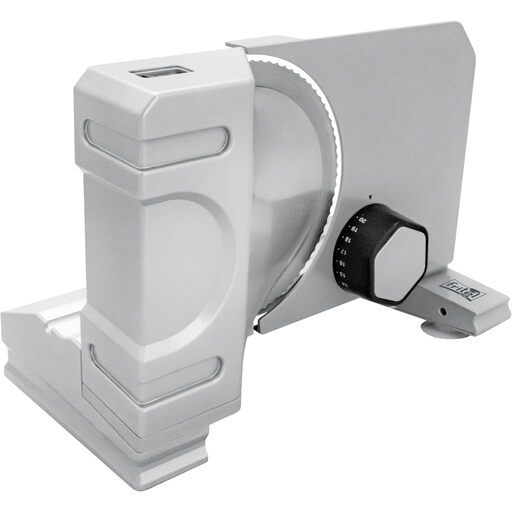
Why it suits this type of user: According to the product description, this model is designed for bread, cheese, cold meats, vegetables and charcuterie. It’s a good fit if you’re looking for one electric slicer to handle a range of ingredients.
According to the product specifications, the slice thickness is continuously adjustable from 0 to 20 mm. A food holder, non-slip feet and a switch with momentary and continuous settings help you use it with control.
190 mm blade, metal housing, carriage angled at 15 degrees and slice thickness of 0-20 mm.
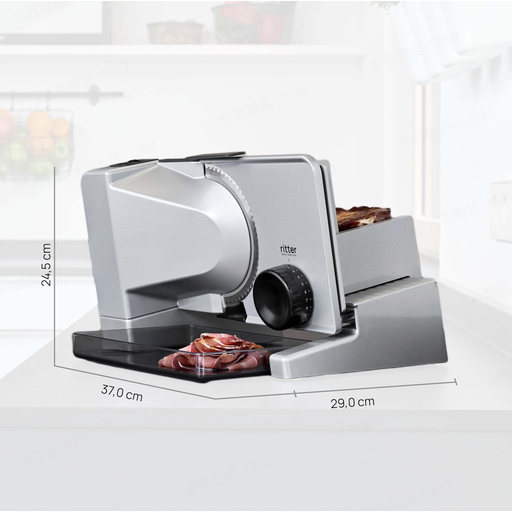
Why it suits this type of user: According to the product description, this model has a metal construction, an angled design, electronic speed control and blades for different slicing tasks. It could suit frequent use for bread, meat, cheese and vegetables.
The product description mentions a removable carriage, a collection tray and a safety switch. Before buying, check that you have enough space and confirm which blades are included.
Slice thickness of up to 23 mm according to the product information, electronically adjustable speed and a 24 cm cutting path.
We’ve put together a complete, up-to-date list of products that meet these strict selection criteria and the applicable European safety regulations.
Consumers in the European Union are generally covered by a statutory guarantee of conformity. The seller handles any faults in accordance with the applicable process. Always check the latest instructions, product page and supplied safety information too.
It can be, if the product information lists both uses and the blade is suitable. A serrated blade is often recommended for bread, while a smooth blade may be included for meat or cheese. So check the blade and maximum slice thickness before you buy.
A low setting is useful for thin slices of cold meat and cheese. You may need a wider range for sandwiches, baguettes or thicker slices of vegetables. In practice, an adjustable range of 0 to 15 or 20 mm gives you more choice than a fixed setting.
The cost depends on its power and how long you use it. A 150 to 180 watt model uses relatively little electricity when run for short periods; total consumption mainly depends on how long and how often you switch it on. Remember to factor in cleaning, storage space and any replacement blades too.
