
Vandaag of morgen in huis

Kwaliteit gegarandeerd

Welkomstaanbiedingen ontgrendelen: GRATIS bezorging | Tot 80% korting | Gratis 30 dagen JoyPlus-proefperiode
Download de app
A food slicer can slice bread, cheese, cold meats and vegetables more quickly and evenly. However, not every model is suitable for everyday use. A machine with an impressive range of features may be awkward to clean, while a compact manual slicer may not have enough capacity for a family.
Look out for these three common pitfalls:
An adjustable slice thickness is useful for bread, cheese and cold meats. With a range of 0 to 20 mm, you can make thin slices for dishes such as carpaccio, or thicker slices for sandwiches. The ideal thickness also depends on how firm the food is and the type of blade you use.
A serrated blade is handy for crusty bread and firmer foods. A smooth blade may be better for finely slicing cold meats. Some models come with two blades. According to the product information, the Severin AS 3915 has a serrated blade and an additional smooth blade.
With a cheese or meat slicer, it is important to keep the food firmly against the stop. A food pusher helps keep your fingers away from the blade.
A metal housing or metal sliding plate may feel sturdier than an all-plastic model. That does not mean plastic is unsuitable: for a lightweight vegetable slicer or kitchen grater, it can be a handy choice because it weighs less.
At the very least, check for:
An electric slicer generally takes up more space than a mandoline vegetable slicer. Measure the space on your worktop beforehand and check where you will store the appliance after use.
Food can easily get caught around the blade, sliding tray or collection container. A model with removable parts is therefore more practical than one that can only be wiped clean on the outside.
Always follow the instructions. According to the stated usage instructions, the Fritel Slicer SL 3710 must not run continuously for more than 10 minutes and must then be left to cool for 30 minutes. After use, turn the control back to setting 0. Details like these matter more than the wattage on the packaging alone.
A manual slicer, food grater or vegetable slicer does not need motor cooling, but it does require controlled pressure and a good hand guard. Children should never use sharp blades unsupervised.
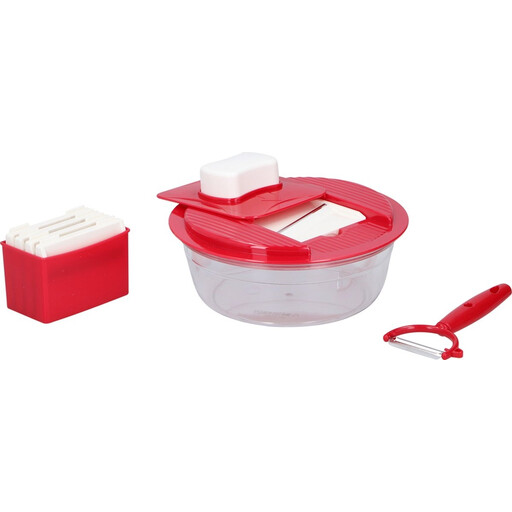
Why it suits this profile: This manual kitchen grater is ideal if you want to grate and slice different ingredients without a motor. The collection container helps keep your worktop tidy.
The set contains seven pieces, including a collection container, various grating and slicing blades, and a safety holder. This makes each function clearer than with a set of accessories that are difficult to identify.
Stainless steel blades, a collection container, and options for coarse and fine grating. The product information recommends cleaning with a damp cloth.

Why it suits this profile: This electric slicer is designed for people who regularly slice bread, cheese, cold meats, fruit and vegetables.
The product description lists a removable tray, a serrated blade and an adjustable slice thickness of up to 20 mm. This makes it possible to check the key features rather than relying on marketing terms alone.
Cantilevered metal construction, a safety glass base plate and a sliding tray with an 18 cm cutting path, according to the product information.
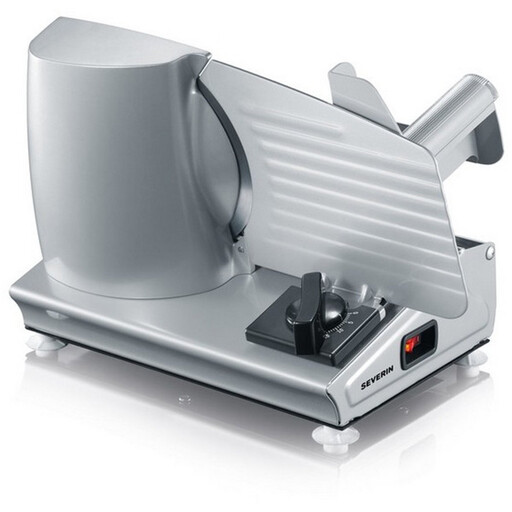
Why it suits this profile: This combined meat and bread slicer is designed for households that regularly prepare different types of food and want to switch between blades.
The slice thickness is continuously adjustable from 0 to 15 mm, and the slicer has a finger guard. The rubber feet help keep the appliance in place during use.
180 watts of power, metal construction, a smooth and serrated blade, and a stainless steel sliding plate, according to the product specifications.
A compact vegetable cutter may be a better choice if you mainly prepare cucumber, potato, carrot, fruit or cheese. The 5five Multifunction Vegetable Slicer Set includes five cutting options, a collection container and stainless steel blades. For simple peeling, the PURECOOK set with three double-sided 304 stainless steel peelers is a practical option. Always use a mandoline or julienne slicer with the hand guard supplied.
We’ve put together a full, up-to-date list of products that meet these strict selection criteria and the applicable European safety regulations.
Power consumption depends on the motor’s wattage and how long you use the appliance. A 180-watt appliance running for 10 minutes would theoretically use around 0.03 kWh. In practice, a slicer usually runs for less time. Consider cleaning time and maintenance as well as energy use.
A range of around 0 to 15 or 20 mm is versatile for bread and cold meats. Thin slices require a stable stop and an even motion. A serrated blade can be useful for thicker bread or firmer foods.
Its lifespan depends on the materials, maintenance, how often you use it and whether you follow the instructions. Clean the appliance after use. For electric models, unplug it before removing the blade, and store sharp parts safely. In the European Union, consumers are covered by the legal guarantee under the applicable rules. If there’s a problem, check the terms of purchase first and contact the seller.
