
Home baker with limited workspace
You want to make pastry for a savoury tart, but the appliance also needs to fit on a narrow worktop or in a small cupboard.


For pastry for a mushroom tart in a narrow kitchen, a food processor with a pulse function and a bowl suited to your recipe is a practical starting point. Measure the space for the appliance and its separate parts, too. A larger bowl and slicing attachments may be useful if you often prepare the filling as well, while mixing by hand is worth considering if you only bake tarts occasionally. Bowl capacity and features alone don’t prove how well a model will mix your particular pastry.
You want to make pastry for a savoury tart, but the appliance also needs to fit on a narrow worktop or in a small cupboard.
You want to chop, slice or grate vegetables as well as make pastry, so you’re considering the bowl and the attachments supplied.
You don’t make tarts often and want to weigh up whether mixing by hand is more practical than using an appliance with separate parts.
First, compare the pulse function and the amount of pastry in your recipe with the model specifications. Then measure the space for the appliance, as well as room for the bowl and attachments.
| What to consider | What should you check? | Who is this important for? |
|---|---|---|
| Mixing pastry briefly | Check whether the exact model has a pulse function and whether the blade supplied is suitable for the task described. | If I want to work the butter into the flour gradually and stop at the right time, control over the mixing is my top priority. Around 33% of relevant consumers prioritise control over the pastry. |
| Worktop and cupboard space | Measure the width, depth and height of the available space; leave room for the bowl and parts, too. | In a narrow kitchen, I want to know whether there’s room for both the appliance and its separate parts before I choose. This is the main priority for consumers who focus on available worktop and storage space; they make up around 27%. |
| Amount per batch | Compare the total amount in your recipe with any stated pastry limit. Don’t use bowl capacity in litres as a substitute for a pastry limit. | If I want to mix my whole recipe in one go, the stated pastry capacity needs to be suitable. Around 20% of consumers prioritise the amount they can make per batch. |
| Filling and cleaning | Check which slicing and grating discs are included, and follow the manufacturer’s cleaning instructions for each part. | If I also want to prepare vegetables for the filling, I check whether the extra attachments support that use and are easy to store. Around 20% of consumers want to prepare both the pastry and filling. |
A power rating isn’t a measured result for shortcrust pastry. The Consumentenbond mainly describes tests of food processors for slicing, grating and chopping; those results don’t automatically tell you how an appliance mixes this type of pastry.
Look at the pulse control, the amount in your recipe and the capabilities stated for the exact model. Don’t treat a general test score as proof of how it will perform with pastry for a mushroom tart.
A bowl’s capacity in litres doesn’t tell you how much pastry you can process at once. For example, Bosch lists the MCM3200W as having a 2.3-litre bowl and a separate maximum pastry capacity of 0.8 kg. The liquid capacity of another model isn’t a pastry limit.
Look up the pastry limit for the exact model and compare it with the weight of your full recipe.
An appliance also needs space while in use, as well as room for the bowl and separate attachments. The parts supplied vary by version.
Measure the available height and storage space, too, and check what comes with the version you’ve chosen.
The MultiPro Go FDP22.140GY is a compact model with a 1.3-litre bowl and accessories for a range of kitchen tasks.
The MultiTalent 3 MCM3200W combines a stated maximum pastry capacity with a 2.3-litre bowl.
According to Braun, the PurEase FP3132BK has a pulse function, a 2.1-litre bowl and a dough tool supplied.
According to Magimix, the Mini Plus has a 1.7-litre bowl and a small 0.5-litre bowl.
These models are worth considering when comparing food processors for pastry preparation and additional mixing, chopping, slicing or grating tasks. For each version, check that the dimensions, bowl and attachments supplied suit your recipe and kitchen.
 No image available
A possible choice if you’re looking for a compact food processor that also has a blender function; check that its dimensions suit your kitchen.
The product information lists a 1.3-litre bowl, a kneading function and dimensions of 37.9 × 33.8 × 23.4 cm.
 No image available
A relevant option if you want to make other baking recipes as well as pastry; take the bowl and accessories supplied into account when choosing.
The product information lists a 3.9-litre bowl, an integrated scale and a patisserie set.
Pulse control and a capacity of up to 2.7 kg of cake batter are also listed; that amount applies to cake batter and not automatically to tart pastry.
 No image available
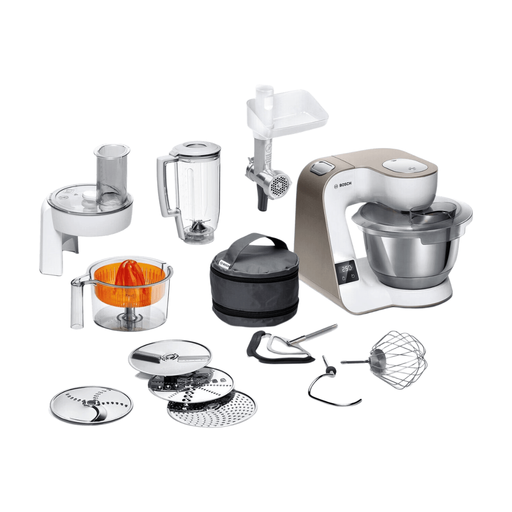
Worth considering if you want to compare a stated pastry limit with the amount in your full recipe.
Bosch lists a 2.3-litre bowl and a maximum pastry capacity of 0.8 kg for the MCM3200W.
The stated dimensions are 375 × 220 × 260 mm (h × w × d); check that they fit the space you have available.
 No image available
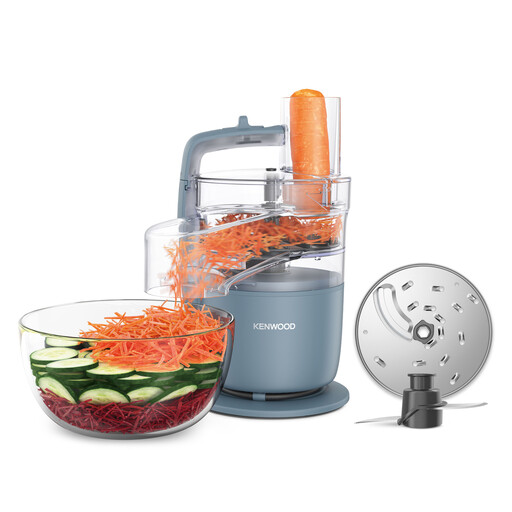
A compact model to consider if you also want to slice or grate vegetables for the filling.
The product information lists a 1.3-litre bowl, pulse control and a reversible slicing and grating disc.
The stated dimensions are 23.9 × 15.8 × 29.7 cm; check that they suit your worktop and storage space.
 No image available
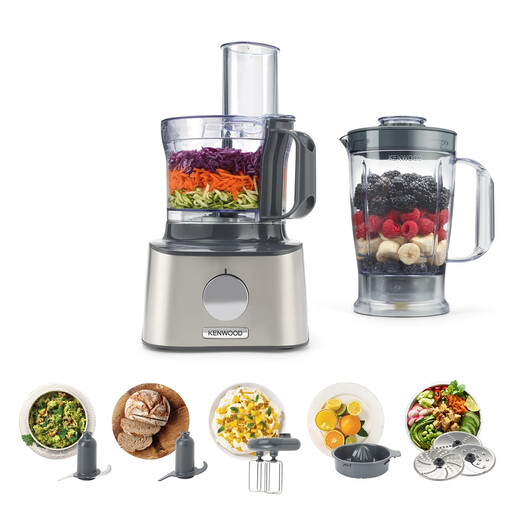
A relevant option if you want to chop, slice or grate as well as make pastry; bear in mind that you’ll need to store the parts after use.
The product information lists a 2.1-litre bowl, pulse control and attachments for kneading, chopping, grating and slicing.
Pulse the cold butter with the flour until the mixture resembles breadcrumbs, then stop as soon as the pastry comes together. Good Food recommends pulsing until you have fine crumbs; don’t process the pastry for longer than necessary, and follow the quantities and instructions in your recipe and appliance manual.
Not to mix the pastry case. If you want to prepare the filling using the appliance, check whether the exact model has a suitable slicing disc. Leuke Recepten recommends frying mushrooms for a savoury tart first if needed, to allow moisture to evaporate; this is recipe advice, not an additional machine function.
Don’t assume so: check the manual for the exact model and each part. Bosch describes the MCM3200W accessories as generally dishwasher-safe, so check exactly which parts this applies to.
In the Netherlands, the seller must offer an appropriate solution free of charge if the product doesn’t meet what you could reasonably expect from it during normal use. ACM ConsuWijzer describes options such as repair, replacement or a refund. A manufacturer’s warranty doesn’t replace your statutory rights, and there isn’t one fixed Dutch warranty period for every appliance.
Electrical kitchen appliances must meet the applicable requirements for electrical equipment. The European Union explains that CE marking is only compulsory when the relevant EU rules require it; where it applies, the manufacturer declares that the product meets those rules. CE marking isn’t an independent test of how well a machine mixes pastry.