
Baker making several tart cases
You’re making more than one pastry case for the gathering and want to know how much dough will actually fit in each batch. Total bowl capacity and the stated dough or processing capacity are different specifications.


Compare the amount of pastry in your recipe with the stated dough limit or processing capacity for the exact model; the bowl capacity in litres alone doesn’t tell you how much dough it can handle. A compact model may be suitable if you want to make smaller batches, while making several tart cases in succession means paying extra attention to the capacity per batch. Magimix’s shortcrust pastry recipe also says to finish the dough by hand and chill it after mixing.
You’re making more than one pastry case for the gathering and want to know how much dough will actually fit in each batch. Total bowl capacity and the stated dough or processing capacity are different specifications.
You want to mix the ingredients with a suitable blade, then finish and chill the dough according to your recipe. The appliance doesn’t need to do the whole job for you.
You want to be able to put the appliance away and, if necessary, make smaller batches. A compact bowl doesn’t automatically mean it can hold a full batch of your recipe.
The main consideration is how much dough you want to make at a time, alongside the space the appliance takes up and the work still needed after mixing.
| What to consider | What to look for | Who will find this most important? |
|---|---|---|
| Dough per batch | Weigh the ingredients in your recipe and compare them with the limit for the exact model. Bosch Netherlands specifies a maximum of 0.8 kg of dough for the MCM3200W; Magimix lists a processing capacity of 1.8 l for the CS 5200XL, not a dough limit in kilograms. | If I’m making several tart cases, I want to know how much dough one batch can handle before choosing an appliance. Around 36% of consumers put batch size first. |
| Control over mixing | Check which blade comes with the model and what controls are available. Bosch Netherlands lists a pulse function for the MCM3200W; Magimix’s shortcrust pastry recipe uses a dough blade. | I want to be able to mix my ingredients in a way that suits my recipe, then finish the dough myself. Around 29% of consumers put control over mixing first. |
| Storage space | Compare the dimensions of the exact model with your cupboard and worktop space. Kenwood says the MultiPro Go Blend FDP23.380GY has a 1.3 l bowl; this alone doesn’t tell you how much dough it can handle. | If my kitchen has little storage space, I weigh up choosing a compact appliance against the possibility of having to make several batches. Around 21% of consumers put storage first. |
| Cleaning and extra features | Check which parts are dishwasher-safe and which accessories you’ll actually use. Kenwood lists specific dishwasher-safe parts for the FDP23.380GY; Magimix lists three bowls and a dough blade for the CS 3200XL. | I don’t want to have to clean or store more parts than I need to after the gathering. Around 14% of consumers put cleaning and versatility first. |
When making several tart cases, the amount of dough per batch can determine whether you’ll need to work in portions. Bowl capacity in litres isn’t the same as an allowed dough weight in kilograms.
Weigh the ingredients in your recipe and compare them with the dough limit for the specific model. If only a processing volume is listed, check what limit applies to your dough.
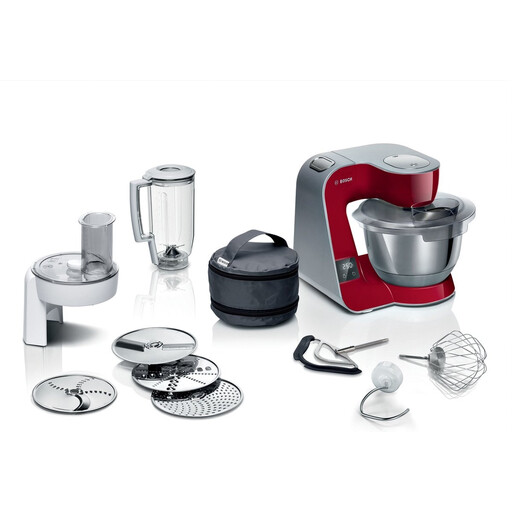
Bosch lists a 2.3 l bowl, a pulse function and a maximum dough capacity of 0.8 kg for the MCM3200W. These are model specifications, not an independent assessment of how it performs with shortcrust pastry.
Magimix lists a total bowl capacity of 2.6 l for the CS 3200XL and 3.6 l for the CS 5200XL. For the CS 5200XL, the brand gives a processing capacity of 1.8 l; its shortcrust pastry recipe describes preparation using a dough blade.
Kenwood says the MultiPro Go Blend FDP23.380GY has a 1.3 l bowl and a pulse setting; the brand lists dough as one possible use.
Below are food processors and stand mixers suited to preparing dough. For each version, check the dough weight, accessories and usage limits that apply to your recipe.
 No image available
Could suit anyone looking to mix dough and wanting a 4.5 l bowl; check the permitted dough weight for your recipe.
The product name specifies a stainless steel bowl, 1300 W, 6 speeds plus pulse, and a beige finish.
 No image available
An option to compare if you’re looking for other kitchen functions as well as dough preparation; check which accessories are included with this version.
The product name lists a Series 4 food processor, mincer attachment, blender, juice extractor and food chopper. Check the dough limit for your recipe.
 No image available
Could be suitable if you’re looking for a compact food processor and are happy to check the batch size it can handle.
The product name specifies model code FDP23.380GR and the colour eucalyptus green. Check the specifications for this exact version.
 No image available
An option to compare if you’re considering both the bowl capacity you need and how you’ll use it; check the dough limit for this version.
The product name specifies 1000 W and a capacity of 3.9 l. Bowl capacity alone doesn’t tell you how much dough it can handle.
 No image available
Could be suitable if you can match the amount of dough per batch to the limit for this exact model.
Bosch Netherlands specifies a maximum of 0.8 kg of dough and a 2.3 l bowl. The product name specifies 800 W; the manufacturer also lists a pulse function.
No. Bowl capacity and the permitted dough weight are different measurements. Bosch Netherlands lists both a 2.3 l bowl capacity and a maximum dough weight of 0.8 kg for the MCM3200W; compare the limit for the exact model with your own recipe.
The Magimix shortcrust pastry recipe we consulted uses a dough blade. It then says to finish the dough by hand and chill it for an hour; also check the instructions for your appliance and recipe.
Don’t assume so: check the instructions for each part. Kenwood lists specific dishwasher-safe parts for the FDP23.380GY, while Bosch says that accessories for the MCM3200W are generally dishwasher-safe. Follow the instructions for the motor unit and any other parts.
In the Netherlands, ordinary online purchases generally come with a statutory cooling-off period of up to 14 days after delivery, subject to legal exceptions. ACM ConsuWijzer also explains that you have a statutory guarantee: if a product doesn’t do what you could reasonably expect under normal use, the seller is responsible for providing an appropriate solution. An additional manufacturer’s guarantee doesn’t replace this right.
The NVWA classifies kitchen appliances as electrical equipment. CE marking is compulsory for electrical equipment covered by the Dutch Commodities Act Decree on Electrical Equipment; for the Low Voltage Directive, the NVWA describes a range of 50–1000 V AC or 75–1500 V DC. Check the markings and usage restrictions on the specific appliance; a retailer’s product listing is not, by itself, an independent safety test.