
Cook who grinds their own peanuts
You want to chop whole peanuts and flavourings, and decide how much texture to leave in the sauce. In a satay sauce recipe from Foodies, the peanuts are finely chopped while retaining some texture.


For satay sauce made with whole peanuts, choose a food processor with a chopping blade and a workable capacity that suits your recipe. A larger stated bowl capacity alone doesn’t tell you how much sauce you can make at a time. If you’re using peanut butter as your base and don’t need to chop anything, a food processor may be unnecessary. Also consider storage space and cleaning.
You want to chop whole peanuts and flavourings, and decide how much texture to leave in the sauce. In a satay sauce recipe from Foodies, the peanuts are finely chopped while retaining some texture.
You want to prepare an amount that suits the number of people you’re serving. So compare the available bowl space with the usable capacity for your recipe.
You want to be able to chop ingredients, but you’re also looking for an appliance you can put away after cooking and whose parts are practical to clean.
Start with the preparation method: whole peanuts need chopping, while you can make a peanut-butter-based sauce without a food processor. Then compare the amount you want to prepare with the usable capacity, and factor in cleaning and storage.
| What to consider | What to look for | Who should pay particular attention? |
|---|---|---|
| Texture and chopping | Check that a suitable chopping blade is included and that the instructions allow you to process your ingredients and the amount you need. | If I’m chopping whole peanuts, I want to be able to stop before all the texture disappears. Around 40% of consumers give chopping and texture top priority. |
| Amount per batch | Compare your recipe with the usable capacity or maximum processing quantity, not just the bowl’s total capacity. | For a meal shared with others, I want to know whether my portion will fit in the bowl. Around 30% of consumers prioritise the amount they can make per batch. |
| Cleaning | Check which parts can be removed and whether the manufacturer says they are dishwasher-safe. | After chopping, I want to be able to clean the parts easily before using them again. Around 20% of consumers consider ease of cleaning their top priority. |
| Storage and other uses | Measure the space you have and compare it with the dimensions and parts of the model. | If I want to use the appliance for other dishes too, it needs to fit in my kitchen between meals. Around 10% of consumers prioritise space and wider use. |
The stated capacity isn’t always the same as the usable amount. For example, Braun lists the FP3131WH with a total bowl capacity of 2,1 l and a usable capacity of 1,2 l for liquids.
Compare the amount in your recipe with the relevant capacity or processing quantity for the exact model.
If everything doesn’t fit in one batch, you may need to work in several batches and wash extra parts.
An appliance designed mainly for dough and batter won’t necessarily do the chopping you need for whole peanuts.
Check that the model includes a suitable chopping blade and see which ingredients and quantities the instructions allow.
The Magimix CS 3200 MAT CHROOM has three bowls, but the manufacturer also states that some accessories aren’t compatible with this model. Extra parts also take up space and need cleaning.
Check that the bowls and accessories suit the way you cook and the exact model.
The Voedingscentrum lists peanuts as an allergen; even a small amount can cause symptoms in someone with a food allergy.
Ask about allergies in advance, check the other ingredients too, and don’t present satay sauce as a peanut-free option.
The MultiTalent 3 MCM3501M is worth considering if you’re looking for a food processor with chopping accessories.
The PurEase FP3131WH is worth considering if you also want to compare its mixing or puréeing functions.
The CS 3200 MAT CHROOM is worth considering if you want to compare separate bowls for different preparations.
The MultiPro Go FDP22.130RD is a compact food processor with a chopping function, worth comparing if you have limited storage space.
These product picks are suited to chopping ingredients for satay sauce, with a range of bowl sizes and practical features for cleaning and storage.
 No image available
An option if you want to chop ingredients and clean removable parts after use.
The product name lists 750 W and a 1,8 l bowl. Use short pulses, let the appliance cool for 2 minutes between cycles under heavy load, and don’t process boiling liquids.
 No image available
The two bowls may suit anyone who alternates between smaller and larger preparations.
The product name lists two glass bowls of 2 l and 0,6 l, and a power rating of 300 W. The bowl and lid aren’t heat-resistant; avoid sudden temperature changes of more than 50 °C and don’t put them in the microwave.
 No image available
The stackable bowls may suit anyone who wants to prepare different dishes and store the parts compactly.
The product name lists three bowls of 2,5, 2,2 and 1,8 l, blades made from 304 stainless steel, and a power rating of 350 W. The product description states that each pulse cycle can run for up to 30 seconds.
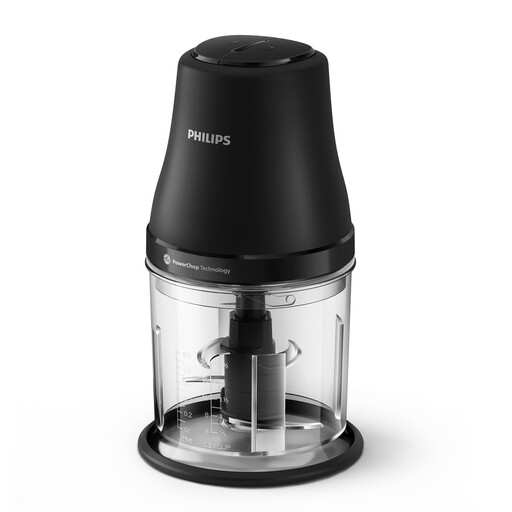 No image available
A compact chopper worth comparing if you’re looking for a smaller bowl for your preparation.
The product name lists a 1 l bowl and a power rating of 450 W. Don’t fill the bowl above the MAX mark, and don’t run the appliance for more than 30 seconds at a time.
 No image available
The 2 l bowl may suit anyone preparing ingredients for several people; compare its capacity with the amount in your recipe.
The product name lists two speeds and blades made from 304 stainless steel. Use short pulses and don’t run the motor for more than 30 seconds at a time.
Not necessarily. A published recipe from Koken met Karin makes peanut-butter-based satay sauce in a saucepan; another recipe uses a food processor to grind whole peanuts and flavourings. First, decide which method you want to use.
Follow the instructions for your model and clean the food processor between preparations. The Foodies satay sauce recipe does this between chopping the peanuts and grinding the flavourings; the Voedingscentrum also recommends using clean, separate utensils to prevent cross-contamination.
No. According to the Dutch government, there’s no fixed statutory guarantee period in the Netherlands; you’re entitled to a product that does what you can reasonably expect of it. If a product is faulty, contact the seller; any manufacturer’s guarantee is in addition to this.
Check the documentation and usage restrictions for the exact model. The Netherlands Food and Consumer Product Safety Authority states that CE marking is mandatory for electrical products where this requirement applies. Separate requirements apply to materials that come into contact with food; CE marking doesn’t prove that every bowl or accessory is suitable for every use.
No. The Voedingscentrum lists peanuts as an allergen that can cause symptoms in someone with a peanut allergy. Ask about allergies, check the other ingredients too, and don’t serve satay sauce as a peanut-free option.