
Cooking for lots of neighbours
You’re making several portions of salsa and want to know how much the machine can actually process in one go.


For several portions of salsa, it’s easier to assess a food processor with a stated processing capacity than to judge a machine by its total bowl capacity alone. A compact chopper is a better fit if you’re making small batches and don’t mind processing them in several rounds. For chunky salsa, a blade with pulse control lets you stop and check the texture as you go. Wash raw vegetables and fruit thoroughly, and follow the Netherlands Nutrition Centre’s advice on refrigerating and serving food.
You’re making several portions of salsa and want to know how much the machine can actually process in one go.
You want to keep pieces of tomato, onion and pepper, and are looking for control with a blade and pulse function.
You don’t mind processing in several rounds if the machine takes up less space and is easy enough to clean for the way you use it.
Start with how many portions you want to make per round. Then consider how much control you’ll have over the texture, how easy it is to clean and any extra features.
| What to consider | What should you look for? | Who is this most important for? |
|---|---|---|
| Quantity per round | Compare the stated processing capacity and any limit for liquid preparations with your recipe; plan to process in several rounds if needed. | If I’m making salsa for lots of neighbours, I want to know whether I’ll need to refill the machine less often; around 36% of consumers put portion size first. |
| Chunky texture | Check whether a suitable blade and pulse function are included; check the texture between short pulses. | For chunky salsa, I want to be able to stop before the tomato and onion get too finely chopped; around 29% of consumers mainly want control over the texture. |
| Cleaning and storage | Check which parts are included and follow the cleaning instructions for each one; in particular, check which parts are dishwasher-safe. | After several rounds, I want to be able to clean and store the parts quickly; around 21% of consumers prioritise easy tidying up. |
| Extra features | Compare the included blades and discs with the slicing and grating tasks you’d like to use the machine for later. | I want to use the machine for slicing or grating as well as making salsa; around 14% of consumers prioritise versatility. |
The stated total capacity isn’t always the amount you can process at once. Magimix lists a total capacity of 3.6 l and a processing capacity of 1.8 l for the CS 5200 XL; Kenwood lists a 3 l bowl and a separate liquid processing capacity of 1.5 l for the FDM71.450SS.
For a wet recipe, compare the model’s stated processing capacity and any liquid limit with your recipe, and allow for several rounds if needed.
Parts and appliance types vary between models. For example, Braun lists both a 500 ml chopper and a 2.0 l XL food processor for the MQ 9195XLI; an attachment may also require a separate base unit.
Check the product type, whether a base unit is required, and exactly which bowls and blades come with the version you’ve chosen.
With salsa, continuous processing can make the pieces finer than you’d like. A KitchenAid recipe uses short pulses to build up the texture gradually.
Process the ingredients in batches and check the texture as you go; speed alone won’t determine whether the pieces are the size you want.
The MultiPro Express Weigh+ FDM71.450SS is worth comparing if you’re making larger batches; the MultiPro Go FDP22.130RD is a more compact range.
The CS 5200 XL is worth considering if you’re comparing models with a higher stated processing capacity; the CS 3200 XL is a smaller alternative.
The MultiTalent 3 MCM3501M is a mid-sized food processor to compare if you want to chop, slice and grate.
The 5KFP1319 is worth comparing if you’re looking for pulse control and included slicing and grating attachments.
The MultiQuick 9 MQ 9195XLI is worth comparing if you’d also like a hand blender and plan to use the included chopper and food processor attachments.
This selection includes food processors and choppers for making salsa in batches. Compare the stated bowl sizes and check whether the pulse function will give you the chunky texture you want.
 No image available
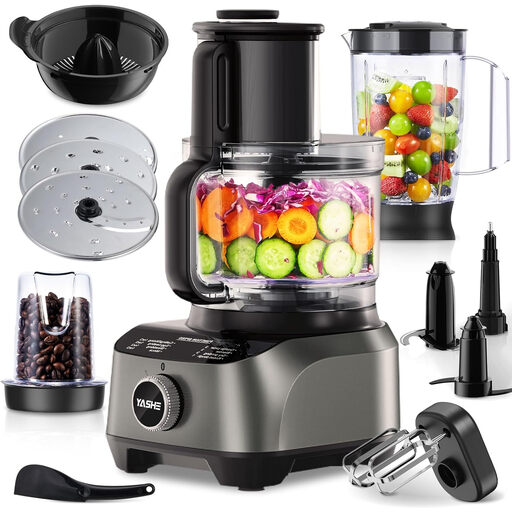
An option if you’re making salsa in batches and also want to slice or grate.
2.5 l bowl and 1.5 l jug; three speeds and pulse function; slicing and grating disc; safety lock; 1,300 W.
 No image available
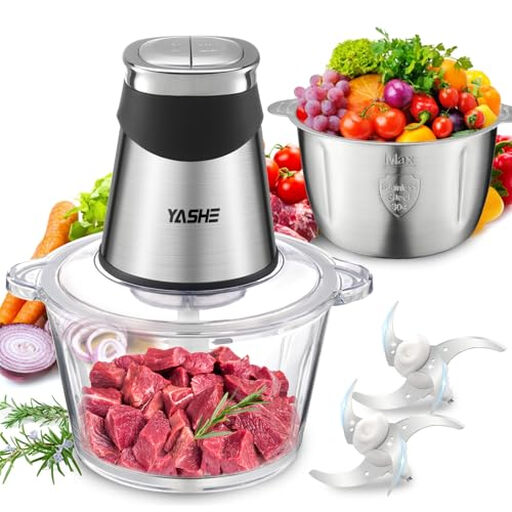
Worth comparing if you’re looking for a chopper with two bowls for different jobs.
1.8 l and 2 l bowls; glass and stainless steel bowls; two speeds; two blade sets; 500 W.
 No image available
An option to compare if you want to make salsa in batches and check the texture as you go.
1.8 l bowl; 750 W. Short pulses are recommended for salsa. Do not process boiling liquids.
 No image available
Worth comparing if you want to prepare larger and smaller quantities separately and adjust the texture with short pulses.
Two glass bowls of 2 l and 0.6 l; 300 W. The bowls and lids are not heat-resistant and must not be used in a microwave.
 No image available
An option if you’re looking for pulse control and want to prepare different ingredients in separate bowls.
Three nesting bowls of 2.5 l, 2.2 l and 1.8 l, made from 304 stainless steel; two speeds; 350 W. The maximum pulse time is 30 seconds per cycle.
Use a suitable blade and work in short pulses. In a KitchenAid recipe, the onion, pepper and garlic are processed first, with the tomatoes added afterwards. Stop when the texture is right. The recipe method won’t guarantee the same result with every appliance.
Wash raw vegetables and fruit thoroughly under running water, and use clean kitchen utensils. The Netherlands Nutrition Centre recommends keeping your fridge at 4 °C and not leaving highly perishable food out of the fridge for more than two hours. Follow the relevant storage advice for your ingredients and recipe.
Don’t assume it can without checking first. Kenwood states that the attachments for the FDM71.450SS are dishwasher-safe, subject to the instructions. Check the manual for every model and part you choose, and clean the motor base as directed.
It depends on the stated processing capacity and any limit for liquid preparations for the model you’ve chosen; the total bowl capacity isn’t automatically the maximum amount of salsa you can make per round. Check the manual against your recipe and allow for several batches.
Report a problem with a faulty product to the retailer. According to the Dutch government, the retailer must provide a solution when there’s a problem with a product; any additional manufacturer’s warranty is separate.