
Cook making small portions
You’re making a small bowl of dip and want to process peppers and other ingredients without having to store a large appliance. Consumentenbond lists chopping and slicing among the typical uses of a food processor.


For small portions, a compact food processor with a chopping blade is a sensible place to start, but check that its usable capacity suits your recipe. If you want a smooth dip, look for a suitable blending function too, while larger batches call for enough processing capacity. In a shared kitchen, storage, cleaning and keeping clean utensils separate are also important.
You’re making a small bowl of dip and want to process peppers and other ingredients without having to store a large appliance. Consumentenbond lists chopping and slicing among the typical uses of a food processor.
You put the appliance back in the shared cupboard after use. Its dimensions and the number of separate parts both affect how practical that is.
You often make a larger batch and want to know how many ingredients you can process at a time, rather than simply choosing the smallest appliance.
First decide what texture you want and how much dip you usually make. Then compare the exact model’s processing capacity with its bowl capacity, and check that its parts suit your available storage space and cleaning routine.
| What to consider | What should you look for? | Who should pay particular attention? |
|---|---|---|
| Texture and small portions | Check whether the model has a chopping blade and whether its specified processing capacity suits your recipe. A blending function may offer a different way to prepare the dip. | If I mainly want to make a smooth dip, I look at both the preparation function and how much the appliance can process at a time. Texture is the top priority for around 31% of consumers. |
| Storage | Measure the available cupboard or drawer space and check whether the accessories will fit too. | If I have to put the appliance away after every use, I want the base and parts to fit together in the space available. Storage is the top priority for around 25% of consumers. |
| Cleaning and shared utensils | Check which parts the manufacturer says are dishwasher-safe, and whether the bowl, lid and blade are easy to reach for cleaning. Voedingscentrum recommends using clean utensils and keeping utensils that have come into contact with raw food separate. | If other people use the same kitchen and utensils, I want to be able to clean the parts thoroughly after use and make sure no food residue is left behind. Cleaning is the top priority for around 25% of consumers. |
| Batch size | Compare the bowl’s total capacity with the maximum fill level for the exact model; the two can differ. | If I’m cooking for several housemates at once, I want to know how much dip I can actually make in one go. Batch size is the top priority for around 19% of consumers. |
For the Kenwood MultiPro Go Blend FDP23.380GR, Kenwood Netherlands lists a 1.3 l bowl and a fill level of 0.75 l for liquids in that bowl. Looking only at the larger capacity figure could therefore give you the wrong idea of how much dip you can make at a time.
Compare the processing capacity in the manual for the exact model with your recipe, particularly if you’re making a runnier dip.
For the FDP23.380GR, Kenwood lists one speed plus a pulse function, while the Joybuy product description lists seven speed settings. These descriptions conflict for the same model designation.
Before buying, check which version is being offered and compare the listed features with Kenwood’s documentation for that model.
A separate attachment may offer another way to prepare food, but it also adds another part to a kitchen you share with others.
Think about which functions you’ll actually use, where you’ll store the separate parts and how to clean them according to the model instructions.
The MultiPro Go range is worth considering if you’re looking for a compact appliance; the FDP23.380GR comes with a separate blender attachment.
The PureEase models are worth a look if you want a larger bowl and, depending on the version, a blender attachment too.
The MultiTalent 3 MCM3501M is a model to compare if you’re looking for a food processor with a larger stated jug capacity.
The Mini Plus is a compact food processor to include in your comparison if storage space is limited.
The Viva HR7530/00 offers model-specific information about chopping and puréeing, but it isn’t a current model choice based on the manufacturer’s page.
This selection includes mini choppers and food processors for chopping or puréeing ingredients, with options for small portions, easy storage or larger batches.
 No image available
The two bowl sizes may suit you if you want to prepare small portions and larger batches separately.
According to the product name: 2 l and 0.6 l glass bowls; 300 W power.
The bowl and lid are not heat-resistant. Allow roasted peppers to cool first and avoid sudden temperature changes of more than 50 °C.
 No image available
The different bowl sizes may suit you if you want to process varying amounts of ingredients.
According to the product name: 350 W, two speeds and three nesting stainless steel bowls of 2.5 l, 2.2 l and 1.8 l.
 No image available
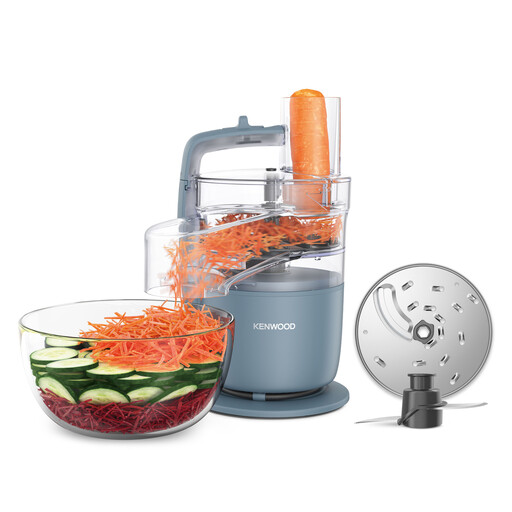
A compact food processor with a separate blending function may suit you if you want to make smooth mixtures as well as chop ingredients.
Kenwood Netherlands lists a 1.3 l bowl and a 0.75 l fill level for liquids in the food processor bowl.
 No image available
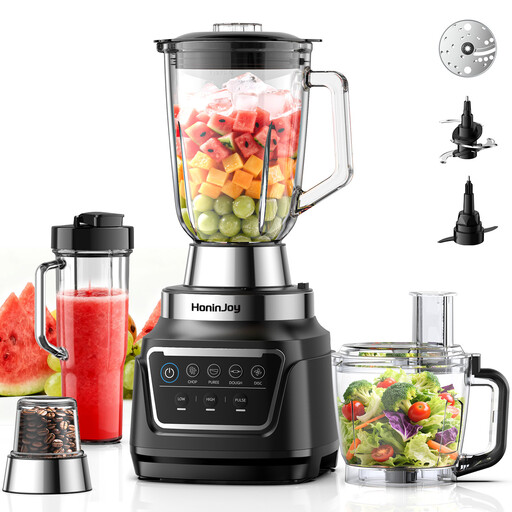
The blender and food processor combination may suit you if you want puréeing functions and the capacity to prepare larger batches.
 No image available
The chopping function and compact design may suit you if you mainly want to chop ingredients and put the appliance away after use.
Check which parts are included with this version and how the manufacturer recommends cleaning them.
If chopping and puréeing are the main tasks, start with a food processor that has a suitable blade. Consumentenbond describes stand mixers with a mixing arm as being mainly for tasks such as mixing and kneading. For a smooth dip, also check whether the food processor has a suitable blending function.
Check the assembly and operating instructions for the exact model, and start with clean utensils. Voedingscentrum recommends keeping utensils that have been in contact with raw meat or fish separate from other ingredients, or washing them thoroughly in between.
According to Voedingscentrum, refrigerate prepared dip within two hours, keep your fridge at 4 °C and eat leftovers within a maximum of two days. Store them covered in the fridge.
In the Netherlands, the retailer is your point of contact for your statutory guarantee. ACM ConsuWijzer states that if a product is faulty under normal use, the retailer must put things right free of charge, for example by repairing or replacing it; the statutory guarantee does not simply have a fixed two-year term.
This depends on the rules that apply to the exact version. The Netherlands Food and Consumer Product Safety Authority lists kitchen appliances as electrical equipment and says that CE marking is required for electrical products covered by the applicable CE rules. So check the product information for the model.