
If you make date and oat bars
You want to chop dates and nuts without losing control of the texture of your bars. The Voedingscentrum recommends chopping the dates first, adding the nuts briefly, then mixing in the remaining ingredients with a fork.


For a small batch of oat bars, a hand blender with a mini chopper may be enough. For larger batches or more frequent chopping and mixing, a food processor is a more practical option to compare. Look for a chopping blade, the amount you can process at a time and how the parts are cleaned. The Voedingscentrum recipe chops the dates first, adds the nuts briefly, then mixes in the remaining ingredients with a fork.
You want to chop dates and nuts without losing control of the texture of your bars. The Voedingscentrum recommends chopping the dates first, adding the nuts briefly, then mixing in the remaining ingredients with a fork.
You want to prepare enough bars, so compare the amount you can process at a time with the available bowl space. Processing the ingredients in batches can be a practical approach.
You want to put the appliance away and clean it easily after use. So compare the bowl and separate accessories too, not just the motor unit.
Start with the preparation steps and the size of your portions. A chopping blade and control over short bursts are useful for the ingredients, while the bowl and separate parts matter when it comes to batch size and storage.
| What to consider | What should you check? | Who is this most important for? |
|---|---|---|
| Control over texture | Check whether the exact model has a chopping blade and controls for short bursts. | I want to chop the dates first and add the nuts briefly, so I can control the texture; around 36% of consumers give texture control top priority. |
| Amount processed at a time | Compare the recipe quantity with the guidance for the exact model, and allow for processing in batches. | If I’m making bars for several people, I want to know whether my portion will fit in one go; around 29% of consumers prioritise the amount processed at a time. |
| Storage space | Measure the available height, width and depth, and allow space for accessories too. | I want to put the appliance away after use without scattering its separate parts around the cupboard; around 21% of consumers prioritise storage space. |
| Cleaning | Check the cleaning instructions for each part and how to remove the blade safely from the bowl. | If I’m processing sticky ingredients, I want to know how many parts I’ll need to wash; around 14% of consumers give ease of cleaning top priority. |
A bowl’s stated capacity doesn’t guarantee that a full portion of sticky bar mixture will fit in one go. You may need to process the ingredients in several batches.
Compare the ingredient quantity with the instructions for the exact appliance, and allow for processing in batches.
Parts can differ between models and versions within the same product range.
Check the full model number and the list of included parts. For bars, it’s especially important to check whether that version comes with a suitable chopping blade.
How best to store them depends on the recipe and ingredients. Food that needs to stay chilled must also be kept cool on the way to your picnic.
Follow the storage advice for your recipe and pack anything that needs to stay chilled in a cool bag.
According to Kenwood, the MultiPro Go FDP22.140GY is a compact food processor with a 1.3-litre bowl and a chopping blade.
According to Bosch, the MultiTalent 3 MCM3501M has a 2.3-litre bowl, making it worth comparing if you’re looking for more stated bowl capacity.
The CS 3200 XL comes with three bowls, including a 1.2-litre mini bowl for smaller quantities, according to Magimix.
The Daily HR7310/10 is an example of a compact food processor with an S-blade and accessories that can be stored inside the bowl.
This selection includes mini choppers and food processors to compare for making oat bars, based on portion size, controls and cleaning.
 No image available
The two bowl sizes are worth considering if you want to compare options for smaller and larger quantities.
The product listing specifies 0.6 and 2-litre glass bowls, two speeds and stainless steel blades. The high speed is recommended for nuts.
 No image available
The nesting bowls may be useful if you want to compare different portion sizes and store the parts compactly.
The product listing specifies 1.8, 2.2 and 2.5-litre bowls, two speeds and a pulse function. Each pulse cycle is specified as lasting up to 30 seconds.
 No image available
This model is worth comparing if you’re looking for a 2-litre glass bowl and short-pulse controls.
The product listing specifies two speeds and stainless steel blades. Cut larger ingredients into 2 cm pieces first and use short pulses; continuous use is limited to 30 seconds at a time.
 No image available
Bowl capacity and the pulse function are worth considering when comparing food processors for chopping and mixing.
The product listing specifies a 2.3-litre bowl, two speeds and a pulse function. The stated bowl capacity is not a confirmed capacity for bar mixture.
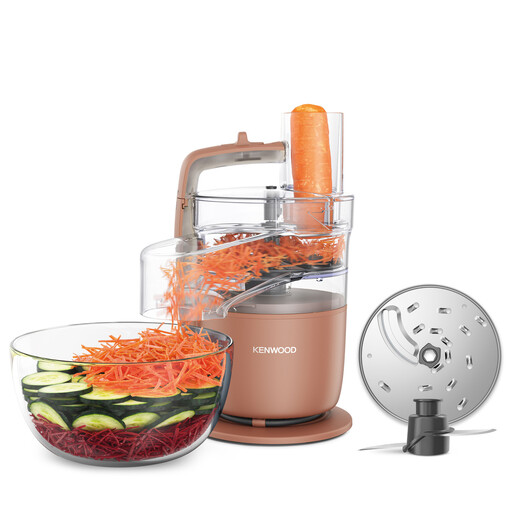 No image available
The compact bowl and cable storage are useful features if you’re short on storage space.
The product listing specifies a 1.3-litre bowl, a chopping blade and a pulse function. Kenwood says the accessories are dishwasher-safe; check the cleaning instructions for each part.
Not according to the Voedingscentrum recipe: chop the dates first, add the nuts for a few seconds, then mix in the remaining ingredients with a fork. Another recipe may call for a different order.
Follow the storage advice for your recipe and ingredients. The Voedingscentrum recommends taking food that needs to stay chilled in a cool bag and taking it out of the fridge shortly before you leave.
It depends on the model and the part. Kenwood lists dishwasher-safe accessories for the FDP22.140GY; check the instructions for your version before cleaning the bowl, blades and attachments.
No. The Dutch government distinguishes between statutory consumer rights and additional manufacturer or seller warranties. There is no fixed statutory warranty period in the Netherlands; if a product is faulty, contact the seller. Check what any additional warranty covers.