
Workshop leader preparing several portions
Wants to make enough purée for one session without having to run the machine more times than necessary. The usable capacity and worktop space are therefore important considerations.


For a cooking workshop, a food processor is a good choice if you want to make pea purée and use the machine for other prep tasks too. Choose based on the usable amount per batch and the blade, not just the wattage. If you only want to purée in a suitable pan, consider a hand blender as well. For every model, check the instructions for hot ingredients, maximum filling levels and cleaning.
Wants to make enough purée for one session without having to run the machine more times than necessary. The usable capacity and worktop space are therefore important considerations.
Wants to show how chopped peas become purée and control the desired final texture. Check the blade, controls and whether you can pause to check the mixture.
Wants to be able to put the machine away and clean it between workshop activities. A compact appliance may be suitable, provided its capacity and the number of batches needed remain manageable.
First decide how much purée you need per batch and what texture you want to demonstrate. Then compare the instructions, cleaning requirements and the space the appliance takes up.
| What to consider | What to look for | Who is it most important for? |
|---|---|---|
| Texture | Check whether the manufacturer says the blade can purée, and whether you can check the mixture as you go. A purée function does not guarantee a particular smoothness. | If I want to show participants how the purée changes in texture, I need to be able to check the result as I go. Around 36% of consumers say texture is their main consideration. |
| Amount per batch | Compare the permitted processing capacity with your recipe, not just the total bowl capacity. For example, Magimix lists a total capacity of 2,6 L and a processing capacity of 1 L for the CS 3200XL. | For a group, I want to know whether one batch will make enough purée, so I don’t have to interrupt the workshop more often than necessary. Around 29% of consumers prioritise the amount per batch. |
| Cleaning | Check whether each part can be washed by hand or in the dishwasher. Bosch says the MCM3501M accessories are generally dishwasher-safe; check the instructions for each individual part. | If I’m supervising several preparations during a session, I need to be able to clean the bowl and blade thoroughly before using them again. Around 21% of consumers say cleaning is their main consideration. |
| Workspace and storage | Compare the appliance dimensions and the space needed for the bowl and controls. Bear in mind that a more compact bowl may mean more batches for group portions. | With limited worktop space, I need to be able to set up the appliance and put it away afterwards without it getting in the way of the rest of the workspace. Around 14% of consumers give space the highest priority. |
The bowl capacity and the permitted processing capacity can differ. This means a machine may process less purée per batch than its total capacity suggests.
Work out how much you need per batch and compare it with the processing limit for the specific model.
A lower processing capacity may mean extra batches during the workshop.
For pea purée, the usable portion size and ability to purée matter. Accessories for other tasks won’t increase the size of a batch that’s too small.
Start with your recipe and the number of participants. Then compare only the features you’ll actually use during the workshop.
The bowl, lid, blade and extra accessories all need storage space and must be cleaned after use.
According to the Dutch Government, the Netherlands has no fixed statutory warranty period. You’re entitled to a product that works as it should, and the retailer is your point of contact if there’s a problem.
Before choosing an offered manufacturer’s or extended warranty, check exactly what it covers.
An extended warranty plan may cost extra; assess its terms and cover separately.
MultiTalent food processors are worth considering if you’re looking for a mixing bowl and several food preparation functions.
The CS range may be a good option if you want to switch between bowls for different preparations.
The 5KFP0719EBM is a food processor with a stated bowl capacity of 1,7 L.
The compact MultiPro Go may be suitable if workspace and storage are key considerations.
This selection focuses on food processors and choppers whose product information mentions puréeing. Compare the usable capacity and follow the instructions for the exact model when processing hot ingredients.
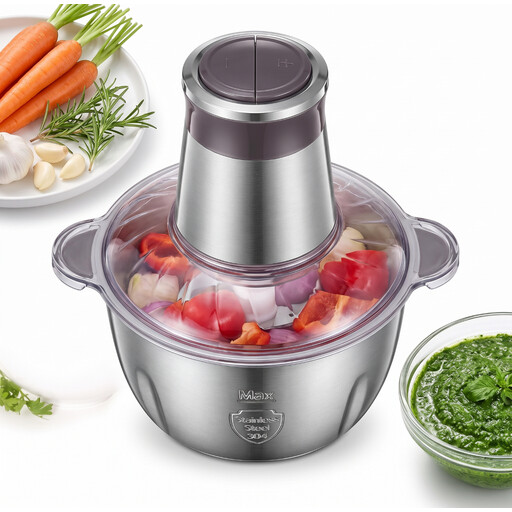 No image available
The product information mentions puréeing and a 2,5 L bowl, which may be useful if you’re making purée in a bowl.
The description lists three S-shaped stainless steel blades and two speeds.
 No image available
The product information mentions puréeing and two bowl sizes for different quantities.
The description lists a three-layer blade system and two speeds. The bowls and lids are not heat-resistant; avoid sudden temperature changes of more than 50 °C.
 No image available
The description lists puréeing as a use and three bowls of 2,5 L, 2,2 L and 1,8 L.
According to the product information, the appliance has two speeds and pulse control. The stated limit is a maximum of 30 seconds per cycle in pulse mode.
 No image available
The product information mentions puréeing and a 1,3 L main bowl; check that the amount per batch suits your workshop portions.
The description lists seven speeds and a separate 600 ml blender cup.
 No image available
The model guide says the blade can purée ingredients when run for longer; the product information describes a compact design and a 1,3 L bowl.
The description lists a chopping blade, a slicing and grating disc, and pulse control. Kenwood recommends letting the appliance rest after two minutes of continuous use.
No, don’t assume it is. For example, Magimix lists a total capacity of 2,6 L and a processing capacity of 1 L for the CS 3200XL. Check the limit for your preparation in the instructions for the exact model.
No, you can’t assume every model is suitable. Check the permitted temperature and filling level in the instructions before processing hot peas.
The Netherlands Nutrition Centre advises cooling leftover cooked green peas quickly, storing them in a sealed container and not leaving them out of the fridge for more than two hours. It says they can be kept in the fridge for two days; if you’re serving food, also follow the relevant food safety procedures.
The requirements that apply depend on how the workshop and food service are organised. The NVWA sets out rules for businesses selling food to consumers and for allergen information on non-prepacked food. Calling an event a ‘cooking workshop’ alone doesn’t determine which rules apply to your situation.
No. According to the Dutch Government, the Netherlands has no fixed statutory warranty period: you’re entitled to a product that works as it should, and the retailer is your point of contact if there’s a problem. Check separately what a manufacturer’s warranty or extended warranty adds.