
If you make small batches
You want to chop ingredients briefly, but have limited shared cupboard space. Look at the working capacity, not just the bowl’s stated capacity.


If you mainly want to chop ingredients and mix them briefly, a food processor with a chopping blade and pulse control is a sensible place to start. Compare its usable processing capacity with the amount in your recipe, and consider how easy it is to clean and store in a shared kitchen. Bowl capacity and features alone don’t tell you how well an appliance will process a sticky oat-bar mixture.
You want to chop ingredients briefly, but have limited shared cupboard space. Look at the working capacity, not just the bowl’s stated capacity.
You share worktops and appliances, and want to be able to clean and store the blades, bowls and attachments properly after use.
You make several bars at once or use the appliance for other kitchen tasks too. Check the processing limits, included accessories and space required.
Start with the task that matters most for your recipe: chopping and controlling the texture of the mixture. Then consider batch size and clean-up.
| What to consider | What to look for | Who is this most important for? |
|---|---|---|
| Chopping and control over the mixture | Check whether a chopping blade and pulse function are included, and consult the manual for the maximum quantity and processing time. | If I want to chop ingredients in short bursts and control the texture, these are the features I look for first. Around 36% of consumers give chopping and control over the mixture top priority. |
| Cleaning | Check the cleaning instructions for each bowl, blade and attachment; don’t assume every part is dishwasher-safe. | If I share appliances with housemates, I want to be able to clean the parts properly after use. Around 29% of consumers put cleaning at the top of their list. |
| Storage | Compare the dimensions, how the accessories can be stored and the space you have available. | If the worktop and cupboard are shared, I want to be able to put the appliance away easily after use. Around 21% of consumers say compact storage is their main concern. |
| Portion size and working capacity | Compare the amount in your recipe with the stated processing capacity and the instructions for that type of ingredient. | If I want to make one batch, I want to know how much mixture the appliance can actually process. Around 14% of consumers give finding the right batch size top priority. |
A bowl’s total capacity isn’t automatically the amount you can process in one go. Kenwood lists a 1.3 l bowl and a dry working capacity of 0.75 l for the MultiPro Go FDP22.130GY; Magimix lists a total capacity of 1.7 l and a processing capacity of 600 ml for the Mini Plus.
Measure out your usual recipe portion and compare it with the relevant working capacity and the instructions in the manual.
A smaller working capacity may mean processing several batches and cleaning extra parts in between.
More power or more functions don’t prove that an appliance will handle your recipe well. Consumentenbond distinguishes chopping from prolonged mixing and kneading; these are different tasks.
First check that it has a chopping blade and pulse control, then read the instructions on capacity and processing time. Don’t treat wattage as proof of how well it will handle your recipe.
Food can be cross-contaminated through used equipment. If someone has a known allergy, the ingredients and the way shared appliances are used matter too.
Agree which ingredients will be used and how the parts will be cleaned. If someone has a known allergy, check which method is safe for the person you’re making the bars for.
The MultiPro Go FDP22.130GY is designed for chopping and short processing tasks when compact storage is important.
The Mini Plus has two bowls, making it suitable if you switch between small and larger food-preparation tasks.
The MultiTalent 3 MCM3501M is a larger all-round food processor for anyone who wants to prepare other ingredients too.
The MultiQuick 7 MQ7087X is a set with a hand blender and several separate accessories, including a food processor attachment.
These product picks focus on chopping and brief mixing, with different bowl configurations to suit a range of portion sizes. Compare the stated capacities and usage limits with your recipe.
 No image available
Suitable if you want to chop ingredients for different portion sizes using several bowls.
The product information lists three bowls, two speeds and pulse operation. The bowls can be nested for storage.
 No image available
A good option if you’re looking for a food processor with a 1.8 l bowl and several food-preparation functions.
The product information lists chopping, blending and grinding functions, as well as removable parts. Continuous use is limited to a maximum of 60 seconds per cycle; let the motor cool for 2 minutes after heavy use. Check the cleaning instructions for each part.
 No image available
Suitable if you want to use different bowl sizes for smaller and larger chopping tasks.
The product name lists two glass bowls of 2 l and 0.6 l, two sets of blades and 300 W.
 No image available
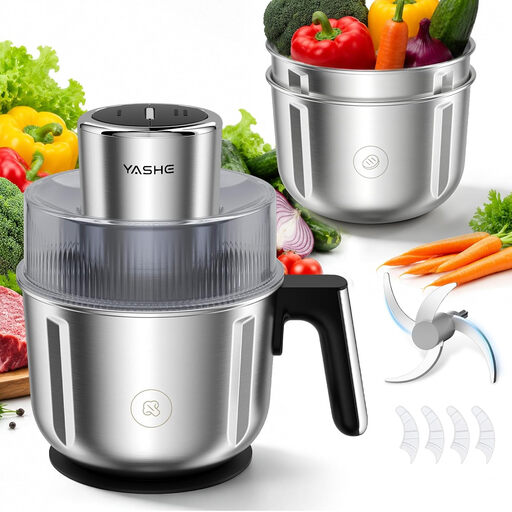
Could suit you if you want to chop different portion sizes and nest the bowls for storage after use.
The product information lists three stainless steel bowls, two speeds and pulse operation. Pulse control is limited to a maximum of 30 seconds per cycle.
 No image available
Could suit you if you’re looking for a chopper with a 2 l bowl and two speeds.
The product information lists stainless steel blades and pulse operation. Don’t run the motor for more than 30 seconds at a time.
If chopping and brief mixing are the main tasks, a food processor is an obvious choice. According to Consumentenbond, a stand mixer is generally better suited to prolonged mixing, kneading and whisking. Check the manual and permitted quantity for your recipe.
No. Don’t assume this from a statement that some parts are dishwasher-safe. Check the instructions for each bowl, blade and attachment, and clean the motor base as directed in the manual. Bosch describes its accessories as generally dishwasher-safe, but that doesn’t apply to every individual part.
Discuss which ingredients and appliances are safe for the person you’re making the bars for, and use clean equipment. In its allergen classification, Voedingscentrum lists oats among the cereals containing gluten. A statement about dishwasher cleaning alone doesn’t guarantee that a shared appliance is suitable for someone with an allergy.
For a consumer buying online, there is generally a statutory cooling-off period of up to 14 days after delivery; ACM ConsuWijzer explains the exceptions. The seller must also resolve, free of charge, any issue where a product used normally doesn’t meet what you were entitled to expect. This could mean repair, replacement or a refund.
The Dutch Food and Consumer Product Safety Authority’s guidance on label warnings is aimed at those who produce, package or sell food. It doesn’t follow that someone making bars solely for themselves in a shared home kitchen has the same labelling obligations. If you sell the bars or provide them in another capacity, that situation must be assessed separately.