What should you look for when buying?
Start with the quantity your recipe calls for and the ingredients you want to chop or purée. Then consider how to retain the texture, how easy it is to clean and how often you’ll use the appliance beyond this gathering.
| What to consider |
What should you check? |
Who is this important for? |
| Quantity per batch |
Compare the recipe quantity with the processing limit in the manual; plan to work in several batches if needed. |
If I’m making bars for several family members at once, I want to know whether my recipe will fit in a single batch. Around 31% of consumers say batch size is their main priority. |
| Dates and nuts |
Check whether the appliance has a chopping blade and what quantities the manual allows. |
If my recipe contains sticky dates and nuts, I want to process those ingredients in line with the recipe steps. Around 25% of consumers say this is their top priority. |
| Desired texture |
Check whether you can use short pulses and process ingredients separately. |
If I want to keep recognisable pieces of oats or nuts, I want to control how long they’re chopped for. Around 19% of consumers prioritise retaining texture. |
| Cleaning and storage |
Check the cleaning instructions for each part and see how much space the appliance and accessories will take up. |
If I’m short on cupboard space, I’d rather accept the possibility of making smaller batches than have an appliance that’s difficult to store. Around 13% of consumers prioritise storage and cleaning. |
| Buying an appliance or using an alternative |
Think about the tasks you’ll need it for after the gathering and whether you already have a suitable hand blender. |
If I only need the appliance for one recipe, I want to find out first whether the tools I already have will do the job. Around 12% of consumers consider how they’ll use it after the gathering when choosing. |
Food processors at Joybuy
These products are suited to chopping or puréeing ingredients in small to medium-sized batches. Compare the stated bowl capacities with your recipe, and follow the instructions for your chosen model when working with sticky mixtures.
 No image available
ochama Food Processor 750W, 1.8L
An option for chopping or grinding ingredients using pulses; check the recommended maximum operating time for your recipe.
The product information lists a 1.8 l bowl, stainless steel blades and short pulses. The instructions specify a maximum of 60 seconds of continuous use per cycle, with a 2-minute cooling period between heavy-duty operations.
View at Joybuy
 No image available
IAGREEA 350W Food Chopper MS-25JM08
The chopping and puréeing functions described are suited to recipes where dates and nuts are processed separately.
The product information lists three nesting bowls with capacities of 2.5, 2.2 and 1.8 l, two speeds, pulse control and three curved blades.
View at Joybuy
 No image available
Bosch MCM3200W MultiTalent 3, 800W, 2.3 l
The listed chopping and pulse functions may suit a recipe where ingredients are processed separately.
The product information lists a 2.3 l bowl, two speeds and a pulse function.
View at Joybuy
 No image available
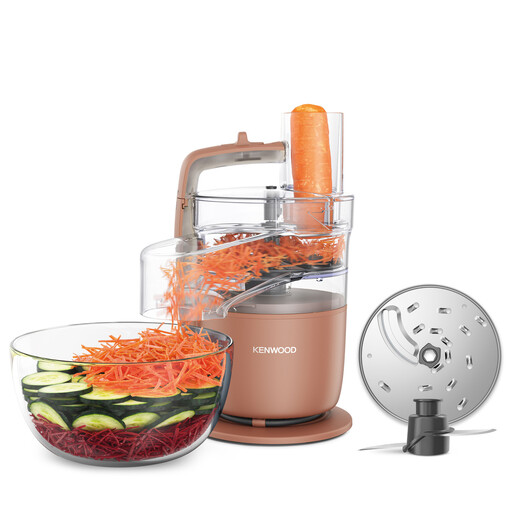
Kenwood MultiPro Go FDP22, red
The 1.3 l bowl is worth considering if you’re happy to process larger recipe quantities in separate batches.
The product information lists a chopping blade and pulse function. Check the instructions for the quantities and ingredients in your recipe.
View at Joybuy
 No image available
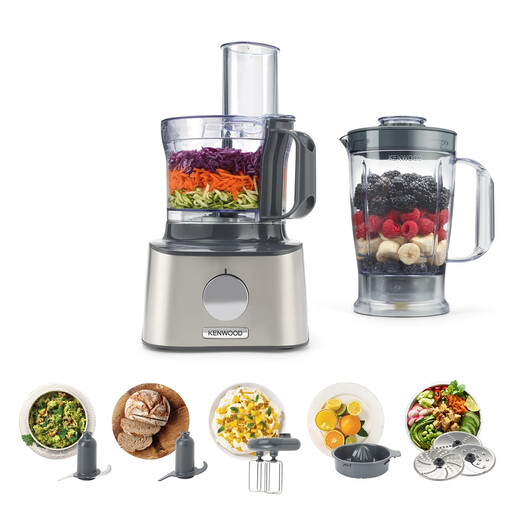
Kenwood MultiPro Compact FDM301, silver
A 2.1 l bowl gives you a capacity to compare with your recipe quantity; bowl capacity alone doesn’t determine how much sticky mixture the appliance can handle.
The product information lists two speeds and pulse control.
View at Joybuy
Frequently asked questions
Does the whole mixture need to go in the food processor?
No. In the Voedingscentrum’s recipe for date-and-nut bars, the dates are puréed, the nuts are ground for a few seconds and the remaining ingredients are mixed with a fork. Follow your own recipe and the operating limits of your appliance.
Can the parts go in the dishwasher after use?
That depends on the model and the part. Bosch says the accessories for the MCM3501M are generally dishwasher-safe; Kenwood lists dishwasher-safe accessories for the FDP22.140GY. Check the instructions for the bowl, lid and blade on your version.
How should I account for allergens when family members are sharing the food?
Ask which ingredients your guests need to avoid and check the labels on the products you use. The Voedingscentrum can’t guarantee that the ingredients you choose for its bar recipe are free from allergens; the appliance’s cleaning instructions alone don’t prove that food prepared with it is suitable for someone with an allergy.
Is CE marking compulsory, and does it mean an independent body has tested the appliance?
CE marking is compulsory for electrical consumer products covered by CE rules. According to the Dutch Food and Consumer Product Safety Authority, testing is not compulsory for this product category, so the marking doesn’t prove that an independent body has tested this particular appliance. Parts that come into contact with food must also comply with the relevant food-contact material rules.
Am I always responsible for repair costs once the manufacturer’s warranty has expired?
No. According to ACM ConsuWijzer, the statutory guarantee applies alongside the manufacturer’s warranty. It has no fixed duration in the Netherlands and depends, among other things, on what you can reasonably expect from the product under normal use. If a product is faulty, the retailer is your point of contact.


