
Cooking for a crowd
You need to prepare lots of onions in batches and mainly want to know how many manageable portions the appliance will require.


For a community meal, a food processor with a chopping blade and enough usable capacity per batch is a sensible starting point. The total bowl capacity doesn’t tell you how much onion you can chop at a time. Use short pulses to control the texture, and weigh up extra discs or bowls against the extra washing-up and storage space they need. Check the exact model and the accessories supplied; electric food processors sold in the Netherlands must carry a CE mark, so check this on the model being offered.
You need to prepare lots of onions in batches and mainly want to know how many manageable portions the appliance will require.
You want to chop or slice onions without losing the texture you’re after, so you’re comparing blades, discs and pulse controls.
You’re happy to prepare smaller batches if the appliance is easy to put away and clean after the community meal.
When preparing onions for a community meal, the number of chopping batches, the texture you want and the space available for the appliance are the main factors that affect how much work your choice involves.
| What to consider | What should you check? | Who is this important for? |
|---|---|---|
| Onions per batch | Check the usable filling capacity in the manual and whether a chopping blade is included. | If I’m preparing lots of onions for a group, I want to know in advance how many batches I’ll need. Around 36% of consumers mainly want to reduce the amount of batch preparation. |
| Texture of the onions | Check which blades and discs come with the exact model code and whether the appliance has a pulse setting. | If you’d rather chop onions finely than slice them, you’ll want an attachment suited to the way you’re preparing them. Around 29% of consumers prioritise texture. |
| Storage space and future use | Measure your cupboard and worktop space, and allow room for the accessories too. | If your kitchen has limited storage, you’ll want to know whether the appliance will still be practical to store and use after the community meal. Around 21% of consumers give the most weight to space and future use. |
| Cleaning and versatility | Check which removable parts the manufacturer says are dishwasher-safe and which attachments you’re actually likely to use. | If you don’t want to be left with lots of separate parts to wash after cooking, consider whether the extra functions are worth the extra cleaning. Around 14% of consumers prioritise cleaning and use after the meal. |
A bowl’s capacity doesn’t automatically tell you how much onion you can process at a time. For example, Magimix lists the CS 3200 XL’s total capacity as 2.6 l and its processing capacity as 1 l; Bosch lists a 2.3 l bowl for the MCM3501M.
Check the working capacity in the manual for the model you’re considering and allow for multiple batches.
If the working capacity is lower than you expect, preparing everything could take more batches and time.
Kenwood lists an extra disc for the MultiPro Go FDP22.140GY, but that doesn’t mean the FDP22.130RD comes with the same accessories.
Compare the full model code with the parts supplied with the version you’re choosing.
If an attachment you want isn’t included, you may need to buy it separately.
The Dutch government explains that a manufacturer’s warranty can be in addition to statutory rights, and that you should contact the retailer if a product is faulty.
Before taking out an extended warranty, read what it covers, what it excludes and what extra protection it provides.
An optional paid warranty may be unnecessary if it adds little to your existing rights.
The MultiTalent 3 MCM3501M is one model to consider, with a chopping blade, slicing disc and bowl.
The MultiPro Go range focuses on compact food processors; Kenwood lists a 1.3 l bowl for the FDP22.140GY.
According to Magimix, the CS 3200 XL has bowls for different quantities and tasks.
Braun describes the PureEase FP 3132 BK as a food processor for tasks including chopping, slicing and grating.
These product picks are aimed at chopping onions for hutspot and a community meal. Don’t assume the stated bowl capacity is the same as the amount that can be processed per batch, and check the CE mark on the specific electric model.
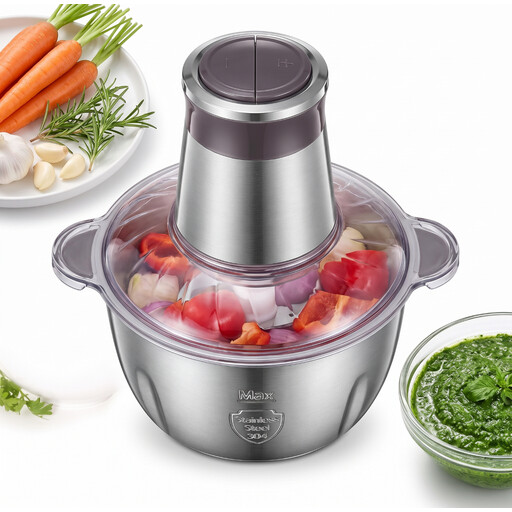 No image available
The product description mentions onions and a low speed for soft ingredients; check whether the working capacity suits your batch sizes.
The product name lists a 2.5 l stainless steel bowl, two speeds and three blades.
 No image available
The product description mentions onions on speed I; the two bowl sizes may be useful if you want to prepare different batch sizes.
The product name lists 2 l and 0.6 l glass bowls and a power rating of 300 W. According to the product copy, the bowls and lids aren’t heat-resistant and must not be used in a microwave.
 No image available
The product name mentions chopping vegetables and a pulse function; check the instructions for recommended use.
The product name lists three stackable 304 stainless steel bowls: 2.5 l, 2.2 l and 1.8 l. The product copy recommends pulsing for no more than 30 seconds per cycle.
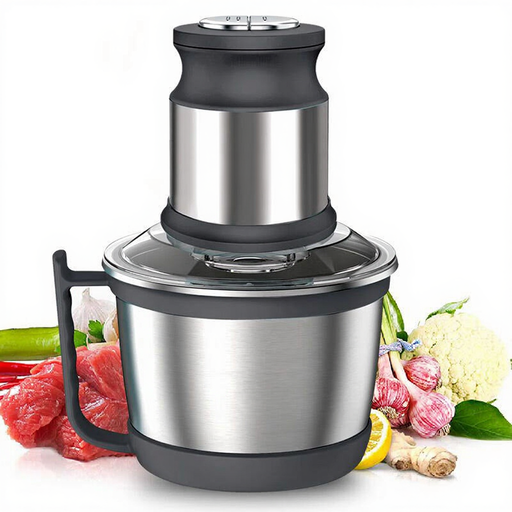 No image available
The product description mentions chopping vegetables for a larger meal; check the usable capacity for your batch sizes.
The product name lists a 3 l bowl.
 No image available
The product description mentions chopping, which may suit you if you want to process other ingredients as well as onions.
The product name lists a power rating of 800 W and a 2.3 l bowl. The bowl capacity isn’t the stated amount of onion you can chop per batch.
Choose a chopping blade if you want chopped onions, and a slicing disc if you’re after slices or another cut. Use short pulses to keep an eye on the texture, and check which parts are included with the exact model; specifications alone can’t guarantee an even chop.
Follow the model’s assembly and cleaning instructions, and check whether the manufacturer says each part is dishwasher-safe. The Netherlands Nutrition Centre advises keeping your hands and kitchen utensils clean. Wash utensils that have touched raw meat with washing-up liquid and hot water before using them for anything else.
The Netherlands Nutrition Centre advises keeping opened raw onion in the fridge for one week. For a carrot and onion mash prepared without salt, it recommends two days in the fridge. It also advises cooling leftovers quickly and not leaving them out of the fridge for more than two hours. This advice for that specific dish doesn’t automatically apply to hutspot made with other ingredients.
Not necessarily. According to the Dutch government, statutory consumer rights apply in the Netherlands without a fixed statutory warranty period, and you should contact the retailer if a product is faulty. First compare what extra cover a paid extended warranty actually provides.
Yes, for an electric food processor sold in the Netherlands as an electrical consumer product. The Netherlands Food and Consumer Product Safety Authority states that electrical products must carry a CE mark. Check the mark on the specific model being offered.