
Cooking for a group of friends
You want to make the right amount of hummus and compare your recipe with the machine’s processing capacity. The Voedingscentrum’s hummus recipe lists ingredients for ten portions.


Choose a food processor with a chopping or purée blade and a processing capacity that suits your recipe. The bowl’s total capacity doesn’t automatically tell you how much hummus you can make at a time. A compact bowl takes up less space, while a larger one gives you room for a bigger batch. Then compare any extra accessories and check how the parts you use should be cleaned.
You want to make the right amount of hummus and compare your recipe with the machine’s processing capacity. The Voedingscentrum’s hummus recipe lists ingredients for ten portions.
You want to purée hummus without having to store a large appliance, so you compare the machine’s dimensions and the space needed for its accessories. Bosch and Magimix list the dimensions of the models featured here.
You don’t want to wash unnecessary parts after puréeing, so you check which accessories you need for hummus and how to clean them. Bosch and Kenwood provide cleaning information for their accessories.
The Voedingscentrum recommends both a food processor and a hand blender for hummus. So first decide how you want to purée your ingredients, then choose a processing capacity to suit your recipe.
| What to consider | What should you check? | Who is it important for? |
|---|---|---|
| Puréeing hummus | Check that the exact model comes with a chopping or purée blade. A pulse function can be useful if you want to stop and check the ingredients as you go. | If puréeing is your main priority, you’ll want to know whether the right blade is included. Around 31% of consumers give puréeing top priority. |
| Batch size | Compare your recipe with the permitted processing capacity, not just the bowl’s total capacity. | If you’re making hummus for friends, you’ll want to know whether you can process your recipe in one go. Around 31% of consumers prioritise the amount they can prepare at a time. |
| Cleaning | Check which parts you’ll use for hummus and look up the cleaning instructions for each one. | If you want to tidy up quickly after puréeing, focus on the parts you’ve actually used. Around 23% of consumers give cleaning top priority. |
| Storage space | Measure the space you have available and compare it with the machine’s dimensions. Remember to allow room for the accessories too. | If you have limited cupboard or worktop space, you’ll want to know where the machine and its parts will fit. Around 15% of consumers prioritise storage. |
The total capacity and the permitted processing capacity aren’t always the same. For example, Magimix lists a 1.7-litre bowl and a processing capacity of 600 ml for the Mini Plus.
Look up the permitted processing capacity for the exact model and compare it with your recipe.
The Consumentenbond describes food processors as suitable for a range of tasks, including chopping and mixing. The Voedingscentrum also recommends a hand blender for its hummus recipe.
First check whether you already have a suitable hand blender. Choose a food processor if you also want to use the bowl or its other functions.
Bosch says the MCM3200W’s accessories are generally dishwasher-safe. That doesn’t automatically apply to every individual part.
Check the manual for cleaning instructions for the bowl, lid and blade.
The MultiPro Go FDP22.140GY is a compact food processor with a 1.3-litre bowl, a chopping blade and two reversible slicing and grating discs.
According to Bosch, the MultiTalent 3 MCM3200W has a 2.3-litre bowl, a universal blade and slicing and grating attachments.
According to Magimix, the Mini Plus has a 1.7-litre bowl and a separate 0.5-litre bowl.
These Joybuy products are options to compare for puréeing hummus. Check the processing capacity, included parts and cleaning instructions for each model.
 No image available
The two bowls give you options for different preparations. Check how much of your hummus recipe you’re allowed to process at a time.
The product name lists two bowls with capacities of 2 l and 0.6 l, and a power rating of 300 W. Bowl capacity isn’t the same as a confirmed hummus processing capacity.
 No image available
The product information lists puréeing as one of its uses. Compare the permitted processing capacity with the portion you want to make for your guests.
The product name lists three stackable bowls with capacities of 2.5, 2.2 and 1.8 litres, and a power rating of 350 W. These are bowl capacities, not confirmed amounts of hummus per batch.
 No image available
A universal blade is useful if you want to use the food processor for hummus. Check the processing capacity before planning a batch based on the bowl’s capacity.
Bosch lists a 2.3-litre bowl, a universal blade and a pulse function for the MCM3200W. The Joybuy product name lists a power rating of 800 W.
 No image available
The product information lists chopping and blending functions. Check whether the stated operating time suits the amount you want to prepare in one go.
The product name lists a power rating of 750 W and a 1.8-litre bowl. The instructions say not to blend continuously for more than 60 seconds and to let the motor cool for 2 minutes after heavy use.
 No image available
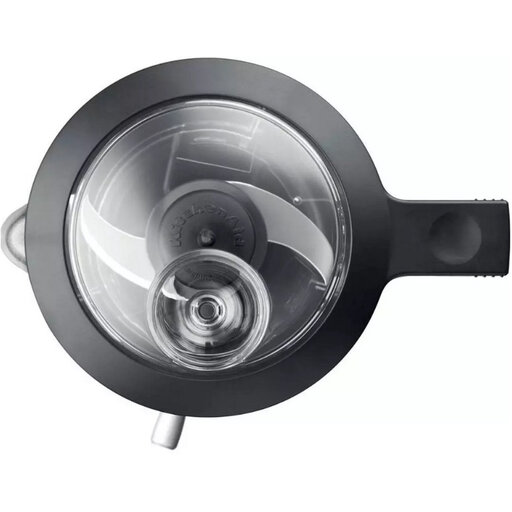
A mini chopper is worth comparing if you’re mainly looking for an appliance to purée ingredients for hummus.
The product information says this appliance isn’t dishwasher-safe. Check the cleaning instructions before choosing it if a quick clean-up is important to you.
Compare your recipe with the permitted processing capacity of the exact model, not just the bowl’s total capacity. The Voedingscentrum uses 240 grams of drained chickpeas for ten portions in its recipe. The final amount will also depend on portion size and any additions.
The Voedingscentrum advises keeping homemade plain hummus in the fridge for 1–3 days and gives 4 °C as the recommended fridge temperature. It also advises not leaving highly perishable food out of the fridge for more than two hours. Use clean utensils when serving.
According to the Rijksoverheid, the seller must provide a solution if a product is faulty. The Netherlands has no fixed statutory warranty period; any manufacturer’s warranty is in addition to your statutory rights.
Yes. The Nederlandse Voedsel- en Warenautoriteit lists CE marking as a requirement for electrical products. The mark is required for a product to be placed on the market, but it doesn’t prove that the model has been independently tested for making hummus.
Ask about the allergy in question and check the labels of all the ingredients you use. The Voedingscentrum’s hummus recipe contains tahini and warns that it can’t guarantee the absence of allergens. The NVWA outlines food labelling requirements for food businesses; those rules don’t automatically mean that someone hosting friends at home has to provide food labels.