
Vandaag of morgen in huis

Kwaliteit gegarandeerd

Welkomstaanbiedingen ontgrendelen: GRATIS bezorging | Tot 80% korting | Gratis 30 dagen JoyPlus-proefperiode
Download de app
A food processor can chop vegetables, mix sauces, grind nuts and sometimes even process meat. Yet many households buy an appliance that ultimately turns out to be too small, difficult to clean or unsuitable for their recipes. The name does not always tell you what the appliance can really do.
Pay particular attention to these three pitfalls:
A food processor is ideal when you want to carry out several preparations with one appliance. Think chopping, mixing, grating, slicing and sometimes grinding. For one small portion of herbs or onion, a mini food processor, food chopper or compact vegetable chopper may be more convenient. If you mainly make smoothies, you will probably need a blender instead. For oranges and lemons, an electric citrus juicer will do the job.
The power should match the ingredients you process:
A pulse function gives you greater control over the texture. This is useful when you do not want to blend everything into a purée. Also check whether the appliance is designed for short pulses. For example, the 750-watt ochama food processor recommends short pulses and a maximum of 60 seconds of continuous use per cycle, followed by a cooling break under heavy loads.
For one person, 500 to 900 ml may be sufficient. Families will usually benefit more from a larger food processor. Pay attention to the difference between:
A food processor with a glass bowl can be a good choice if you are concerned about stains or odours being absorbed by the material. Glass is heavier, however, and can break if knocked hard or exposed to a sudden change in temperature. The Kenwood Easy Chop+ has a 600 ml glass bowl. According to the product information, this bowl is suitable for storing and serving, and several parts are dishwasher-safe.
Before buying, check whether the blades are suitable for your ingredients. A standard chopping blade is not automatically designed for ice, hard nuts or raw meat. For a meat and vegetable chopper, a stable base, sturdy blades and a suitable bowl are important.
An easy-to-clean food processor has removable parts and clear instructions on dishwasher use. Also pay attention to hard-to-reach seams around the blade. Wash parts immediately after processing raw meat or preparing baby food, following the instructions. The motor base must not be submerged in water.
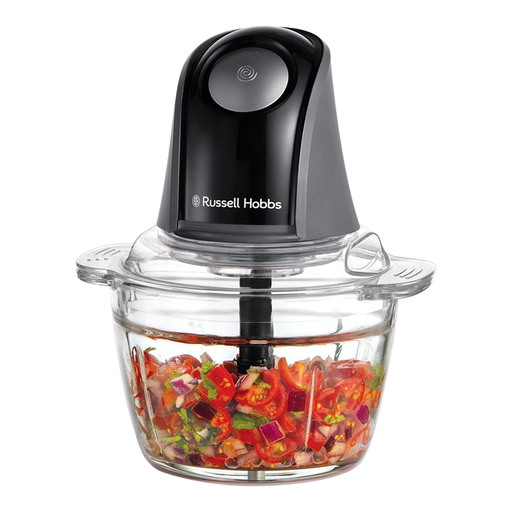
Why it suits this user profile: The single large button is easy to use for anyone who mainly wants to chop onion, herbs, vegetables, meat or nuts in small quantities. The glass bowl has a stated working capacity of 500 ml.
The specifications clearly state 200 watts, one speed and a 500 ml working capacity. This makes it clear from the outset that this is a compact chopper, not a large food processor.
Glass bowl, stainless steel blades, non-slip base and dishwasher-safe parts according to the product information.
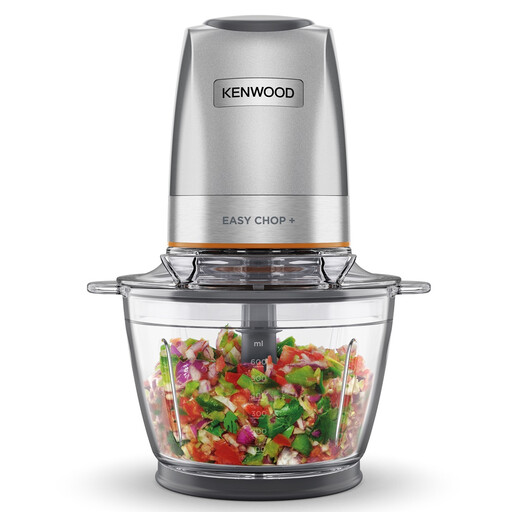
Why it suits this user profile: This model combines a 600 ml glass bowl with two speeds, a QuadBlade system and a non-slip ring. It is well suited to home cooks who value control and the choice of materials.
The two speeds and one-touch operation make it easier to control the difference between coarse chopping and finer processing than with a model offering only one setting.
600 ml glass bowl, ice-crushing function, liquid inlet and removable dishwasher-safe parts according to the product description.

Why it suits this user profile: This model is designed for households looking for multiple functions: chopping, blending, grinding, grating, slicing and preparing baby food. The bowl has a stated capacity of 1.8 litres.
The functions and safety instructions are described clearly. The description specifies, among other things, a maximum of 60 seconds per cycle, ingredients cut into pieces of approximately 2 cm and no boiling liquids above 60 °C.
750 watts, 1.8-litre bowl, removable parts and included functions for chopping, blending, grinding and grating, among other uses.
We have put together a complete, up-to-date list of products that fully meet these strict selection criteria and the applicable European safety regulations.
Choose a blender when liquids, smoothies and puréed preparations are your main focus. The Ninja Detect Blender Pro, for example, has a 2.1-litre jug, a 700 ml cup and a motor power of 1,200 watts. According to the product description, it also has automatic programmes for coarse chopping, fine chopping, grinding and pulsing, among other functions.
An electric chopper is more compact and practical for onion, garlic, herbs, nuts and small quantities of meat. A mini food processor takes up less space, but you will more often need several batches when preparing a family meal. A citrus juicer, such as the ochama Electric Citrus Juicer with a 1.4-litre capacity, is specifically designed for oranges, lemons and similar citrus fruits and is not a substitute for a food processor.
That depends on the blades and accessories. Many models can process vegetables, herbs, nuts, sauces and purées. Some are suitable for meat, smoothies, baby food or grating. Always check the product manual and maximum quantities.
Switch off the appliance, unplug it and wait until the blades have come to a complete stop. Then remove the bowl and blades according to the instructions. Dishwasher-safe parts should only be put in the dishwasher if this is explicitly stated. Clean the motor base with a slightly damp cloth.
Its lifespan depends on use, maintenance, storage and load. Use short pulses when instructed to do so in the manual, do not exceed the fill mark and allow the motor to cool down after heavy preparations. When buying, also check the statutory guarantee and any additional manufacturer’s warranty.
