
The batch-cooking planner
You prepare several meals at once and want to know how much meat you can process in one go. Compare the processing capacity with the total bowl capacity separately.


If you want to chop cooked meat for several meals, choose a food processor with a chopping blade and check how much you can process in one go; the bowl’s total capacity doesn’t tell you this automatically. For pulled meat, such as pulled pork, a suitable beater offers a different approach from a chopping blade. Work in batches and use clean equipment for cooked meat.
You prepare several meals at once and want to know how much meat you can process in one go. Compare the processing capacity with the total bowl capacity separately.
You’re choosing between finely chopped meat and pulled meat. So, check the chopping blade and pulse function, or whether your machine has a suitable beater.
You’re weighing up a compact machine and how easy its parts are to clean against the number of batches you need to process.
First decide whether you want finely chopped or pulled meat. Then compare the amount you can process in one go, the controls and cleaning requirements with the space in your kitchen and your cooking routine.
| What to consider | What should you check? | Who should prioritise this? |
|---|---|---|
| Amount per batch | Compare the stated processing capacity with the total bowl capacity. Check what quantity of cooked meat is permitted for the exact model. | If you’re preparing several meals at once, you’ll want to know how many batches you’ll need. Around 36% of consumers say batch capacity is their top buying priority. |
| Texture you want | Choose between a chopping blade for finely chopping and a suitable beater for pulled meat; check which accessories come with the model. | If you want to choose between finely chopped and shredded meat, the attachment will help determine which method is suitable. Around 29% of consumers prioritise the texture they want. |
| Cleaning and hygiene | Check the cleaning instructions for each part. Use clean equipment for cooked meat, and thoroughly wash anything that has been in contact with raw meat before using it again. | If you want to move on to cooked food straight after chopping, clean food-contact parts are important. Around 21% of consumers give cleaning and hygiene top priority. |
| Storage and portions | Measure the available cupboard space and compare it with the bowl capacity. Also check the permitted amount per batch. | If space is limited, a more compact machine may fit your kitchen better, even if you might need to refill it more often. Around 14% of consumers prioritise storage space. |
According to Magimix, the CS 4200XL has a total capacity of 3 litres and a processing capacity of 1.3 litres. These figures don’t tell you the maximum amount of cooked meat you can process in one go.
Check the permitted quantity for your recipe and, if necessary, plan to work in smaller batches.
If you want to process more meat than fits in one batch, you’ll need to do extra filling and cleaning.
Finely chopping meat and pulling it into strands produce different results. Kenwood’s pulled pork recipe uses a K-beater in the Cooking Chef XL; this doesn’t prove that a food processor with a chopping blade will produce the same texture.
First decide which texture you want, then check which attachment comes with the exact model.
Bosch says the MCM3200W accessories are generally dishwasher-safe, but this doesn’t confirm the cleaning method for every individual part.
Check the manual for each part before putting it in the dishwasher.
Any part that isn’t dishwasher-safe may need to be washed by hand.
Magimix describes the CS 4200XL as a food processor for larger food-preparation tasks and lists chopping meat as one of its uses.
According to Bosch, the MultiTalent 3 MCM3200W has a universal blade, a 2.3-litre bowl and a pulse function.
The MultiPro Go FDP22.140GY is a compact food processor with a chopping blade and pulse function.
These Joybuy picks include food processors and choppers for finely chopping meat and preparing several ingredients.
 No image available
The product title mentions a meat grinder and a capacity of 1.8L for preparing meat and other ingredients.
The title also mentions detachable parts. Check the permitted amount per batch for your recipe.
 No image available
The product name lists three bowls with capacities of 2.5L, 2.2L and 1.8L for preparing different quantities.
The name also mentions two speeds and curved stainless-steel blades; check which bowl is suitable for the amount of cooked meat you need to prepare.
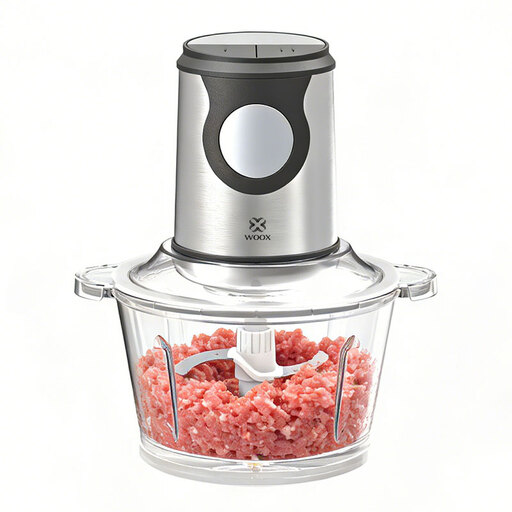 No image available
The product name describes an electric chopper with a 2L glass bowl for chopping meat.
The title mentions stainless-steel blades. Check the permitted amount per batch for your recipe.
 No image available
The product name describes a chopper with a 2L bowl and two speeds for preparing meat.
The title mentions 304 stainless-steel blades. The description recommends pulsing for no more than 30 seconds at a time.
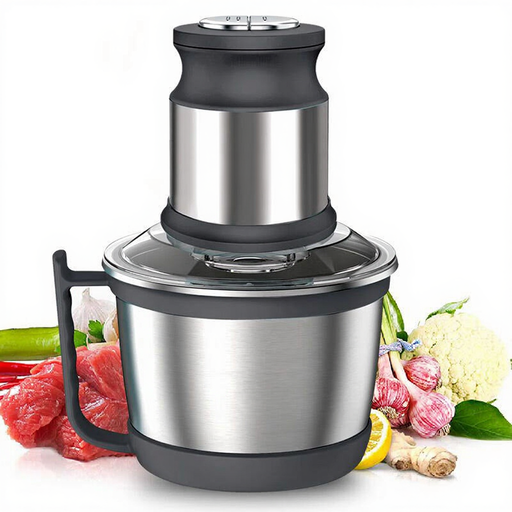 No image available
The product name describes a food processor with a 3L bowl and a meat grinder for preparing meat.
The title also mentions a vegetable chopper. Check the permitted amount per batch for your ingredients.
No. A food processor can be used to chop meat finely; for pulled meat, Kenwood describes a recipe using a K-beater in the Cooking Chef XL. Don’t assume that a food processor with a chopping blade will give you the same result.
Use clean equipment for cooked meat. The Netherlands Nutrition Centre advises keeping equipment that has touched raw meat separate or washing it thoroughly before using it again. Before putting anything in the dishwasher, also check the instructions for the specific appliance and part.
The Netherlands Nutrition Centre advises cooling leftovers and storing them covered in the fridge or freezer within 2 hours of cooking, and keeping your fridge at 4 °C. Eat refrigerated leftovers within two days and, when reheating them, heat them thoroughly until steaming hot.
No, extra cover isn’t a requirement for your statutory guarantee. ACM ConsuWijzer explains that if a product is faulty despite normal use, the seller is responsible for providing an appropriate solution free of charge. In the Netherlands, the statutory guarantee doesn’t have a fixed two-year term.