
Vandaag of morgen in huis

Kwaliteit gegarandeerd

Welkomstaanbiedingen ontgrendelen: GRATIS bezorging | Tot 80% korting | Gratis 30 dagen JoyPlus-proefperiode
Download de app
A food processor can chop, slice, grate, blend, purée, knead and juice. However, not every appliance is suited to every kitchen. A compact model for a small household works differently from a multifunctional food processor with a large bowl and dough attachments.
The most difficult choice often isn’t the number of functions, but what you’ll actually use. A long list of attachments may sound appealing, but separate parts take up space and need washing after every preparation. A high wattage rating also doesn’t, by itself, tell you how large the bowl is, how long the appliance can run continuously or which ingredients it is suitable for.
A motor power rating of 1,000 or 1,300 watts may seem suitable for every task. In practice, the bowl capacity, blade design, speed control and maximum ingredient quantity are also important. A small bowl remains limiting, even when the motor is powerful.
When choosing a food processor for dough, also check the maximum amount of flour. This figure helps prevent you from putting more strain on the appliance than specified.
A product may be described as a multifunctional food processor, while a blender, citrus press or mini chopper is only included with certain versions. Always check what is included in the box.
If you want a food processor with a blender or a food processor with a citrus press, look for that attachment in the specifications rather than relying solely on the product title.
A large bowl is useful for a family, but the appliance also needs to fit on your worktop. Check the height, width and depth, including the space required to open the lid. A compact food processor is easier to store, but usually has a smaller working capacity.
Also consider the weight and non-slip base. A lightweight appliance is practical to move, while a heavier model may remain more stable during kneading.
The stated capacity is not always the maximum amount you can process safely. For example, the Philips Avance HR7776/90 has a 3.4-litre bowl, with a stated maximum capacity of 2.4 litres for dry or liquid ingredients and a maximum of 1,000 grams of flour.
For small portions, herbs or sauces, a bowl of 500 to 900 millilitres is often sufficient. Families and keen home cooks will benefit more from 2 to 4 litres. Also check whether there is a separate blender jug and what its capacity is.
The wattage indicates the appliance’s electrical power, but doesn’t fully guarantee the result. For everyday chopping and slicing, 700 to 900 watts may be suitable. For heavier preparations, such as dough, higher power combined with a suitable dough hook can be useful.
A pulse function provides short bursts for greater control when processing ingredients such as onions, nuts or herbs. Multiple speeds are useful if you want to whisk as well as chop. An appliance with only two settings may instead be simpler to operate.
For a food processor used for chopping and slicing, an S-blade, slicing disc and grating disc are relevant. For dough, you’ll need a dough hook. A whisk or twin beater is suitable for whipped cream and light mixtures.
Also check:
The CE marking is a conformity mark for applicable EU requirements. It is not a quality ranking. The statutory guarantee in the EU is at least two years, while any additional manufacturer’s warranty may vary by brand and product.

Why it suits this profile: This model combines a compact design with a 2.3-litre bowl, 800 watts and two speeds plus a pulse function. It is therefore suitable for everyday food preparation without requiring a large kitchen set-up.
The specifications clearly state which functions are available: chopping, mixing, slicing and grating. This means you don’t have to rely solely on broad marketing descriptions.
800 watts, 2.3-litre bowl, compact design and pulse function. A suitable choice if you want to buy a food processor without immediately opting for a large model.
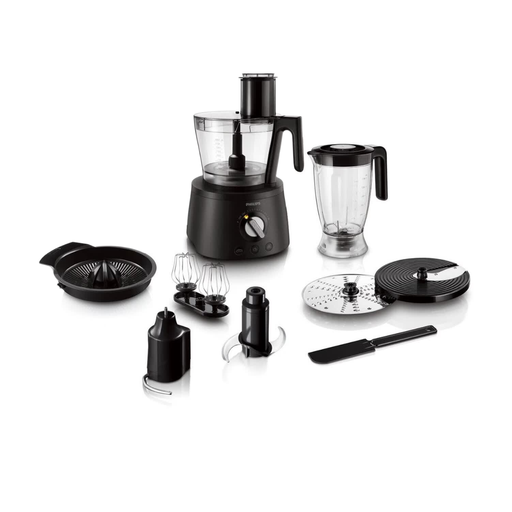
Why it suits this profile: The spacious bowl and comprehensive set of attachments are ideal for households that regularly prepare a variety of foods, from dough and whipped cream to chopped ingredients and freshly squeezed citrus juice.
The product details specify the 3.4-litre bowl, 12 speeds plus pulse and the individual attachments. This makes the choice easy to verify rather than dependent solely on the number of functions listed.
1300 watts, maximum flour capacity of 1000 grams, metal dough hook, citrus press and dishwasher-safe attachments.
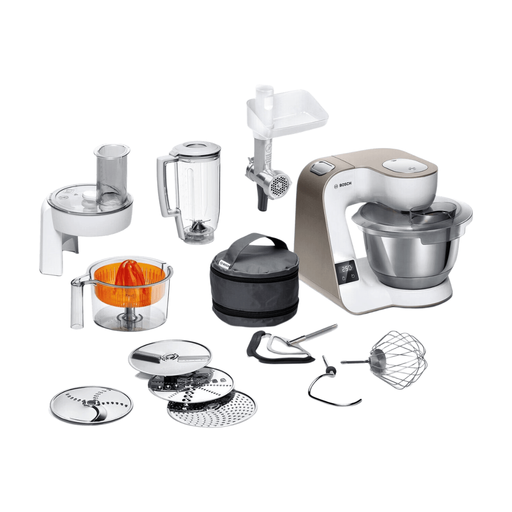
Why it suits this profile: This model is designed for users who combine dough, batter and multiple kitchen tasks. The described set includes a dough set, meat grinder, citrus press and blender jug, among other attachments.
The attachments are listed individually and the maximum capacity is stated as 2.7 kilograms. Before use, however, check the instructions for each preparation and attachment.
1000 watts, seven speeds, pulse function, integrated scales and a 1.25-litre blender jug.
We’ve put together a complete, up-to-date list of products that fully meet these strict selection criteria and the applicable European safety regulations.
A food processor is generally designed for chopping, slicing, grating, mixing and puréeing. A stand mixer may also have a mixing bowl with a whisk or dough hook, making it more suitable for batter and dough. Product classifications vary by brand, so pay particular attention to the included attachments.
For everyday chopping, slicing and grating, 700 to 900 watts is often a practical range. For heavier preparations, also consider the bowl, dough hook, maximum flour quantity and recommended operating time. Wattage alone does not determine whether an appliance is suitable for your recipes.
Always unplug it from the mains first. Then remove the attachments according to the instructions and handle the blades carefully. Dishwasher-safe parts can go in the dishwasher if the manufacturer states that they can. The motor base must not be immersed in water. Clean the parts immediately after they come into contact with raw meat or other fresh ingredients.
