
Vandaag of morgen in huis

Kwaliteit gegarandeerd

Welkomstaanbiedingen ontgrendelen: GRATIS bezorging | Tot 80% korting | Gratis 30 dagen JoyPlus-proefperiode
Download de app
A food processor can replace several kitchen appliances, from a mini chopper and vegetable slicer to a smoothie blender. However, a purchase can sometimes disappoint in practice. An appliance may appear powerful based on its wattage, for example, but prove less useful if the bowl is small, accessories are missing or cleaning takes too long.
As a Joybuy Product Recommendation Officer, I therefore focus mainly on verifiable specifications and how you use the appliance at home. Below, you’ll find what to look for, which pitfalls are common and which models suit different households.
A 1,200-watt motor sounds appealing, but wattage does not tell you everything about the result. The shape of the blades, the bowl capacity, the available speeds and the maximum operating time are also important. A powerful motor can also mean more noise and higher electricity consumption.
So look at the combination of:
Some models, for example, specify that you should use the motor for a maximum of one minute at a time, followed by two minutes of cooling. This is relevant if you regularly want to process hard vegetables, nuts or ice.
A multifunctional kitchen machine is only versatile if the accessories actually suit your recipes. Check whether an S-blade, blender jug, whisk, dough hook, mini chopper and grating and slicing discs are included.
A product with only a stick blender and small chopping bowl is suitable for soup, sauces and baby food, but it does not replace a fully fledged food processor for grating, kneading dough or preparing large quantities of vegetables.
Blades and discs should be safely removable. Dishwasher-safe parts can save time, but always check the temperature limit and which parts are suitable for this. The motor base must not be immersed in water.
Also pay attention to gaps around the spindle, lid lock and feed chute. After processing raw meat or baby food, immediate cleaning is important to prevent food residue from drying.
For one or two people, a bowl of around 1 to 1.5 litres is often practical. This takes up less space and means you do not have to use a large bowl when it is only half full. Families will benefit more from 1.8 to 2.3 litres. For dough and larger quantities, a kitchen machine with a 3-litre mixing bowl or larger may be more suitable.
Pay attention to the difference between the bowl’s total capacity and its usable capacity. When processing liquids, follow the maximum fill line to prevent splashing and overflowing.
For everyday chopping, slicing and puréeing, a motor of around 600 to 900 watts is often suitable, depending on the accessories. For heavy dough, hard ingredients or more intensive use, a higher stated power rating may be worth considering.
A pulse function provides short, powerful bursts. This is useful for coarse chopping, salsa and onions, as it gives you more control over the texture. Multiple speeds are particularly useful when processing both soft ingredients and hard vegetables.
Blades and discs are sharp. Choose a model with a securely locking lid and, where stated, a safety lock that prevents the motor from starting when the bowl has not been fitted correctly. Place the appliance on a stable, dry surface and unplug it before changing accessories.
Check the product description for materials such as stainless steel blades and BPA-free components where this matters to you. A visible CE mark is mentioned for some products, but always check the latest product information and manual.

Why it suits this profile: This compact food processor is designed for everyday use and takes up relatively little space on the worktop. The 2.3-litre bowl is suitable for small families and preparing normal-sized batches of meals.
The product information lists specific functions: chopping, mixing, slicing and grating. With two speeds and a pulse function, you are not buying an appliance marketed solely on the basis of a high wattage.
800 watts, 2.3-litre bowl, two speeds plus pulse setting, and accessories for chopping, mixing, slicing and grating.
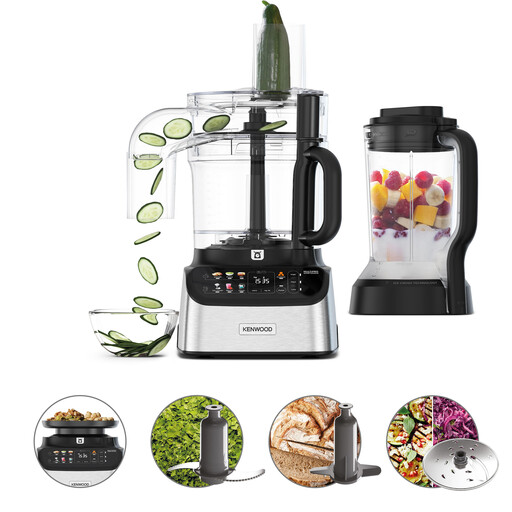
Why it suits this profile: This model combines a food processor with a blender, digital scales and automatic programmes. It is ideal for keen cooks who want to prepare a variety of dishes with one appliance.
The functions are clearly described: weighing, mixing, kneading, puréeing, chopping, grating, slicing and blending. However, check that you genuinely need the many accessories.
1000 watts, 1.5-litre blender jug, 3-litre bowl, digital scales, six programmes, and a disc for slicing and grating.
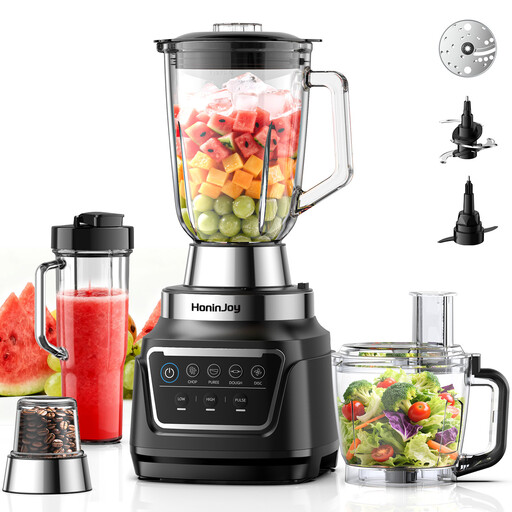
Why it suits this profile: The accessory package is designed for users who want to make smoothies, sauces, dough, chopped ingredients and ground spices using one base unit.
Rather than simply listing broad marketing claims, the product description names the individual bowls and accessories. Before buying, check which parts are included in your package.
Stated maximum power of 1300 watts, 2-litre bowl, 1.5-litre blender jug, separate grinder and dishwasher-safe removable parts according to the product description.
We have put together a complete, up-to-date list of products that fully meet these strict selection criteria and the applicable European safety regulations.
A stick blender is useful for soups, sauces and small portions. A set with a mini chopper, whisk and measuring jug may be sufficient for a small household. A food processor with a blender offers more options for slicing, grating and preparing larger quantities.
A fully fledged kitchen machine with a mixing bowl and dough hook is better suited to anyone who often makes bread dough, cakes or large batches. If you mainly prepare smoothies, a smoothie blender with a jug of around 1.5 to 2 litres may be all you need.
Look out for inconsistencies on a product page. With some offers, the product name and description do not fully match. For example, the supplied description for the Camry CR 4498 refers to a 1000-watt milk frother, while the product name mentions a food processor and blender. In this situation, check the current photos, accessories and manual before placing your order.
Its lifespan depends on use, maintenance and workload. Use the appliance according to the stated operating intervals, do not exceed the maximum fill quantity and allow the motor to cool when instructed in the manual. Regularly check the blades, lid and cable for signs of wear.
It can be, because you use one motor base with several accessories. However, a multifunctional machine often has more parts to clean and store. So do not compare only the purchase price; also consider power consumption, maintenance and the functions you will actually use.
Only if the manual explicitly allows it. Some product information states that liquids above a certain temperature must not be processed because of steam pressure. If necessary, allow soup to cool first and always follow the maximum fill line and safety instructions for the specific model.
