
Vandaag of morgen in huis

Kwaliteit gegarandeerd

Welkomstaanbiedingen ontgrendelen: GRATIS bezorging | Tot 80% korting | Gratis 30 dagen JoyPlus-proefperiode
Download de app
A food processor can take over a lot of the manual work when making bread, cakes, pizza, whipped cream and sauces. However, it’s not wise to only look at the highest wattage or the largest bowl. A powerful motor can be impractical if the machine slides around on the worktop, while a large bowl adds little value if you usually make small portions.
In this buying guide, you’ll discover which specifications matter, which marketing claims you should view critically, and which type of food mixer, stand mixer or electric food processor suits your needs.
A higher wattage sounds appealing, but the figure doesn’t fully tell you how a motor performs during kneading. Gearing, speed, maximum operating time and the permitted amount of dough also play a role.
So, pay attention to the combination of:
Also check whether the product title and technical description match. With the Bosch MUMS2AW00, the product title states 1000W, while the product description mentions 700W. That difference is a reason to check the current specifications and manual before purchasing.
A 5 or 6-litre bowl may seem spacious, but you usually can’t fill it completely. For a food processor with a bowl, the permitted amount of dough or batter is what really matters. An overfilled bowl can lead to poor mixing, splashing and extra strain on the motor.
Choose a capacity based on your usual portions:
A multifunctional food processor with a blender, meat grinder and extra attachments sounds versatile. Think beforehand about which functions you’ll actually use. Extra accessories take up space and can make cleaning more complicated.
For baking, these three attachments are usually sufficient:
A mixer for baking should start gently and offer multiple speeds. A low setting prevents flour from flying out of the bowl. Higher settings are useful for airy preparations, but always follow the manufacturer’s instructions.
A pulse function can be handy for short tasks. With heavy dough, it’s not just the motor power that matters, but also the specified maximum quantity and rest time. Some models may only run for a few minutes at a time during intensive kneading.
Stainless steel is sturdy, absorbs few odours and is generally easy to clean. A plastic bowl can be lighter and, on some models, is dishwasher-safe. Don’t just look at the material, but also at:
Non-slip feet, suction pads or a heavy base help to prevent movement on the worktop. No construction makes a machine completely silent. So check whether a brand specifies a noise level and under what conditions it was measured.
A tilting head makes it easier to place the bowl and attachments. A locking mechanism is important: the head must be securely fastened before the motor starts.

Why this fits the profile: This compact stand mixer has a 3.8-litre bowl and comes with a whisk, beater and dough hook. That’s a straightforward foundation for cakes, pastries and lighter doughs.
The product information states a maximum quantity of 1.7 kg of dough and 2.4 kg of batter. This allows you to match the capacity to your recipe rather than just the bowl volume.
3D planetary mixing action, non-slip feet and dishwasher-safe accessories according to the product description.
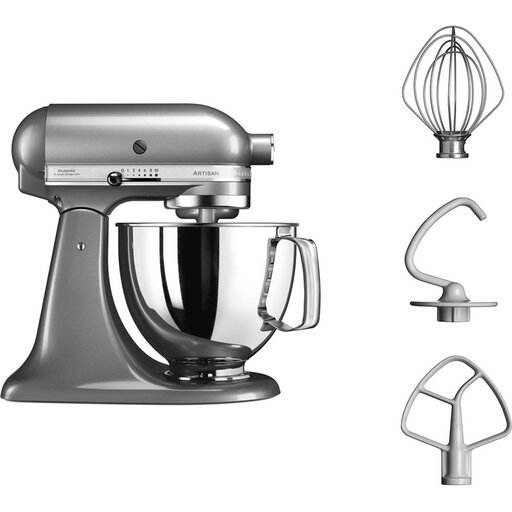
Why this fits the profile: The metal housing, direct drive and 4.8-litre stainless steel bowl suit users who want a fixed food processor for regular mixing and whisking.
The product information clearly states that the machine, with 300W, is not intended for heavy dough. This allows you to choose this model specifically for batter, whipped cream and lighter preparations.
10 speeds, direct drive and included whisk, flat beater and dough hook.
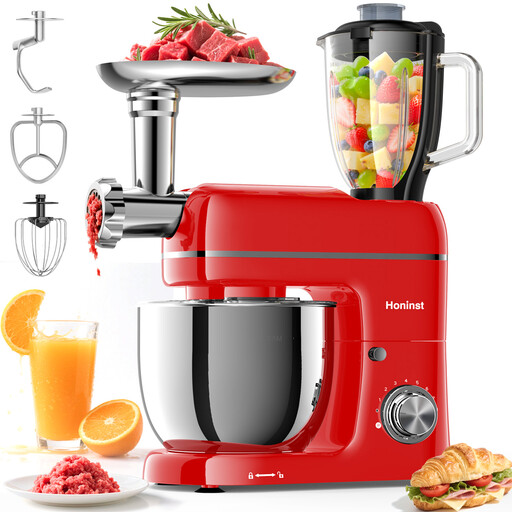
Why this fits the profile: If you want to mix, blend or grind as well as knead and whisk, this model offers multiple functions in one appliance.
The machine has a safety lock on the tilting head and a pulse setting. Only use the included accessories according to the manual and do not exceed the maximum quantities.
6 QT stainless steel bowl, up to 1300W according to the product description, 8 speeds and functions for mixing, kneading, blending and grinding.
A dough mixer stays practical for longer when you follow the basic rules:
A food processor for bread and cake therefore requires a different choice than a small mixer for just whipped cream. Look at your recipes, portion size, available space and cleaning routine. For extra kitchen helpers, such as choppers and blenders, you can also browse the range of newest kitchen tools.
We’ve put together a full, up-to-date list of products that fully meet these strict selection criteria and current European safety regulations.
Choose a model with a dough hook, clear maximum dough capacity, non-slip features and motor protection. Pay particular attention to the operating time and rest period. A high wattage alone is no guarantee that the machine can knead heavy dough for a long time.
For regular baking in a family, 5 to 6 litres is often practical. If you usually make small amounts, 3.8 to 4 litres can save space. Alongside the capacity, look at the minimum amount the whisk or beater can handle properly.
The consumption depends on the power and the time the machine runs. A 700W appliance running for one hour theoretically uses 0.7 kWh, but a food processor is usually on for much less time. Use the lowest suitable speed and respect the recommended running time.
