
Vandaag of morgen in huis

Kwaliteit gegarandeerd

Welkomstaanbiedingen ontgrendelen: GRATIS bezorging | Tot 80% korting | Gratis 30 dagen JoyPlus-proefperiode
Download de app
A food processor can knead, mix, chop, slice, grate or blend. That sounds versatile, but it is also where unsuitable purchases often arise. An appliance with lots of accessories will not automatically become a regular fixture on your worktop. And a high wattage does not tell you everything about how easy a food processor is to use.
So watch out for these three common pitfalls:
The first choice is the type of appliance. A stand mixer or kitchen mixer is particularly suitable for batter, cream and dough. A food processor generally works better for chopping, slicing, grating and puréeing. A food processor with a blender combines several functions, but often takes up more space and requires extra cleaning.
Use these rules of thumb:
A hand mixer or stick blender is usually compact and quick to use. These appliances are less suitable for large quantities of bread dough, but are handy for soup, sauce, whipped cream and small portions.
Do not compare only 450 W with 1,000 W or 1,300 W. Also check the permitted operating time and required breaks. For example, the product information for the AUCMA Stand Mixer states that the appliance may operate for a maximum of six minutes at a time. For some stick blenders and food processors, this is even shorter.
A higher power rating can be useful for heavy dough or hard ingredients, but the manufacturer determines the permitted load. Claims such as “effortlessly processes heavy dough” come from the brand’s product description, so treat them as marketing claims and check the specific capacity limits in the manual.
A large bowl is practical for families and bigger baking projects. However, pay attention to the difference between the bowl’s total capacity and the maximum quantity of ingredients.
Examples from the product specifications:
Also measure the space available on your worktop. A dough machine with a tilt-head design needs room for opening the head and changing accessories.
A stainless-steel mixing bowl is generally easy to wipe clean and suitable for regular use. With plastic bowls, the maximum temperature and dishwasher safety are particularly relevant. Check whether each individual part is dishwasher-safe; this does not automatically apply to the motor base.
Look out for features such as:
Chopping blades, grating discs and accessories for a food processor with a meat grinder are sharp. Always unplug the appliance before changing or cleaning any parts.

Why it suits this profile: The combination of a 6-litre stainless-steel bowl, six speeds and three standard accessories is straightforward for anyone mainly looking to make cakes, bread, pizza or pastries.
The product description lists specific details: 450 W, six speeds, pulse function, splash guard and a maximum continuous operating time of six minutes.
6-litre bowl, tilt-head design, dough hook, whisk and beater; the manufacturer also lists non-slip suction cups.
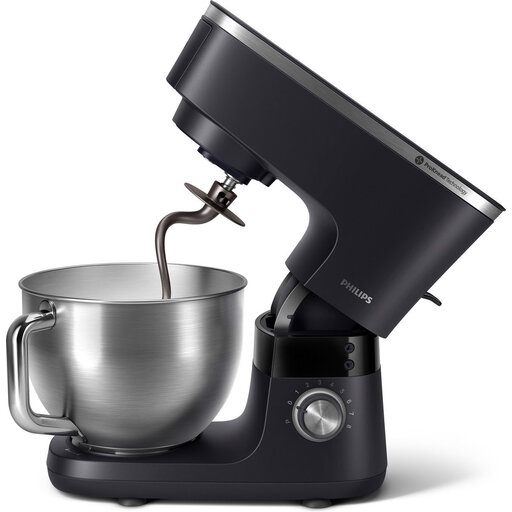
Why it suits this profile: This model combines a kitchen mixer with a blender and meat grinder, so you need fewer separate appliances for baking, sauces, smoothies and mince.
The accessories and capacities are listed separately: 5.5-litre bowl, 1.5-litre glass blender and meat grinder. Before buying, check the exact contents of the package.
1,000 W, eight speeds, stainless-steel bowl, timer with automatic shut-off and compatibility with the HomeID app.
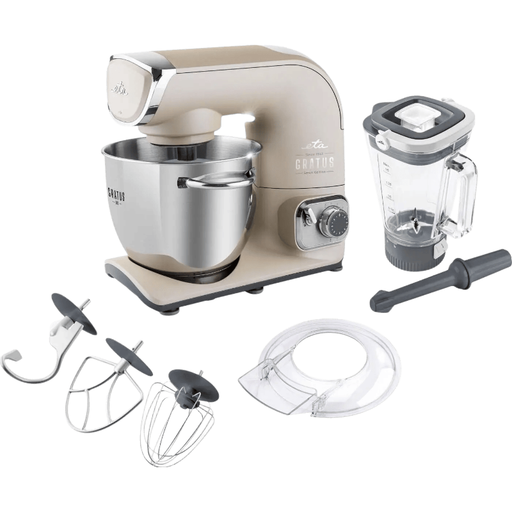
Why it suits this profile: The metal housing, planetary mixing action and stated maximum dough capacity make it suitable for users who regularly prepare larger quantities.
The specifications state a maximum dough capacity of 2.5 kg, a thermal fuse, safety lock and non-slip base. This provides more useful guidance than wattage alone.
1,500 W, 5.5-litre stainless-steel bowl, 1.5-litre glass blender and continuous speed control with pulse function.
We have put together a complete, up-to-date list of products that fully meet these strict selection criteria and the applicable European safety regulations.
Yes, a stand mixer with a dough hook can be suitable for this. Check the maximum dough quantity, recommended speed and permitted operating time. Allow the appliance to rest whenever the manual instructs you to do so. A large bowl does not mean that you can fill it completely with heavy dough.
Its lifespan depends on use, maintenance, load and materials. Use the machine according to the manual, do not exceed the maximum quantities and clean the accessories immediately after use. In the European Union, consumers have a legal guarantee of at least two years for conformity; additional terms may vary by product and situation.
Consumption depends on the power rating and operating time. A 1,000 W motor theoretically uses 1 kWh when running at full power for one hour, but a food processor usually runs for shorter periods and not continuously at maximum power. So consider how you actually use it: short preparation times and the correct speed have more impact than the wattage printed on the packaging.
