
Vandaag of morgen in huis

Kwaliteit gegarandeerd

Welkomstaanbiedingen ontgrendelen: GRATIS bezorging | Tot 80% korting | Gratis 30 dagen JoyPlus-proefperiode
Download de app
A food processor can mix, knead, chop, grate or blend. However, one appliance is not automatically suitable for every task. A stand mixer for bread dough works differently from a food processor for vegetables, while a hand blender is particularly useful for soups, sauces and smoothies.
The biggest purchasing mistakes often result from three familiar pitfalls:
First, think about the preparations you make each week. For bread, pizza, cakes and biscuits, a food processor for baking with a sturdy mixing bowl, dough hook and multiple speeds is a sensible choice. A kitchen mixer or stand mixer takes the effort out of kneading.
Do you mainly make hummus, pesto, baby food, chopped vegetables or smoothies? In that case, a food processor, blender or hand blender may be a better fit. A multifunctional food processor can combine several functions, but it usually takes up more space and requires additional cleaning.
Also consider your worktop. An appliance around 40 centimetres high or wide may be difficult to store beneath wall cabinets. Check the weight and the grip of the feet too, especially if you regularly work at high speed.
Wattage is a useful point of reference, but it is not a complete measure of performance. Look at the difference between peak power and rated or continuous power. The Monsga SM100, for example, lists 1,000 watts of peak power and 600 watts of rated power. This gives a more realistic impression of its suitability for prolonged use.
For dough, a low speed with sufficient torque is more important than simply having a high number. Therefore, check:
A powerful food processor may be able to handle heavy dough according to the product information, but never exceed the recommended quantity. AUCMA, for example, states that the appliance must not be used for more than six minutes continuously. Usage limits like these are more important than a marketing claim about speed.
A food processor with a mixing bowl is practical for families and home bakers, but look beyond the number of litres. Pay attention to the recommended capacity for batter and dough. A stainless-steel bowl is generally easy to clean and suitable for everyday use. Also check whether the bowl has a handle and whether it is dishwasher-safe.
For smaller households, a 4- to 5-litre bowl is often sufficient. If you make several loaves or large quantities of batter, you may want to consider a bowl of 6 litres or more. However, a larger bowl usually makes the appliance heavier and takes up more storage space.
A standard stand mixer set often consists of a whisk, flat beater and dough hook. For everyday convenience, a splash guard, tilting head, locking mechanism and non-slip feet are useful additions.
For chopping blades and grating discs, other points are important:
A CE mark shows that the manufacturer declares compliance with the relevant European requirements. It does not guarantee that an appliance is suitable for every preparation. Always follow the manual and use only approved accessories.
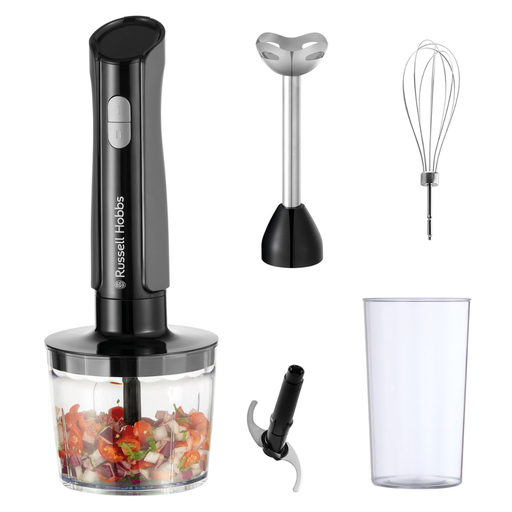
Why it suits this profile: For anyone with limited space who mainly wants to prepare soups, smoothies, sauces and small portions.
The specifications list the 600 ml blending beaker and 500 ml chopper bowl separately, making the available working space clear.
500 watts, two speeds, removable dishwasher-safe parts and a compact design.

Why it suits this profile: A practical choice for home bakers who regularly make dough, cake batter and whipped cream.
The product information lists both 1,000 watts of peak power and 600 watts of rated power, and recommends a maximum of 5 litres for the 6-litre bowl.
8 speeds, a stainless-steel bowl, tilting head, splash guard and three listed main accessories.
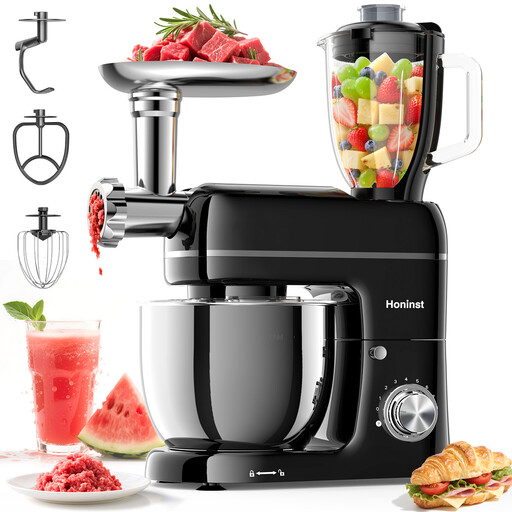
Why it suits this profile: For households that want to mince meat and make smoothies or sauces as well as mix and knead.
The product description lists the functions and included parts separately, including the meat mincer, blender, whisk, beater and dough hook.
Up to 1,300 watts according to the product information, a 6 qt bowl, 8 speeds, pulse function and safety lock.

Why it suits this profile: Ideal for anyone who wants to chop, slice and grate vegetables, or process ingredients for sauces or baby food.
The product information states a capacity of 1.8 litres and recommends short pulses and cooling breaks for demanding preparations.
750 watts, blending and chopping functions, slicing and grating discs, removable parts and stated dishwasher-safe components.
We have put together a complete, up-to-date list of products that fully meet these strict selection criteria and the applicable European safety regulations.
A stand mixer with a dough hook can knead bread dough, provided you respect the maximum quantity and operating time. Usually, use a low to medium speed and check that the machine remains stable. For regularly handling heavy dough, torque, non-slip feet and overload protection are more important than the highest wattage alone.
The lifespan depends on how often it is used, the load, cleaning and storage. Allow the motor to cool down as instructed in the manual and do not use accessories that have not been approved by the manufacturer. A metal bowl can withstand daily use, but blades and plastic parts require careful maintenance.
Power consumption depends on both the wattage and the operating time. A 1,000-watt appliance running for ten minutes uses less energy than the same appliance running for an hour. Pulse functions, short operating sessions and following the recommended capacity help to limit unnecessary energy use.
