
Vandaag of morgen in huis

Kwaliteit gegarandeerd

Welkomstaanbiedingen ontgrendelen: GRATIS bezorging | Tot 80% korting | Gratis 30 dagen JoyPlus-proefperiode
Download de app
A food processor can slice vegetables, mince meat, blend sauces and knead dough. Yet many households end up buying a model that is too large, too limited or difficult to clean. A powerful motor alone says little about how practical an appliance is for everyday use.
In this buying guide from the Joybuy Product Recommendation Officer, you’ll learn what to look for, which marketing claims to assess with caution and which type of food processor best suits your kitchen.
A 1300W food processor may sound more powerful than a 700W model, but wattage does not tell the whole story. The shape of the bowl, blade design, speed control and recommended maximum quantity also determine how smoothly an appliance performs.
A 700W food processor can be perfectly adequate for vegetables, cheese, sauces and smaller batches of dough. A 1300W model makes more sense if you regularly prepare large portions or heavier dough. Always check the maximum capacity. For example, although the Philips HR7776/90 has a 3.4-litre bowl, the specified maximum capacity is 2.4 litres for dry or liquid ingredients.
The term “multifunctional” can mean different things. Some models include only a chopping blade and mixing bowl. Others also come with a whisk, dough hook, grating and slicing discs, blender jug or citrus press.
Always check the contents of the package. A food processor with accessories is only worthwhile if you will actually use those functions. If you mainly chop onions, herbs and nuts, a compact chopper may be more practical than a large food processor.
Slicing discs, blades and lid components can create a considerable amount of washing-up after use. Check whether the parts are removable and dishwasher-safe. Also consider the dimensions: an appliance that can remain permanently on the worktop is more likely to be used than a large model that is difficult to take out of a kitchen cupboard.
Also look for a safety lock, non-slip feet and the maximum continuous operating time. Some compact models are designed to be used in short pulses, with time for the motor to cool down between cycles.
A 700W food processor is often sufficient for a small household. If you regularly prepare bread dough, hard vegetables or meals for the whole family, it is better to look for a model with a larger bowl and higher stated power. According to the product description, the Philips HR7776/90 features a 1300W motor, 12 speeds and a pulse setting.
The capacity stated on the packaging does not always correspond to the amount you can safely process. Therefore, check the following:
For single-person households, a mini food processor of approximately 400 to 900 ml is usually more convenient. For families, bowls ranging from 2 to 3.4 litres are more practical. However, a large bowl does not automatically guarantee even results when processing small quantities.
A stainless-steel blade is standard in choppers and food processors. Check whether the blade can be removed and whether the bowl is durable enough for everyday use. With a food processor for vegetables and meat, it is advisable to process raw meat immediately after use and clean all components thoroughly.
Do not use boiling liquids unless the product information explicitly permits it. For example, the instructions for the ochama model state that liquids above 60°C must not be processed. Always follow the manual for the appliance you choose.

Why it’s a good fit: The 2.3-litre bowl and compact footprint are practical for everyday meals in a smaller kitchen.
The product information specifies 800W, two speeds and a pulse function. This keeps operation straightforward without a long list of programmes you may never use.
2.3-litre bowl; chopping, mixing, slicing and grating functions; dimensions of approximately 39.7 × 26.3 × 36.9 cm.
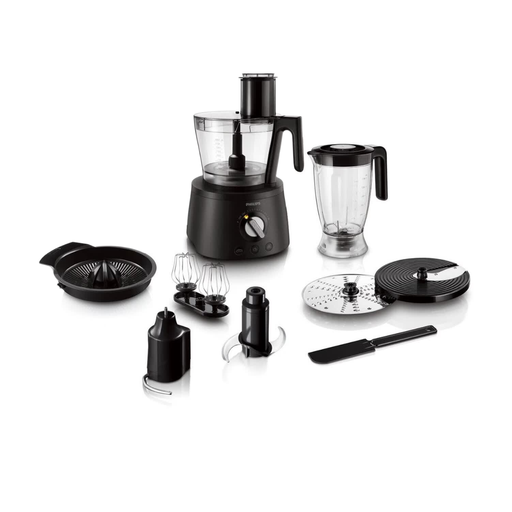
Why it’s a good fit: Ideal for households looking for one appliance to handle multiple preparations while offering generous working space.
The included accessories are clearly specified, including a dough hook, whisk, citrus press and slicing discs.
1300W, 3.4-litre bowl, 12 speeds plus pulse function, and dishwasher-safe accessories according to the product details.
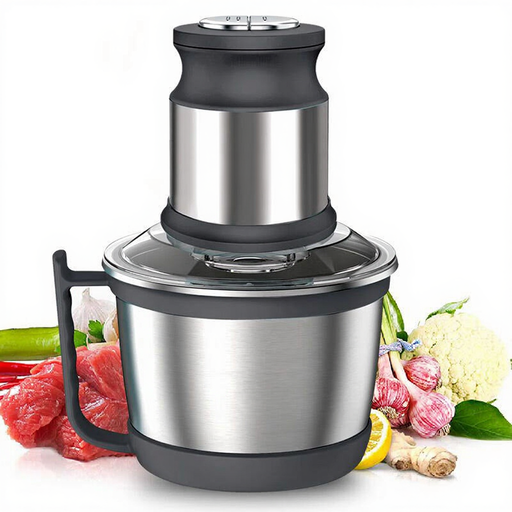
Why it’s a good fit: The 3-litre bowl is designed for larger portions, and the product description lists vegetables, nuts and meat among its chopping capabilities.
The functions are clearly described as chopping and grinding. Before buying, check the manual for portion sizes and operating times.
800W, 3-litre bowl, 220–240V and an EU plug according to the product information.
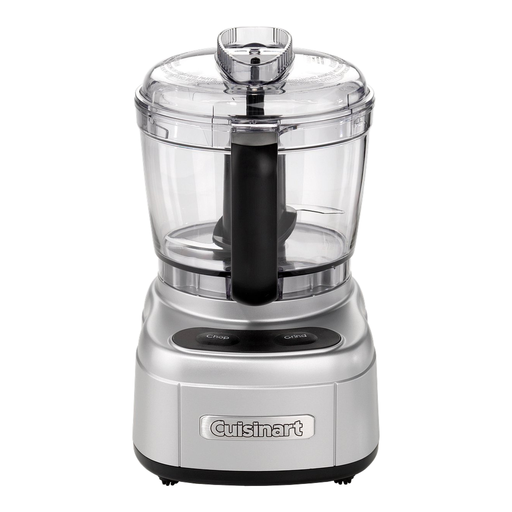
Why it’s a good fit: The 900ml bowl is ideal for pesto, hummus, herbs, nuts and other small-batch preparations.
The appliance focuses on chopping and grinding rather than functions you may not use. According to the product description, the components are dishwasher-safe.
0.9-litre capacity, two programmes, pulse control and a stainless-steel chopping and grinding blade.
Discover a current selection of kitchen machines and food processors with different capacities, power levels and accessories.
That depends on the model and its manual. A food processor with meat grinder or electric chopper may be designed for this purpose, but pay attention to the maximum quantity, pulse duration and blade construction. Clean the bowl, lid and blade immediately after use, and keep raw meat separate from other ingredients.
Its lifespan depends on how it is used, cleaned and loaded. Do not treat the maximum fill level as a fixed guideline for every preparation, and allow the motor to cool down when instructed in the manual. Also check the warranty before buying. According to the product information and EU consumer rules, many of the models featured in this selection have a statutory warranty period of at least two years.
Energy consumption depends on the wattage and operating time. A 1300W model uses more power per minute than a 700W appliance, but a food processor typically runs only for short periods. For everyday chopping, a compact food processor with an appropriate power rating is often sufficient; choose a more powerful model when you genuinely need the additional capacity and functions.
