
Vandaag of morgen in huis

Kwaliteit gegarandeerd

Welkomstaanbiedingen ontgrendelen: GRATIS bezorging | Tot 80% korting | Gratis 30 dagen JoyPlus-proefperiode
Download de app
A food processor can chop vegetables, mix ingredients, knead dough or grind nuts. Yet many people end up buying an appliance that proves too big, too limited or difficult to clean. The number of features listed on the packaging doesn’t always reflect how it performs in daily use.
When choosing a food processor, watch out for three common pitfalls:
A good choice therefore starts not with the appearance, but with your regular cooking tasks, available space and desired portion size.
Power is measured in watts. Models in this selection range from 350 to 900 watts. For soft vegetables, herbs and sauces, a lower power level is often sufficient. If you regularly process hard vegetables, nuts, dough or ice, it’s better to look for a model with more power and a suitable blade or disc accessory.
Also check how many speed settings are available. Two speeds and a pulse function already give you control over the texture. A pulse setting is handy when you want to chop ingredients coarsely without turning them into a puree.
A mini food processor or compact food processor of around 500 to 900 millilitres works well for herbs, dips, small portions of onion or baby food. For a family, models with a bowl of 1.3 to 2.3 litres are more practical.
Bear in mind that the external dimensions aren’t the same as the usable capacity. Also check whether the appliance fits on your worktop and where accessories are stored. A multifunctional kitchen machine can save space if chopping, grating, slicing and blending are all possible with one motor base.
Decide in advance which functions you’ll actually use:
Check whether bowls are made of glass, plastic or stainless steel, and whether parts can go in the dishwasher. Sharp blades should always be removed and cleaned carefully. The motor base must never be submerged in water.
The following models have been selected based on verifiable features such as power, capacity, functions and accessories. They suit different households and cooking habits.

Why this fits the profile: This model combines blending, chopping and grinding in one appliance with a 1.5-litre capacity. That makes it suitable for everyday preparations without jumping straight to a large kitchen appliance.
The product information states three speeds, a 600W motor and removable parts. Do check the instructions for maximum running time before use.
1.5-litre capacity, 600W power, functions for chopping, mixing and grinding, and a design that, according to the product description, is easy to clean.
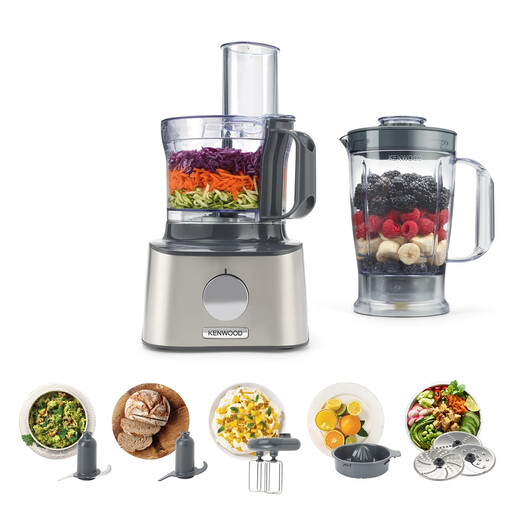
Why this fits the profile: The 2.1-litre bowl and various accessories suit households that regularly prepare larger quantities and want to combine multiple techniques in one kitchen machine.
The functions are clearly described: chopping, slicing, grating, mixing, kneading, whisking and juicing. This means you can match the accessories to your own recipes.
800W power, 2.1-litre bowl, 1.2-litre blender capacity, two programmes and dishwasher-safe accessories according to the product information.
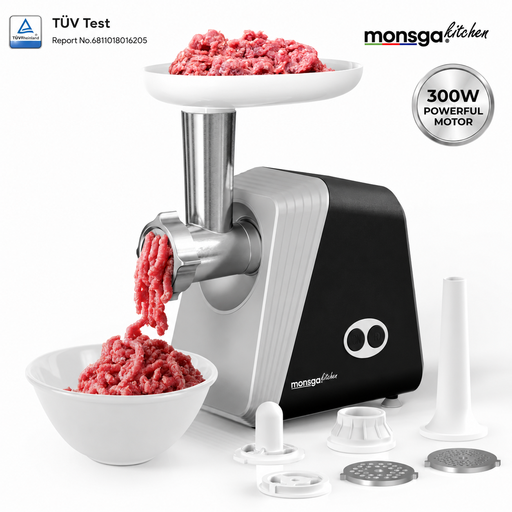
Why this fits the profile: This is primarily an electric chopper and meat grinder for anyone who wants to make their own mince, sausages or other preparations using ground ingredients.
The three grinding plates allow for different textures. According to the safety information, the parts must be washed by hand and dried completely.
300W nominal power, up to 1200W maximum stated power, three grinding plates and accessories for sausages and kibbeh.
If you have limited storage space, consider the Kenwood Duo Prep CHP80 Chopper Grinder. According to the product information, this appliance combines a chopping function with a separate grinding function, has a 500-millilitre capacity and operates at 800 watts with two speeds. The stackable parts and dishwasher-safe components are practical for small kitchens.
An alternative is the Kenwood Easy Chop+ CHP62 with a 600-millilitre glass bowl, two speeds and a QuadBlade system. For a slightly roomier but still compact solution, the Kenwood FDP22 MultiPro Go offers a 1.3-litre bowl, 650 watts of power and a slicing and grating disc.
If you mainly want to slice, grate, chop and blend, the Kenwood FDP23.380GR GO Blend has a 1.3-litre bowl, 900 watts, seven speed levels and a 600-millilitre personal blender.
We’ve put together a full, up-to-date list of products that fully meet these strict selection criteria and comply with current European safety regulations.
A food processor is usually designed for chopping, slicing, grating, mixing and sometimes blending. A kitchen machine can often also knead dough or whisk ingredients. Always check the included accessories; the names aren’t used consistently across different brands.
The lifespan depends on usage, maintenance and workload. Use the appliance within the stated time limits, don’t process unsuitable hard objects and let the motor cool down between heavy cycles. The statutory guarantee in the EU is at least two years; some manufacturers also mention an additional warranty.
The consumption depends on the wattage and the duration of use. An 800-watt model uses a maximum of 0.8 kWh per hour when the motor runs continuously at that power. In practice, a food processor usually works for just a few minutes per preparation. So alongside the power, also consider the speed of preparation and the portion size.
