
Vandaag of morgen in huis

Kwaliteit gegarandeerd

Welkomstaanbiedingen ontgrendelen: GRATIS bezorging | Tot 80% korting | Gratis 30 dagen JoyPlus-proefperiode
Download de app
A food processor can take a lot of preparation work off your hands. However, the difference between a practical purchase and an appliance that ends up unused in the cupboard is often greater than the marketing copy suggests. Someone who mainly bakes needs different functions from a family that chops vegetables, makes sauces and prepares smoothies.
When choosing a food processor, therefore, don’t just look at the wattage or the number of accessories. The capacity, drive system, cleaning requirements and available workspace all have at least as much influence on how enjoyable the appliance remains to use.
A motor rating in watts indicates how much electrical power the appliance uses or, according to the product information, can deliver. It does not tell you on its own how well a food processor kneads dough or chops ingredients. The transmission, blade or beater design, operating time and maximum quantity also play a role.
Some product descriptions mention peak power, for example. This is not the same as the rated power during prolonged use. With a mixer for baking, it is therefore more sensible to look at the specified operating time and recommended dough quantity.
A food processor with a 5- or 6-litre bowl may seem suitable for large quantities, but you cannot always fill a bowl to the brim. Dough, in particular, needs room to be processed properly. Check whether the product information distinguishes between total capacity and recommended working capacity.
A large bowl also takes up more space. Measure your worktop and check the height as well, especially if the head needs to be raised.
A multifunctional food processor may come with a dough hook, whisk, beater, blender jug, meat grinder or slicing discs. These are only useful if you actually use those functions and the parts are easy to store and clean.
Check each accessory:
For light mixing tasks, cake batter and whipped cream, a hand mixer is often sufficient. A stand mixer makes more sense if you regularly prepare bread, pizza or pasta dough. Alongside the power rating, check the overheating protection and the instructions regarding breaks during intensive use.
With a food processor, the blade, slicing discs, bowl capacity and feed chute are particularly important. A blender, on the other hand, is designed for liquid preparations such as smoothies, soups and sauces. Not every appliance marketed as multifunctional can replace a food processor, blender and stand mixer equally well.
A bowl of around 3 litres is suitable for smaller households and regular quantities of batter. For families or larger baking batches, 5 to 7 litres may be more convenient. However, bear the minimum quantity in mind: in a large bowl, small quantities may not be picked up as effectively by the beaters.
With a blender, the maximum capacity is not always the working capacity. For example, the Philips HR3020/20 lists a 2-litre jug with a working capacity of 1.5 litres. This kind of information is more useful than simply looking at the largest number on the packaging.
A stainless-steel bowl is durable and suitable for everyday use. A metal housing can be heavy, but often provides greater stability on the worktop. Non-slip feet or suction cups help prevent a mixer from shifting while kneading.
Also pay attention to sharp blades, locking mechanisms and maintenance. Always unplug the appliance before removing accessories. Do not immerse the motor unit. Follow the manual regarding maximum filling temperatures, operating intervals and dishwasher use.

Why it suits this profile: This compact food processor offers several functions for everyday cooking without the bulk of a large stand mixer.
The specifications clearly state 800 W, a 2.3-litre bowl and two speeds with a pulse function. This makes it clearer what the appliance is designed for.
Chop, mix, slice and grate with one appliance; compact dimensions of approximately 39.7 × 26.3 × 36.9 cm.

Why it suits this profile: For enthusiastic home bakers who regularly knead and mix large quantities, this model offers a spacious bowl and robust construction.
The product details state 1200 W, a 7-litre bowl, automatic speed control and integrated scales. Do check the space available on your worktop.
Suitable for kneading and mixing; stainless-steel housing and automatic speed control according to the product information.

Why it suits this profile: This model is aimed at home bakers who want a large bowl, dough hook and multiple speeds for bread, pizza and cakes.
In addition to the stated 450 W power, the manufacturer lists overheating and overload protection. The instruction manual also specifies a maximum continuous operating time.
6-litre bowl, six speeds plus pulse function, tilt-head and non-slip feet.
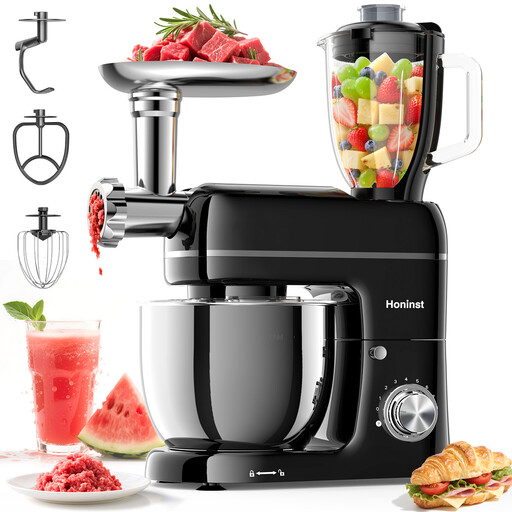
Why it suits this profile: If you want to chop, blend or mince meat as well as mix, this type of multifunctional kitchen mixer gives you several applications in one housing.
The functions and accessories are listed separately: a 6-quart bowl, blender and meat grinder. Check in advance which parts are included in your delivery.
1300 W maximum motor power, eight speeds plus pulse function and a locking system for the tilt-head.
We have put together a complete, up-to-date list of products that fully meet these strict selection criteria and the applicable European safety regulations.
That depends on the type of appliance, its power, the dough hook and the maximum dough quantity. A stand mixer with a bowl is generally more suitable for making bread dough regularly than a hand mixer. When working with heavy dough, use a low to medium speed and follow the specified operating time.
Its lifespan depends on the materials, motor load, maintenance and frequency of use. Allow the appliance to cool down whenever the manual instructs you to, do not exceed the maximum quantities and clean the accessories according to the instructions. A statutory minimum two-year guarantee applies to many consumer products in the EU; additional terms may vary by retailer and manufacturer.
Consumption depends on the power rating and how long the appliance is used. A 1000 W appliance running for ten minutes theoretically uses approximately 0.17 kWh. In practice, a food processor often runs for less time or at a lower power level. So don’t look only at the wattage; consider the preparation time and selected speed as well.
